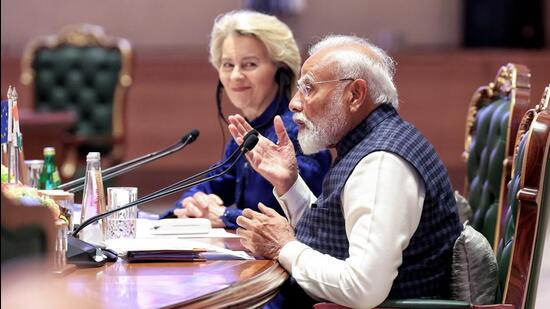
NEW DELHI: The landmark free trade deal reached by India and EU is expected to boost shipments of key agricultural produce, especially seafood, from India, while still protecting the country’s politically sensitive dairy, cereals and poultry businesses, analysts say.
The deal, which both Prime Minister Narendra Modi and European Commission President Ursula von der Leyen have hailed, is expected to double EU exports of goods to India by 2032 (DPR PMO)
Unlike the US, which has insisted India open up its agriculture sector to American produce, such as corn and soybean, a sticking point, India has managed to keep its dairy, cereals and poultry businesses out of the deal with the EU to protect millions of small farmers.
The farm component of the deal, therefore, is not as big as other sectors, such as electronics and manufactured goods, but significant, experts said. The EU is set to remove or significantly reduce tariff lines on a slew of farm products, from spices to tea, giving a leg-up to agricultural exports, while continuing to protect the rural economy. “This is what makes the EU-India trade deal significant,” State Bank of India, the largest public lender, said in a note.
Indian dairy, cereals and poultry will enjoy “strategic protections to support local farmers” but trade in agriculture will result in “higher price realization for rural India”, the commerce ministry said on Tuesday. The “fortress of our rural heartland” remains “fully shielded”, according to the ministry.
The contours of deal with EU, the largest India is set to sign so far, show the 27-country bloc will allow “full preferential access” to Indian marine and seafood across the basket. This will open up market access for shrimp, frozen fish and value-added seafood products, according to details shared by the ministry. Full preferential market access typically refers to an arrangement where imports are allowed without duties or quota restrictions. Exports of marine products have been expanding with the total value of shrimp shipments reaching $518.16 in the last fiscal year, according to official data. This will accelerate investment in marine infrastructure, the government said.
The deal also grants India preferential access for grapes, tea, coffee, spices, ghee (clarified butter), cucumber, sweetcorn and dehydrated (dried) onions, according to the commerce ministry.
The deal, which both Prime Minister Narendra Modi and European Commission President Ursula von der Leyen have hailed, is expected to double EU exports of goods to India by 2032. The pact will give India a competitive edge in labour-intensive sectors, with key concessions across the services sector.
Grape exports to the EU, which totalled $175 million in the last financial year, stand to gain from lower tariffs, along with spices, such as turmeric, which touched an export value of $36.82 million. The deal will drive investment in food processing, dry foods and value-added farm products, according to Mihir Gupta, an official of All India Food Processors’ Association.