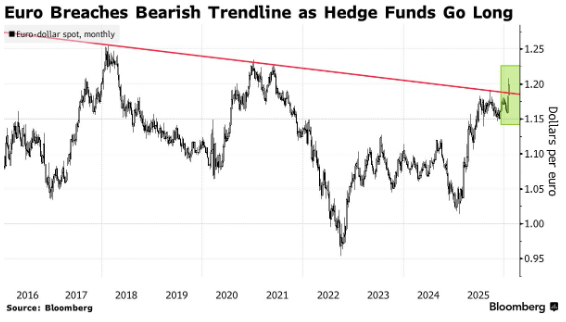
The euro exchange rate has climbed to its highest level since 2021, posing a policy challenge for the European Central Bank.
According to Zhitong Finance, the euro exchange rate has risen to its highest level since 2021, posing a policy dilemma for the European Central Bank (ECB). Driven by the weakening of the US dollar, the euro broke through the closely watched threshold of 1.20 dollars this week, with the options market indicating further upward potential. Short-term bullish bets have approached their most optimistic levels since April this year, while long-term option pricing has hit a nearly six-year high.
The strengthening of the euro could place the ECB in an awkward position. Currency appreciation may suppress the pace of price increases, potentially forcing officials to ease policies to maintain inflation targets. Some analysts believe this would also draw more attention to calls for enhancing the euro’s international status.
 Chris Turner, head of FX strategy at ING Groep, stated: “The rise of the euro has been one of the threats to the ECB’s neutral policy outlook.” He added that recent price movements “suggest that dovish members within the central bank have reason to worry, as a stronger euro may lead to inflation falling below target levels.”
There are signs that the rally may continue. According to foreign exchange traders familiar with the transactions, macro investors and hedge funds have significantly increased their bullish euro options positions this week. Data from the Depository Trust & Clearing Corporation shows that about one-tenth of euro options traded over the past week were bets on the euro rising above 1.25 dollars by the end of June.
Steven Barrow, head of G10 strategy at Standard Bank, believes that given time, the euro exchange rate could reach the “1.25 to 1.30 dollar range.” He added that this would require a stronger European economy and large-scale inflows into eurozone assets, noting that trade threats from the US and shifts in China’s exports might jointly prompt action in the region.
Within the ECB, there are already signs that policymakers are closely monitoring exchange rate movements.
François Villeroy de Galhau, a member of the ECB’s Governing Council, reiterated that officials do not set exchange rate targets while stating that the impact of euro appreciation would be considered in policymaking. Before US President Trump’s remarks on Tuesday about the weak dollar (which further boosted the euro), Austria’s central bank governor Martin Koch had warned that the ECB must remain vigilant against further euro appreciation.
Last year, ECB Vice President Luis de Guindos stated that if the euro were to rise above 1.20 dollars, it could pose challenges for policymakers.
Valentin Marinov, head of FX strategy at Crédit Agricole, believes subsequent developments will be crucial. If the strengthening of the euro is not accompanied by capital flowing back into European stocks and bonds, the central bank may view the appreciation as problematic. Meanwhile, this episode may also bring greater attention to efforts to promote the euro as an alternative to the dollar.
Marinov noted: “I would not be surprised if President Lagarde, while calling next week for the enhancement of the euro’s global status, also increasingly focuses on the recent aggressive rise of the euro against the dollar.” He added, “To some extent, the ECB should be cautious about unintended consequences.”
However, not all observers expect a stronger exchange rate to influence monetary policy.
Roberto Cobo Garcia, head of foreign exchange strategy at BBVA in Madrid, stated, ‘As long as disorderly volatility is avoided, we believe a stronger euro will not have a dovish impact as it did in early 2025.’
Strategist Wen Lam noted, ‘A stronger euro is raising concerns among some at the European Central Bank, but it is not enough to halt its continued rise… Uncertainty in U.S. policies is prompting investors to sell the dollar, and given concerns about Japan’s fiscal situation, European currencies are better positioned to absorb capital inflows.’