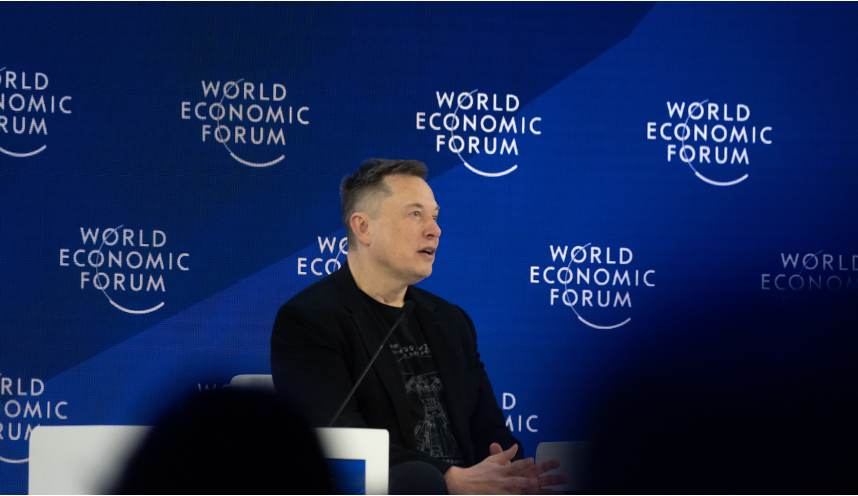
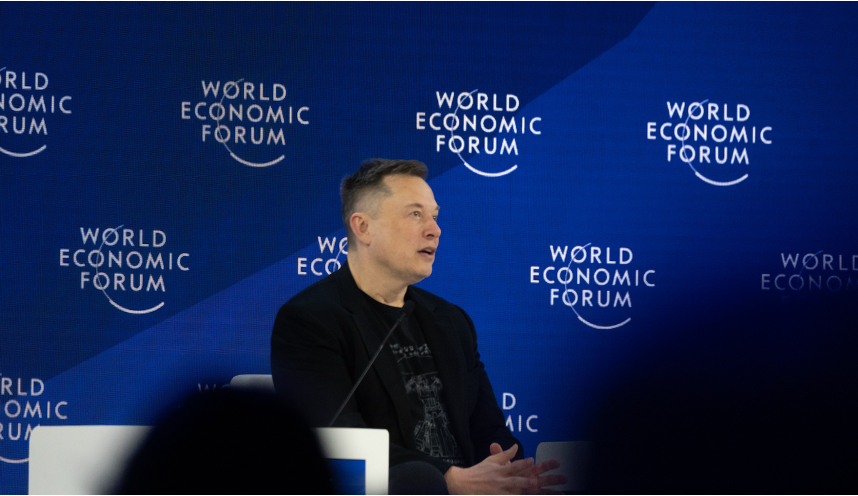
Elon Musk presenting at World Economic Forum, Jan 22, 2026
John Werner
One of the things that I like best about meeting at Davos each January is that, in reality, it’s a big tent – business people talking to academics, academics talking to heads of state, and everyone mixing together in addressing the challenges of our day.
So I was paying attention in the central hall where Elon Musk was interviewed by Blackrock CEO Larry Fink about the future of technology.
One of the first things that came up was the breadth of what we’re dealing with as decision-makers in the AI age, and the breadth of what Musk himself oversees – in AI, in robotics, in space exploration, in energy work. What does all of it have in common?
Elon Musk and Larry Fink at WEF
John Werner
“The overall goal of my companies is to maximize the future of civilization … maximize the probability that civilization has a great future, and to expand consciousness beyond earth.”
By that, he seemed to mean space travel, and the ensuing conversation showed how some of these things blend together. Specifically, there was some talk of locating satellites in space for energy harvesting, which I’ll get back to a bit later.
Elon Musk and Larry Fink at WEF, Jan 22, 2026
John Werner
Among Us
“We should always view consciousness – life as we know it – as precarious and delicate,” Musk said, “because to the best of our knowledge, we don’t know of life anywhere else.”
He was talking about the prospect of alien life, life beyond our terrestrial sphere, and noting that we have no evidence of such a thing, although, he said, people often ask him about it.
“We have 9,000 satellites up there, and not once have we had to maneuver around an alien spaceship,” Musk quipped. “I think we need to assume that life and consciousness is extremely rare, and it might only be us, and if that’s the case, then we need to do everything possible to ensure that the light of consciousness is not extinguished, because we’re effectively … a tiny candle in a vast darkness, a tiny candle of consciousness that could easily go out.”
Flame analogies aside, the two discussed sustainable technology, raising human standards of living, and humanoid robots.
Around the WEF Congress Hall
John Werner
“If you have a large number of humanoid robots, the economic output is the average productivity per robot, times the number of robots, right?” Musk said. “My prediction is, in the benign scenario of the future, that we will actually make so many robots in AI that they will actually saturate all human needs. Meaning you won’t be able to even think of something to ask the robot for, at a certain point, (because) there will be such an abundance of goods and services.”
Elon Musk and Larry Fink, WEF, Jan 22, 2026
John Werner
Fink then asked: what about human purpose in such a world?
Well, it’s tricky, Musk suggested. You can’t have the abundance and the work to be done. You sort of have to pick one.
The Energy Scenario
Turning to energy, Musk pointed out that the Chinese, aside from generating quite a bit of energy with small nuclear plants, are far ahead of the rest of the world in solar power. It sounded to me like his estimates were that the Chinese generate 1000 gigawatts of solar, or 250 gigawatts of “steady state power.” Others, he suggested, should follow suit, using natural, renewable energy to power a future world.
Big Old Sun
Embarking on a spur of the moment astronomy lesson, Musk explained that the sun makes up some 99.8% of mass of the solar system, and that Jupiter, the biggest planet, is just kind of a rounding error in comparison.
“If you were to burn Jupiter in a thermonuclear reactor, the sun, the amount of energy produced by the sun would still round up to 100%, because Jupiter is only .1%,” he said. “If you teleported three more Jupiters into our solar system, (adding up) three more Jupiters and everything else in the solar system, the sun’s energy would still round up to 100%. So, it’s really all about the sun.”
With that in mind, Musk said, SpaceX is focused on getting many more solar powered satellites in orbit. But there’s also a lot of potential, he noted, for solar energy harvesting down here below. Musk estimated we could get by, as a nation, with the product of 100 miles by 100 miles of solar power.
“You could take, basically, a small corner of Utah, Nevada, Nevada, New Mexico,” he said. “Obviously, you wouldn’t want it all in one place, but … it’s a very small percentage of the area of the U.S. to generate all of the electricity that the U.S. uses.”
AI Drives My Car
Later, Musk sounded ebullient on autonomous vehicles.
“I think self-driving cars is essentially a solved problem at this point,” he said. “Tesla’s rolled out a sort of robo taxi service in a few cities, and I think this will be very widespread by the end of this year within the U.S., and then we hope to get supervised full self-driving approval in Europe, hopefully next month.”
After covering self-driving cars, rockets and other means of locomotion, the talk took an intellectual turn.
Elon Musk at WEF
John Werner
Inspiration to Learn
Musk talked about a “philosophy of curiosity” that drives him to explore the world, and the space beyond it.
“I’d like to understand … the meaning of life, you know, the is the standard model of physics correct regarding the beginning of life, beginning of existence and the end of the universe? What questions do we not know to ask, that we should ask? AI will help us with these things. I’m just trying to understand: how did we get here? What’s going on? What’s real? Are there aliens? Maybe there are. And if we’ve got spaceships that are traveling to other star systems, we may find, we may encounter aliens, or we may find many long dead alien civilizations. But I just want to know what’s going on; I’m kind of curious about the universe, and that’s my philosophy.”
That’s a good note to end on, as you can view the whole talk for yourself. Musk urged others to be optimistic about the future, if only for one’s own mental health.
So that’s one facet of the big, ornate, profound, many-segmented conference that is Davos. It’s a place to really dig into a year’s worth of questions, theories, initiatives, efforts, and hopefully, solutions for our world.