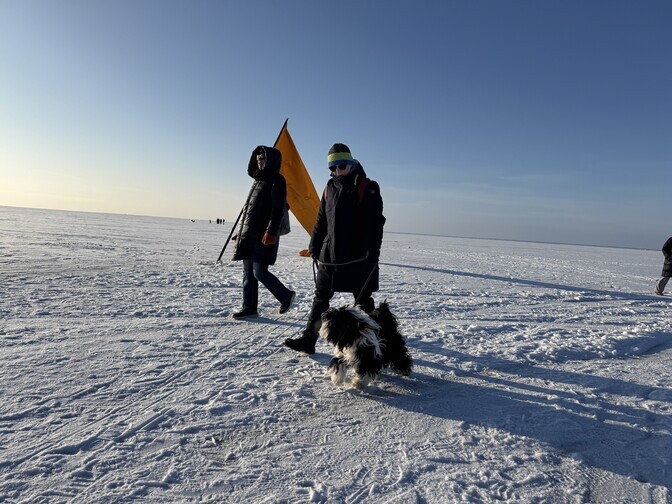
The cold winter has led to Pärnu Bay freezing over as far as the island of Kihnu, as well as a solid layer of ice in many other places, Maaleht reported.
At the same time, care must be taken when on the ice near Estonia’s eastern border, which runs along the Narva River and through the vast lake complex to the south, so as not to inadvertently cross over into Russian Federation territory.
Rescue units measure ice thickness according to weather conditions and the presence of ice, until ice conditions have become stable: At present there is a great variety of thickness on freshwater and seawater bodies, ranging from 10 cm, the bare minimum required before the authorities allow the public on to the ice, to over 30 cm.
Pärnu harbour captain Viktor Palmet said this year’s ice conditions in Pärnu Bay are his favorite topic, particularly given the contrast with last winter, when no ice at all formed – “a very rare phenomenon” he said, with the state-operated Eva 316 icebreaker, standing idle a year ago, now working full-time.
This winter started off mildly enough in November and December, he noted, but the peculiarities of the Pärnu River, which empties itself into the bay of the same name, are such that the Eva 316 had to be pressed into service within a few days of the cold weather arriving – such was the speed of the freeze.
The bay also hosts an on-the-ice cafe.
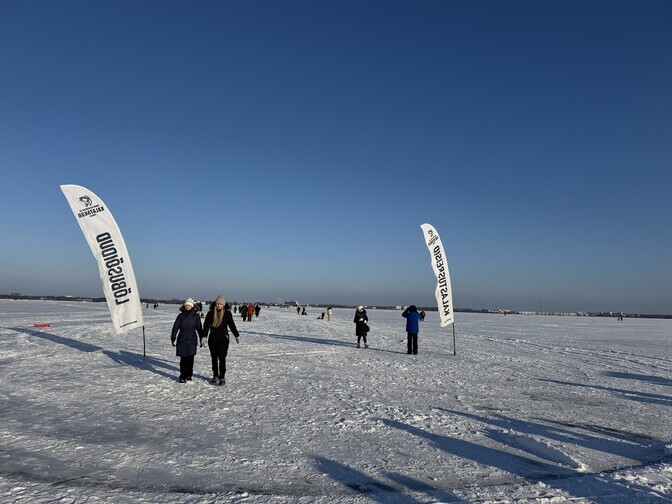 Cafe on the Pärnu Bay ice. Source: Kristi Raidla/ERR
As well as the Eva, Pärnu harbor’s own tugboat, the Nico, is also out on ice-breaking duties, with the vessels going out several times a day to keep the fairway navigable.
Freshwater bodies also make up the bulk of Estonia’s eastern border and the freezing up there not only brings safety issues but has led to a small uptick in illegal border crossings, in both directions.
Jalmar Ernits, head of the Police and Border Guard Board’s Mustvee (Lake Peipus) cordon, stressed the importance of, when heading out on to the ice of Lake Peipus (Peipsi järv), taking not only electronic navigation tech like a smartphone with GPS, but also old-school items like a compass as “That way you won’t wander onto the wrong side of the border.”
Going out on the ice in a vehicle of any description is permitted, but you must register at all times when heading out on to Lämmijärv and Pihkva, or Peipsi if the plan is to head further than a kilometer from the shoreline, Ernits added.
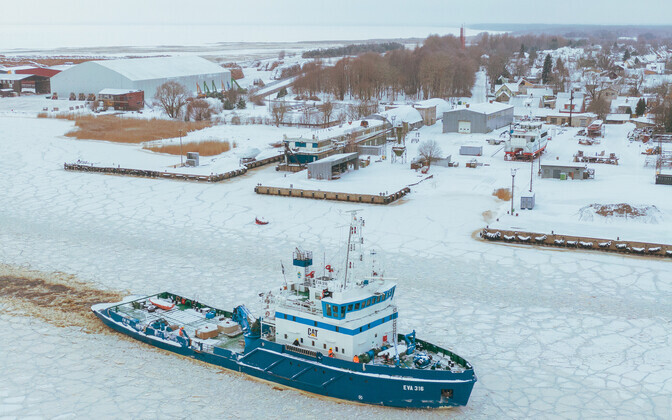 Icebreaker EVA-316 Source: Jaanus Lepalaan/Transport Administration
The lake ice is up to 35 cm in places, he said, adding you must be attentive to the ice surface – pressure ridges can render some spots impassable, while signs indicating forbidden zones, such as near the mouth of rivers, should be avoided – running water sources like rivers and streams must be avoided in any case.
Despite the cold, with temperatures threatening to soon get to the lowest seen in several years, the Transport Administration has no plans to open the once-famous ice roads between the mainland and the western isles, with a lack of demand and budget cited as the reasons.
The last time an ice road was open, the Haapsalu–Noarootsi route, was in 2019, while it is now 15 years since all seven Estonian ice roads were last open.
The Botnica icebreaker is also now at work on Estonia’s north coast, keeping lanes open to the ports of Sillamäe and Kunda.
—