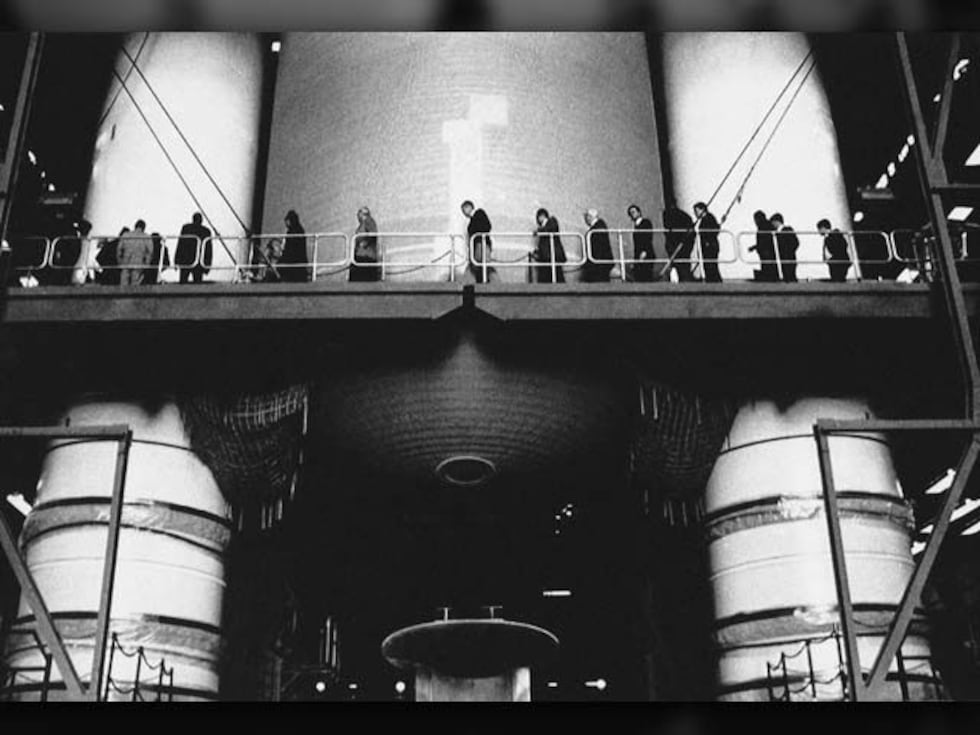
Members of the Presidential Commission on the Space Shuttle Challenger Accident walk past the solid rocket boosters and the external tank of a shuttle being fitted in the Vehicle Assembly building at Kennedy Space Center in Cape Canaveral (Source: AP)
HUNTSVILLE, AL (WAFF) – 40 years ago, NASA was on a frenetic path to get shuttles flying.
In fact, the Kennedy Space Center’s “dance card” for January 1986 was full. Marine and pilot-turned-astronaut Charlie Bolden made his first space flight on the shuttle Columbia.
Bolden’s launch on Columbia was delayed a handful of times – so much so that NASA cut the mission short to make way for the all-important Challenger flight scheduled just days later.
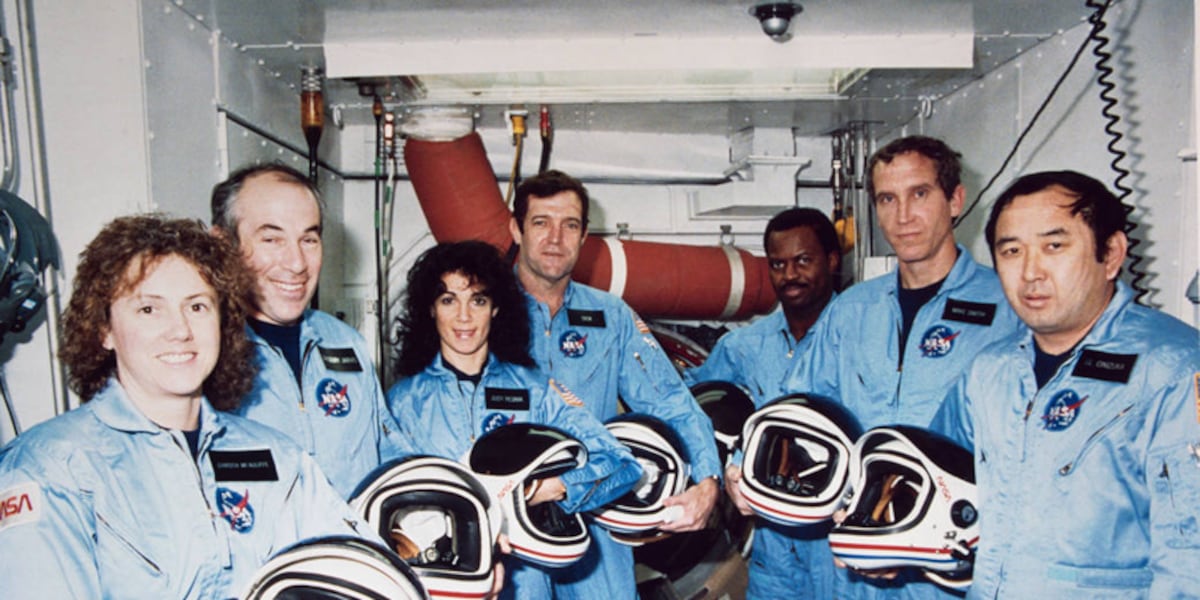
Challenger’s seven-member crew included three first-timers: pilot Michael Smith, payload specialist Greg Jarvis, and Christa McAuliffe, who was set to be the first teacher in space.
The shuttle mission was commanded by Dick Scobee. Joining the rest of the crew were mission specialists Judith Resnik, Ronald McNair and Ellison Onizuka.,
Like Columbia, Challenger saw a handful of delays, but liftoff was finally set for Jan. 28, 1986, at Cape Canaveral. The temperature that morning was 38 degrees, the coldest ever for a shuttle launch.
There were cheers – both near the launchpad and from the crowd watching a short distance away. Classrooms across the country were full of cheers as well, including Concord High School in New Hampshire, where McAuliffe taught social studies.
For 73 seconds, it seemed like the start of another successful mission.
“Challenger, go with throttle-up,” said Mission Control on the infamous recording of the liftoff.
Then, suddenly, smoke and fire filled the sky 18 miles off the Cape.
“Obviously a major malfunction… the vehicle apparently exploded.”
Faces once full of wonder and joy soon fell, first in shock, then in horror as the gravity of what they witnessed sunk in.
VIDEO: Archival footage from WAFF 48 News coverage the night of Jan. 28, 1986 | YouTube: NASA resource tape
For those working the flight, for the crew’s immediate family watching below, and for schoolchildren watching across America, disbelief.
Charlie Bolden was taking a break from debriefings at the Johnson Space Center to watch Challenger launch on live television. He said disbelief was his first reaction as well.
“I asked myself the question, ‘All right then, is this something I want to do?’” he said.
Meanwhile, back at the Cape, the rescue and recovery effort got underway. For days and weeks after the explosion, dozens of watercraft, aircraft, and underwater vehicles combed the depths of the Atlantic Ocean. Shuttle parts that had either floated to the surface or sunk to the bottom began to be reeled in.
MORE on the WEB: NASA’s comprehensive timeline of the explosion and investigation
Video analysis showed the crew’s capsule did not break up in the explosion, but still, it would take a further two months before their bodies would be found.
President Reagan delayed his State of the Union address the night of the explosion to comfort a distraught nation.
He spoke again at a national memorial service.
“Sometimes, when we reach for the stars, we fall short – but we must pick ourselves up and press on despite the pain,” he said.
As the nation mourned, many demanded answers – and fingers started to point toward Huntsville’s Marshall Space Flight Center immediately.
Was it too cold to fly that day? Were there pre-flight communication issues? What were those puffs of dark smoke coming from the right solid rocket booster?
A Presidential investigative team, the Rogers Commission, led by former Secretary of State William Rogers, began to look for answers at Marshall.
“We had a failure; I never thought we’d have a failure,” said MSFC’s Judson Lovingood. “There was something that was done wrong, and I don’t know what that was.”
It was cold – too cold, we know now – and there were major communication issues between NASA-Marshall and solid rocket booster contractor Morton-Thiokol on the icy weather’s potential impact on safety and vehicle performance.
The O-rings that seal the booster segments together had not been tested at temperatures below 53 degrees.
“I would have been concerned if Thiokol had come in and said, ‘We don’t think you should launch because of weather,’” said MSFC Director Dr. Bill Lucas.
“That’s exactly what they did at first,” replied Rogers. “Didn’t you know that?”
“There are hundreds of decisions that have to be made every day in prepping for launch and in executing a launch, and it is impossible for all those to come to the top,” Lucas said in response.
“Going through the rigorous flight readiness review process that we did through all levels of NASA, we concluded we had a safe situation to fly,” said Larry Mulloy with MSFC. “I was satisfied on the 27th. I was satisfied at liftoff on the 28th that the proper data had been considered and that the proper decisions and conclusions reached. In retrospect, I still believe that to be the case.”
Post-explosion, J.R. Thompson led the Technical Response Team for the Rogers Commission.
“They were caught by surprise,” said Thompson. “We all got our bell rung, and it stayed rung for a long time.”
What happened to the Challenger is the stuff college courses are made of. The Rogers Commission put technical blame on the O-rings on the shuttle’s boosters, citing poor design.
Collaterally, the commission found NASA’s decision-making process to be flawed, and said they had an over-pressured flight schedule.
Thompson, who ran Marshall’s shuttle main program, had left for Princeton in the early 1980s. He was hired back by NASA in September 1986 to lead MSFC and implement sweeping changes.
“We had to make sure we not only fixed the problem, but we built suspenders to fix the problem, and I think we did,” said Thompson.
MORE on the WEB: House Report 99-1016 on the Challenger accident (PDF) | Rogers Report in full
Astronauts in management positions seen in the 60s and 70s were resurrected. Future NASA administrator Charlie Bolden was reassigned to Marshall in 1986 to help get America flying again safely.
“People were a little bit down,” Bolden said. “It focused everybody. It woke everybody up and said this stuff we do is risky, and we’re not as smart as we think we are, and we better get on it.”
Get on it, they did – but it would take much work and nearly three years before a shuttle would soar again.
The shuttles that remained following the 2003 Columbia disaster were all retired by 2011. The goal of building the International Space Station was met. Since then, no astronauts have launched from US soil into low-earth orbit.
“‘Is this something I want to do,’” Bolden said, repeating the question he asked himself in the moments immediately following the Challenger’s explosion. “It took me a nanosecond to decide. To not stay in the office and go after that would have really been the utmost in disrespect for the crew we had just lost.
“Going to Mars – that’s the greatest tribute we can pay, to get us as far out of the solar system as humanly possible,” he added.
What is perhaps the biggest question learned from Challenger?
“We have to stay hungry – which means that we cannot ever believe that we’ve got it all figured out – you’ve got to keep asking questions,” said Bolden.
Keep asking questions… speak up… cross-check your answers.
Bolden’s remarks echo the instructions of a teacher imparting the Scientific Method to a new class. It’s almost as if a teacher from New Hampshire did make it to space after all, and left that most-important lesson for those rebuilding America’s space program.
Post-Challenger, the answers resulted in a new way of doing business – with an emphasis on making human space flight as safe as possible: Document everything; improve communication; create an astronaut escape system and protective spacesuits for launch and re-entry.
And as with all scientists and explorers, understand the risks – with an aim to relish the rewards.
That is the way NASA continues to do business as it looks to launch into space from U.S. soil once again.
MORE: Accomplishments of shuttle program | BLOG: ‘Remembrance is not enough’
Copyright 2016 WAFF. All rights reserved.