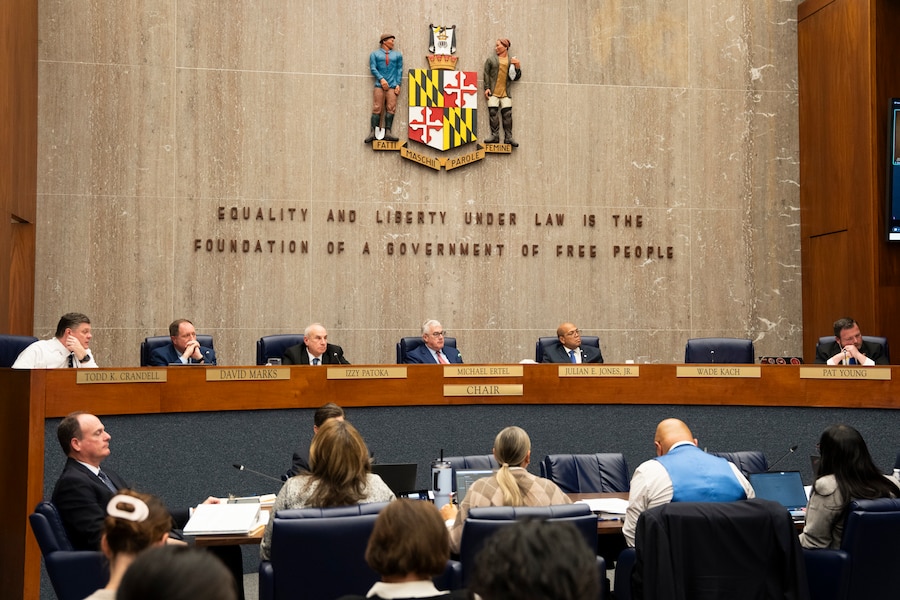
A pension bill the Baltimore County Council passed 15 months ago that could double their retirement payouts is heating up the competitive four-way race for county executive.
The bill, approved by all the council members save one, tied their pensions to the salary increases of future members.
While current council members earn $69,000 a year, future ones could make as much as $140,000, if the council approves a county board’s recent salary recommendation. That would double their annual pensions, too — from around $40,000 a year to above $80,000.
Nick Stewart, a financial attorney running for executive of Maryland’s third-largest county, called the pension bill “a moral outrage” and wants it repealed. He sent supporters an email titled “how dare they,” asking for contributions to his campaign as the race’s lone outsider.
Responding to criticism over the bill, Councilman Izzy Patoka, who’s also running for county executive, announced Monday night that he would introduce legislation Feb. 17 to repeal it. Joining him is Councilman Mike Ertel, the only member to vote against the pension measure.
Councilman Julian Jones, also a county executive candidate, blamed the pension increases on a “backroom deal” that was part of a council expansion he never agreed with — one that made the positions full time. He said he plans to introduce a charter amendment to reverse “dramatic and unjustified compensation increases” and return the council to part-time.
Councilman Pat Young, who also opposed the council expansion, said he supports “revisiting policies that create the appearance or reality of insider benefit.”
Like Stewart, Patoka and Jones, Young is running to be the Democratic nominee in a county that has not elected a Republican county executive since 1990.
The council has until November to set salaries for the new members; they can reduce the recommendation but can’t increase it.
Here’s what you need to know about the pension bump, the salaries, and the legislation that led to all of it.
 From left, council member Julian Jones, Nick Stewart, a former school board member and financial attorney, and council member Izzy Patoka. (Wesley Lapointe for The Banner; Katie Simbala for The Banner; Kaitlin Newman/The Banner)
Several bills — one pension boost
The process that led to doubling the pensions began in 2022, when Jones introduced legislation that increased the cap on council pension benefits from 60% to 70% of their salaries.
Two years later, Councilman Wade Kach introduced a bill allowing retired members to get pension increases whenever current members do. Kach is a Republican who, at 79, has been in public service most of his life. He collects two other pensions — one from being a teacher and one for nearly four decades in the Maryland General Assembly.
Kach submitted the bill because, he said at the time, council members do not receive cost-of-living raises or promotions. Kach is retiring, so he would benefit directly.
In 2024, voters approved a Patoka-sponsored charter amendment to expand the council to nine members and make it full time. They can also still hold other jobs.
The final piece was the county’s Personnel and Salary Advisory Board recommending last month that council members elected in 2026 earn $140,000 annually. The council chair would earn $150,000.
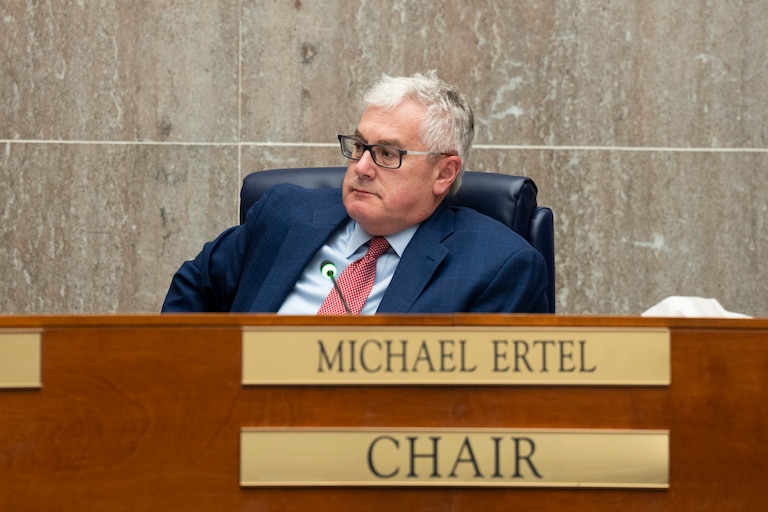 Council member Mike Ertel was the only one to vote against the pension increases. (Kaitlin Newman/The Banner)
No other county employee has the potential for this windfall
Pensions are a perk of public-sector jobs. They provide decent retirements for firefighters, teachers, nurses, mechanics and dozens of others. But no other employees can tie pension increases to future salaries, or approve their own increases.
For that reason, and for the high salaries these pensions were tied to, the pension bill has become an albatross for the county executive candidates on the council.
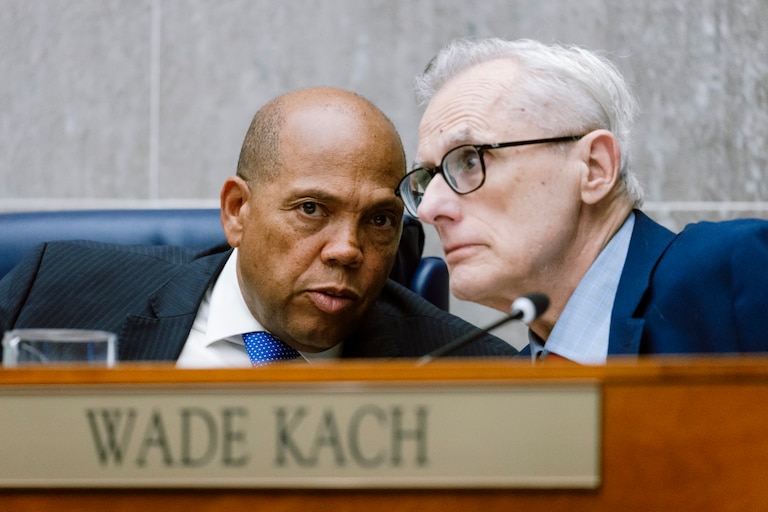 Fourth District Councilman Julian E. Jones Jr., left, speaks with Third District Councilman Wade Kach during a Baltimore County Council legislative session at the Old Courthouse on Tuesday, Sept. 3, 2024, in Towson. Kach was physically absent for the latter half of 2025, though he often joined remotely with his camera off. (Wesley Lapointe for The Baltimore Banner)
The proposed salary is in line with other large full-time councils
Salaries are similar for other full-time councils around the state. Montgomery County Council members earn $167,172, and the council chair earns $184,890.
“One of the things we heard from people is that it has to be a full-time job, and be paid like one,” said Ertel, one of two councilmen who holds another job.
The council functions differently than when it was created in 1956, Ertel said. Each councilman functions something like a mayor — shoveling snow, acting as a fiscal watchdog, passing laws. Increasingly, the county’s 850,000 residents demand full-time representation, and attracting diverse and committed people to represent them requires full-time compensation.
The council did not set the salaries — a county board did
On Dec. 10, the Baltimore County Personnel and Salary Advisory Board met virtually to approve the salaries of a half-dozen county positions, among them the council members.
The board includes four members appointed by County Executive Kathy Klausmeier and one elected by employees. Only three voted.
The chair is attorney Jonathan Krasnoff, who signed the decision. He referred questions to county spokesperson Erica Palmisano. Renee Coleman, the county’s human resources director, also referred questions to Palmisano’s office. Palmisano referred questions back to council members.
The other board members are Jacqueline V. Eldridge Wheeler, a human resources administrator at Lifebridge Health; Joanne Williams, director of the Baltimore County Department of Aging; Brian DeHart, a county police officer; and Nancy Hafford, executive director of the Towson Chamber of Commerce.
Hafford was not present and said she could not recall the board considering council members’ salaries in the past — it usually focuses on lower-level positions. The others could not be reached for comment.
Patoka and Ertel pushed for an expanded council before they were elected. The council is all male and all white except for Jones, who is Black. Everyone but Young, who is age 42, is over 50.
Though Patoka does not support the $140,000 salary, he said a full-time council would attract more diverse candidates. Several Black women, at least one Hispanic man, and a candidate under age 25 are now running for seats.
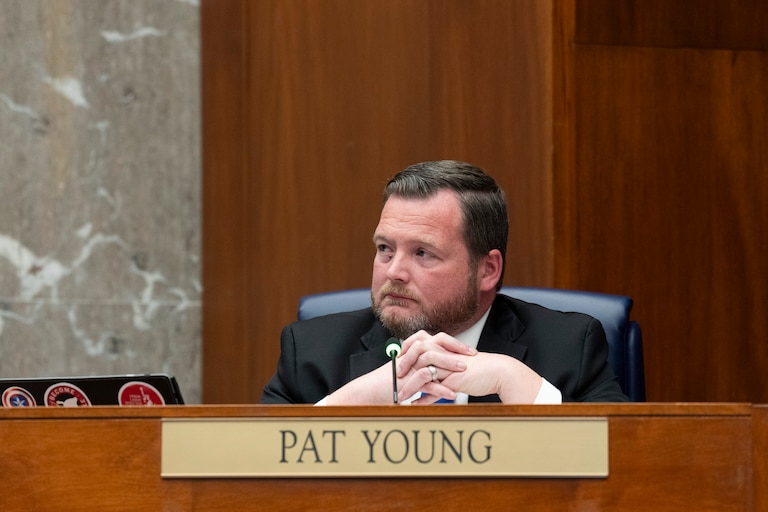 Council member Pat Young, a Catonsville Democrat, voted to increase pensions but against the council expansion that triggered the higher salaries. (Kaitlin Newman/The Banner)
There’s the pension bill, and there’s the expansion bill
Kach’s bill renewed Jones’ and Young’s criticism about how the council voted to expand.
The pair contend that Patoka and Republicans colluded in secret on a map to maintain a strong Republican block. Patoka and Ertel say the council held multiple public hearings.
The County Council includes four Democrats and three Republicans. The future council is likely to be split 5-4 in a county where Democrats outnumber Republicans 2 to 1.