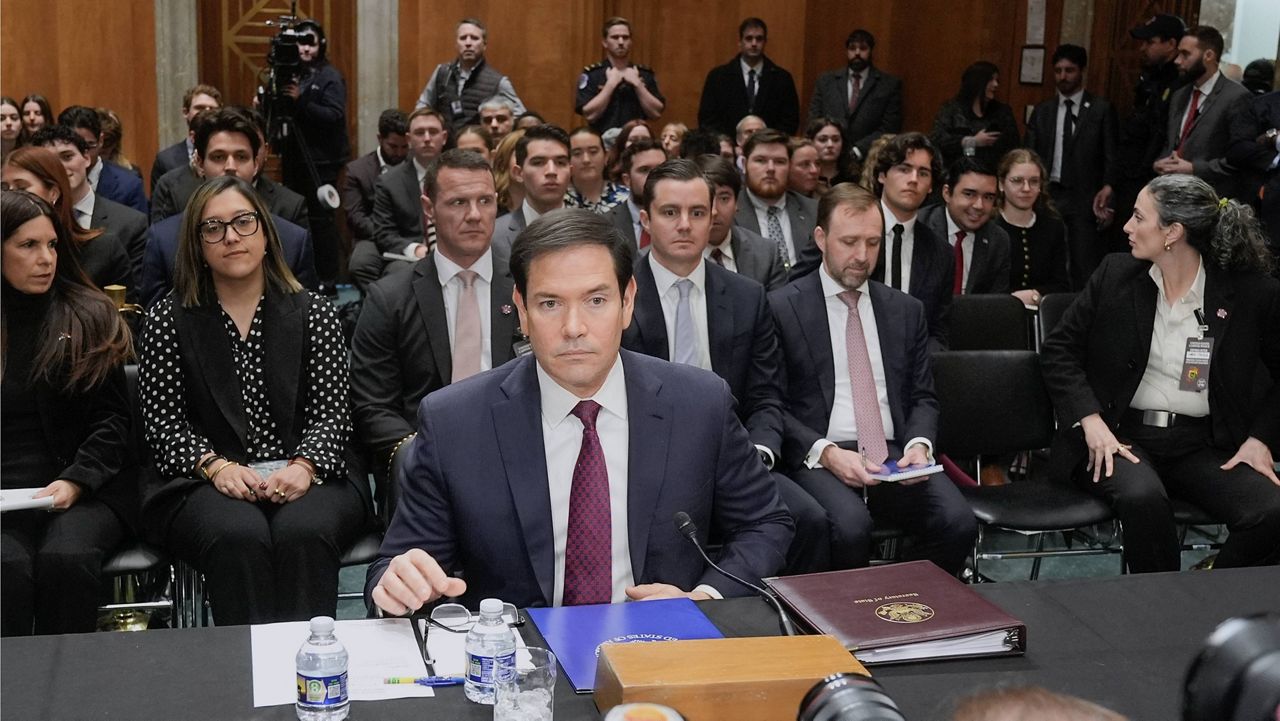
WASHINGTON — Almost four weeks after American military forces captured Nicolás Maduro and indicted the ousted Venezuelan leader in New York for drug trafficking, Secretary of State Marco Rubio said the U.S. plans to “very quickly” open a diplomatic presence on the ground in Venezuela.
During a three-hour hearing before the Senate Foreign Relations Committee on U.S. policy toward Venezuela, Rubio said the embassy will allow the Trump administration to have real-time information and interact with interim government authorities as well as its opposition while working to transition the country to a functioning democracy.
“The end state that we want is a free, fair, prosperous and friendly Venezuela,” he said, adding that the goal will take time to achieve.
“We need to be much further along six months from now, even three months from now,” he said of a transition away from its current autocratic to regime. “We want to see quick progress.”
The U.S. has established “respectful but very direct and honest conversations,” he said, with the country’s law enforcement and interim leader, Delcy Rodriguez, who previously served as Maduro’s second in charge and whom the U.S. Drug Enforcement Agency has said is a significant actor in narco-trafficking.
Rubio said working with individuals who may not be acceptable to the U.S. in the long term has provided the stability necessary for Venezuela to recover from Maduro’s capture and eventually transition to a new government with free and fair elections.
He praised Venezuela’s interim leadership for passing reforms to hydrocarbon laws that allow private ownership and investment in the country. He said more reforms were necessary for oil companies to invest without fear of having their land taken away and a system to enforce contracts.
“It’s to their benefit to set up a normal, transparent process that encourages foreign investment not just in oil, by the way, and other natural resources, but in other sectors of their economy,” including retail and banking, Rubio said.
He defended the recent sale of U.S.-sanctioned oil through two no-bid contracts, saying the oil needed to move quickly. The long-term plan, he said, is to sell oil directly into the market, not through trading companies.
“We want it to become a normal oil economy,” he said. “That’s what the ultimate goal is here.”
He said $300 million of a recent $500 million oil sale went to Venezuela to pay police officers and sanitation and government workers. The remaining $200 million is currently in Qatar to protect it from creditors, he said, though it will eventually be moved to a U.S. bank that is blocked from the Treasury Department.
“This is not a country that will require money from the United States to rebuild, to stabilize the transition,” Rubio said, adding that the U.S. is not spending any money on the country right now other than setting up a new embassy in Caracas. “It has been historically the wealthiest country in South America. The problem is that the wealth of the country was being stolen.”
When asked if the Trump administration had ruled out the use of force if the interim government doesn’t comply with U.S. requests, Rubio said, “The president never rules out his options as commander in chief to protect the national interests of the United States. I can tell you right now, with full certainty, we are not postured to, nor do we intend or expect to have to take any military action in Venezuela at any time.”
Saying “military action is not good for recovery and transition,” Rubio added “the only military presence you’ll see in Venezuela is our Marine Guards at an embassy.”
The U.S. takeover of Venezuela is having dramatic spillover effects on nearby Cuba. President Donald Trump said Tuesday that Venezuela has not sent any money or oil to the Caribbean island nation recently and predicted, “Cuba will be falling pretty soon.”
When asked at the hearing if the U.S. is trying to precipitate the country’s fall, Rubio cited the Helms Burton Act of 1996, which codified the longstanding U.S. embargo against the country to pressure it into transitioning to a democratically elected government.
The only way to lift the U.S. embargo on Cuba, he said, is regime change.
Criticizing Cuba’s one-party Marxist government as an economic model that “hasn’t worked anywhere on the planet,” Rubio said the Trump administration is looking for “the opportunity for a change in dynamic” in the Caribbean island nation, saying it is “backwards” and “has no functional economy.”
While the Trump administration would like to see regime change in the country, “that doesn’t mean that we’re going to make a change, but we would love to see a change. There’s no doubt about the fact that it would be of great benefit to the United States if Cuba was no longer governed by an autocratic regime.”