Sri Lanka’s economy has “stabilised decisively” under its International Monetary Fund (IMF)-supported programme, with growth rebounding, tax revenues doubling, and inflation sharply declining, a senior IMF official said in Colombo yesterday.
Dr. Krishna Srinivasan, Director of the IMF’s Asia and Pacific Department, delivered the assessment during a public lecture on the IMF Regional Economic Outlook: Asia and Pacific, held at the Central Bank of Sri Lanka. He was joined by Dr. Thomas Helbling, the Department’s Country Director.
Both officials commended the Asia-Pacific (APAC) region’s overall economic resilience in the face of global challenges and advocated for deeper trade and supply chain integration to mitigate vulnerabilities in international trade.
Presenting a country-focused analysis, Dr. Srinivasan outlined how Sri Lanka has performed against the five key pillars of the IMF programme:
Revenue-based fiscal consolidation, supported by tax reforms and strengthened social safety nets.
Restoring debt sustainability through fiscal adjustment and debt restructuring.
Maintaining price stability and rebuilding foreign exchange reserves.
Safeguarding external stability.
Combating corruption via a comprehensive anti-corruption reform agenda.
“Sri Lanka has come out of the crisis stabilising its economy across three dimensions,” Dr. Srinivasan stated referring to Sri Lanka’s Growth, Revenue, and Inflation. He highlighted that growth “bounced back decisively,” turning positive within six months of the programme and recently averaging about 5 percent annually.
On fiscal performance, he noted a “significant turnaround.” Tax revenue has doubled from a critically low 7.3 percent of GDP to 14.8 percent in 2025.
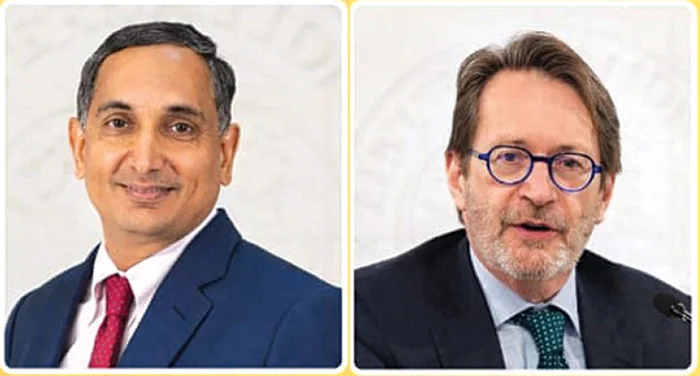
Dr. Krishna Srinivasan / Dr. Thomas Helbling
Furthermore, inflation has dropped “in a very convincing manner” from approximately 70 percent to the current 2-3 percent range. “One would hope that in the next few quarters, it will reach the Central Bank’s target of 5 percent,” he added.
“Overall, the IMF programme for Sri Lanka has delivered on many of its objectives,” Dr. Srinivasan concluded. “There is still a long way to go in terms of securing strong, sustained, balanced growth, but the program is off to a very good start. All of you, the authorities, and the people of Sri Lanka need to be congratulated for the progress made so far,” he said.
In his regional remarks, Dr. Srinivasan projected that Artificial Intelligence (AI) will be a key driver of the Asian economy. He suggested that technology companies in the region would be “better served by the capital markets than from conventional banks,” pointing to a need for evolved financial ecosystems to support innovation.
The lecture underscored the IMF’s constructive outlook for Asia’s continued resilience, while emphasising structural reforms and regional cooperation as vital for future stability and growth.
By Sanath Nanayakkare