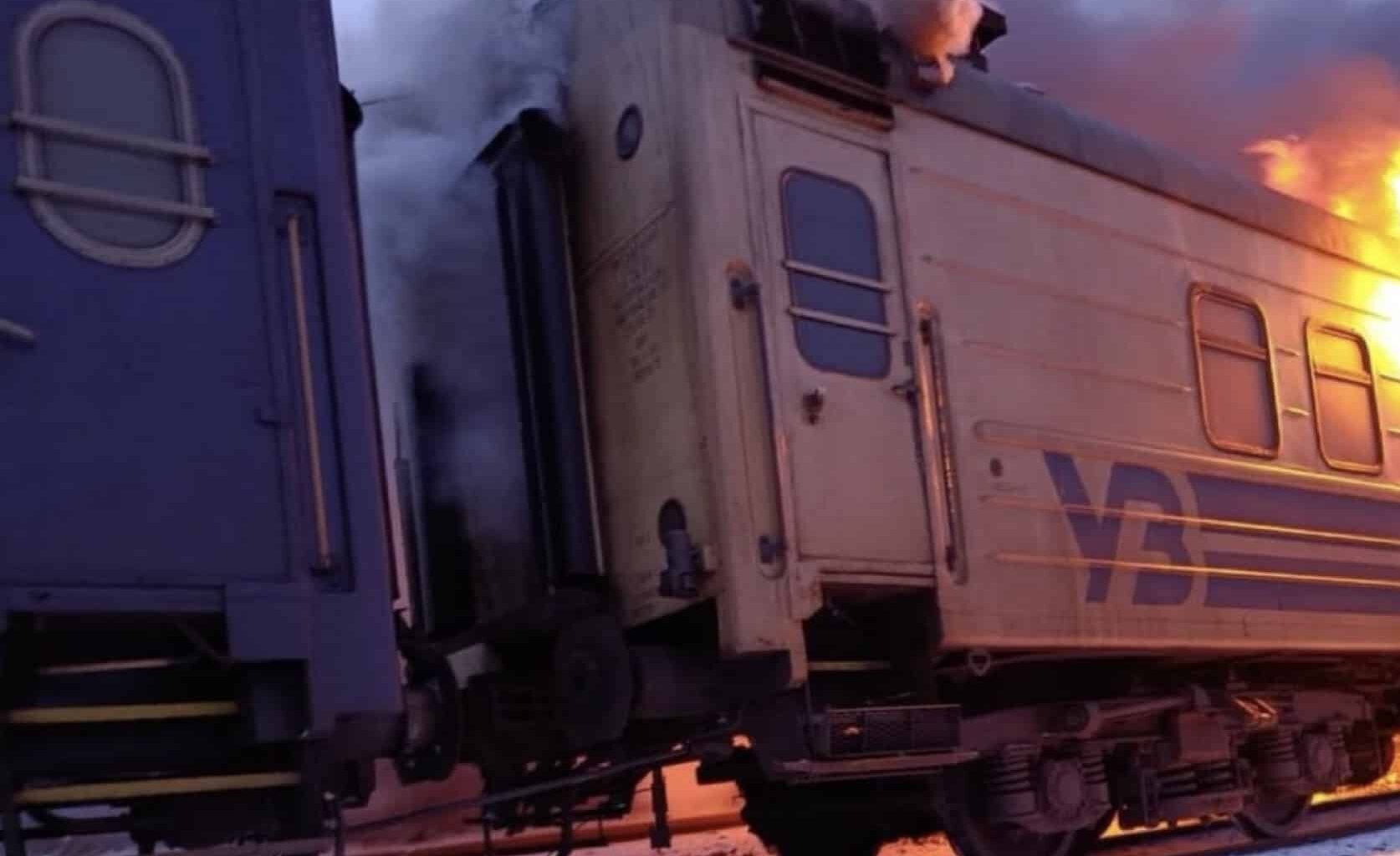
You cannot hit a moving passenger train with a GPS coordinate. A pre-programmed Shahed-136 flies to a fixed point on a map and detonates. If the target moves, the drone misses. Three Shaheds hit the Barvinkove-Lviv-Chop train in Ukraine’s Kharkiv region on Tuesday anyway, striking not the locomotive but a passenger car in the center of the formation. At least five people died.
That targeting precision on a moving target tells you everything: someone was watching a live feed and steering.
Ukrainian defense analysts immediately pointed to SpaceX’s Starlink satellite network as the enabling technology. Ukrainian military analyst Serhiy Beskrestnov posted that the train was hit by “Shaheds with online control,” noting that the strike on the center of the train rather than the locomotive suggested deliberate targeting of the passenger car “intentionally and consciously.”
The strike: Three Iranian-made Shahed drones hit a train carrying 291 passengers in the Kharkiv region, killing at least five. The drones struck the passenger car, not the engine.
Why it matters: A Starlink-connected Shahed is no longer a dumb munition flying to fixed coordinates. It becomes a man-in-the-loop precision weapon capable of tracking and engaging moving targets at ranges far beyond radio line-of-sight.
The confrontation: Poland’s foreign minister demanded Musk block Russian Starlink use. Musk called him a “drooling imbecile.”
Starlink Solves The Two Problems That Limited Shahed Effectiveness
The Shahed-136 (designated Geran-2 by Russia) is cheap, slow, and loud. It has been the workhorse of Russia’s aerial campaign against Ukraine, accounting for the bulk of 54,700 drone attacks recorded in 2025, according to the Ukraine Air War Monitor. But in its standard configuration, it has two weaknesses that limit what it can hit.
First, GPS guidance can be jammed or spoofed. Ukrainian electronic warfare units have gotten good at this, and it has been one of their most effective countermeasures against incoming Shaheds.
Second, fixed coordinates cannot track a moving target. A train, a convoy, a mobile air defense unit — none of these can be hit by a drone that only knows where to crash.
Starlink eliminates both problems. A satellite internet link is far harder to jam than GPS. And it provides enough bandwidth for a live video feed, allowing an operator potentially sitting hundreds of kilometers away in Russia to see through the drone’s camera and manually guide it to impact.
According to the Washington, D.C.-based Institute for the Study of War, Russian drone units began integrating Starlink terminals into their Molniya strike drones in December 2025, with Shaheds following shortly after.
Electronic warfare specialist Olena Kryzhanivska told CBS News the development was “not surprising at all. It was expected.” She said Russia had been using Starlink on other drone types before deploying it on Shaheds.
Ukraine’s Drone Interception Rate Has Collapsed As Guidance Systems Evolve
The numbers tell the story. Ukraine’s drone interception rate fell from 98% in February 2025 to 80% by October, according to the Air War Monitor, published by Kyiv Dialogue in cooperation with OSINT analyst Marcus Welsch and the Konrad Adenauer Foundation.
Put differently: in February, only 90 drones got through Ukrainian defenses per month. By October, that number exceeded 1,000. In December alone, 987 drones were not intercepted out of 5,131 launched, an average of 166 drones per night hitting Ukrainian territory.
The Air War Monitor’s 2026 outlook warned specifically about this threat: “modified armament and control systems on Russian drones could pose a greater threat.” Starlink-equipped Shaheds are exactly the kind of modification they were predicting.
The problem compounds. A standard Shahed flies a predictable route that air defense systems can anticipate and intercept. A Starlink-controlled Shahed can change course mid-flight, dodge defenses, loiter over an area, select its target in real time, and time its attack for maximum impact. Every interception technique built around predicting a drone’s flight path becomes less effective.
Russia launched approximately 56,700 air attacks on Ukrainian civilian targets in 2025, four times the 13,300 recorded in 2024. Drones now account for 96% of all Russian aerial weapons deployed. Ukraine’s state railway company Ukrzaliznytsia estimates damage to the rail network at $5.8 billion since 2022, with more than 1,100 attacks on rail infrastructure in 2025 alone.
Musk’s Response To Poland’s Foreign Minister Reveals SpaceX’s Impossible Position
Polish Foreign Minister Radosław Sikorski publicly confronted Elon Musk on X following the train attack, demanding Musk “stop the Russians from using Starlinks to target Ukrainian cities.”
Musk called Sikorski a “drooling imbecile” and pointed out that “Starlink is the backbone of Ukraine’s military communications.” He also noted that Starlink’s terms of service “do not allow for offensive military use, as it is a civilian commercial system.”
Both statements are technically accurate, which is precisely the problem. Ukraine’s military has relied heavily on Starlink since the invasion began. Ukrainian units like Aerorozvidka integrated Starlink terminals directly onto heavy bomber drones, enabling internet-based control beyond line-of-sight. The technology has been instrumental in Ukraine’s drone warfare success.
But Russia has now copied the playbook. SpaceX did not respond to CBS News’ request for comment on claims that its technology may have been used in the train strike.
The company has previously stated it does not sell Starlink to Russia and works to deactivate terminals used by sanctioned parties. But analysts have documented Russian acquisition of terminals through intermediaries in third countries. According to analysis from the Ukraine Arms Monitor, one scenario involves relatives or intermediaries in Europe purchasing Starlink units and transferring them to Russian military personnel under personal accounts. Recovered drone wreckage examined by Western journalists has reportedly shown Starlink terminals integrated with NVIDIA Jetson Orin processors and Sony IMX477 camera sensors, indicating factory-level production rather than field improvisation.
No Protocol Exists For Defending Trains Against Guided Drones
Kryzhanivska raised a question with no good answer: “There is no protocol in place for what to do when there is a Shahed drone approaching a train. What can the crew do? Should they stop the train? Or continue moving?”
Ukrainian air defense coverage is uneven across the country. Trains run on fixed, predictable routes. And the train attack demonstrated what Starlink guidance makes possible: hitting a moving target requires continuous tracking and course correction. The fact that the drone struck the passenger car rather than the more visible locomotive suggests the operator was watching a live video feed and chose to maximize civilian casualties.
Deputy PM Kuleba confirmed 291 passengers were aboard and called the strike “a direct act of Russian terror against civilians. No military target.” President Zelenskyy stated: “In any country, a drone strike on a civilian train would be regarded in the same way — purely as an act of terrorism.”
Deputy Minister Oleksii Balesta told CBS News that Russia has been using larger drones in higher quantities, increasing overall strike lethality. Across Ukraine that night, 165 Russian-launched drones killed at least 11 people total, according to Ukraine’s Air Force.
Russia offered no specific response to the allegation that it deliberately targeted a passenger train.
DroneXL’s Take
This is the most important development in drone warfare in months, and it has nothing to do with a new airframe or a faster motor. It’s a connectivity upgrade on an existing weapon. That’s what makes it so dangerous.
The Shahed was designed as a saturation weapon. Launch dozens, overwhelm defenses, accept that most will be intercepted or miss. The guidance was crude, the targeting imprecise, the effectiveness dependent on volume. Adding Starlink turns it into something fundamentally different: a remotely piloted strike weapon with real-time target acquisition at ranges that make radio control impossible. The operator doesn’t need to be anywhere near the battlefield. The drone doesn’t need to fly a predictable path. And the data link is satellite-based, which means jamming it requires capabilities most countries don’t have.
The scalability is what should keep defense planners awake. A Starlink Mini terminal weighs roughly a kilogram. The Shahed carries a 40-50 kg warhead. Bolting on satellite guidance doesn’t meaningfully reduce payload capacity. Russia produced tens of thousands of these drones in 2025 with Chinese component support. If even a fraction get Starlink upgrades, Ukraine’s interception math gets drastically worse.
The same technology that gave Ukraine a decisive edge in drone warfare is now being turned against Ukrainian civilians. That’s the strategic boomerang. Musk is in an impossible position, and his insult-laden response to Sikorski, however diplomatically reckless, reflects a real technical dilemma. SpaceX cannot geofence Russian-occupied territories without cutting off Ukrainian forces operating in those same areas. They cannot remotely brick terminals without risking false positives on Ukrainian military units. The architecture was designed for consumer broadband, not battlefield access control.
What bothers me most is the targeting choice. Beskrestnov’s observation that the strike hit the center of the train rather than the locomotive suggests the operator was watching and chose to maximize civilian casualties. That’s not a technical achievement. That’s a war crime with better guidance.
Expect two things within six months. First, European pressure on SpaceX will escalate, likely starting with formal EU inquiries into Starlink terminal supply chain controls. Sikorski isn’t a backbencher — he’s a senior NATO-country diplomat. Second, Ukrainian forces will develop countermeasures specifically targeting Starlink-equipped drones, likely focused on disrupting the satellite uplink rather than GPS. The question is whether those countermeasures arrive before Russia scales this capability across its entire drone fleet. Neither outcome will help the people on Ukraine’s trains today.
Editorial Note: This article was researched and drafted with the assistance of AI to ensure technical accuracy and archive retrieval. All insights, industry analysis, and perspectives were provided exclusively by Haye Kesteloo and our other DroneXL authors, editors, and YouTube partners to ensure the “Human-First” perspective our readers expect.
Last update on 2026-01-28 / Affiliate links / Images from Amazon Product Advertising API
Discover more from DroneXL.co
Subscribe to get the latest posts sent to your email.