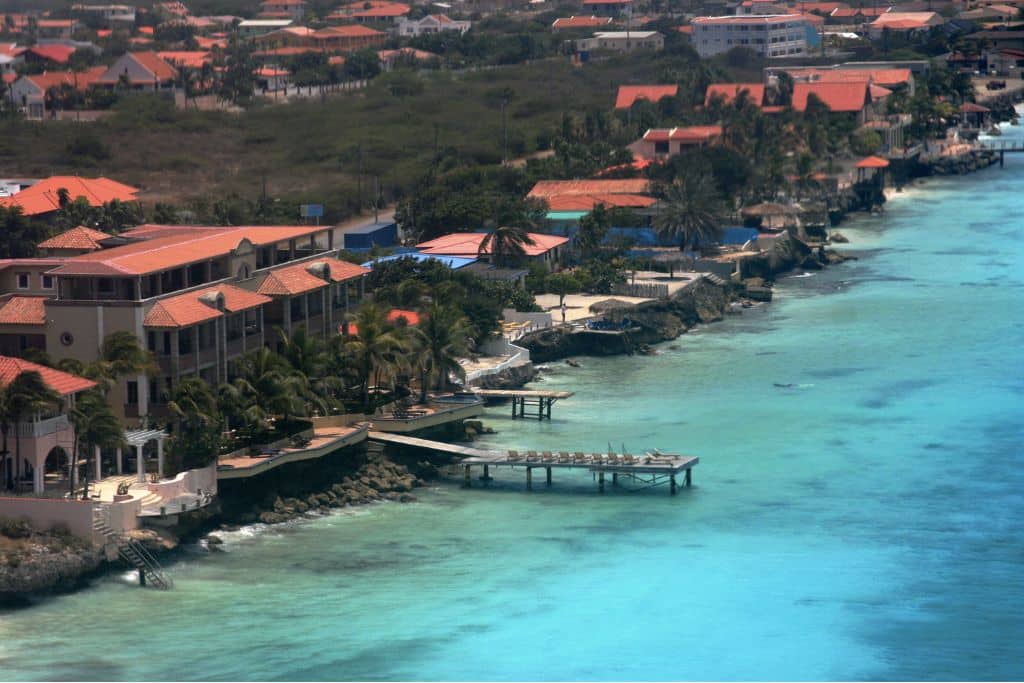
The Hague District Court ruled that the government has failed to take sufficient timely and appropriate mitigation and adaptation measures to protect the inhabitants of Bonaire, a special Dutch municipality, from the effects of climate change.
—
The Dutch government has failed to protect the people of Bonaire by not helping them adapt to climate change, a national court has ruled.
The case was brought by eight residents of the tiny Caribbean island in early 2024. Backed by Greenpeace, they accused the Netherlands’ government of not doing enough to protect them from the devastating impacts of climate change, such as rising temperatures and sea levels. Bonaire became special Dutch municipalities in 2010, and roughly 80% of its 26,000 residents have Dutch citizenship.
The Hague District Court rejected the complaints brought by the individuals but admitted the claim brought by Greenpeace, which is acting on their behalf.
Human Rights Breach
On Wednesday, the court found that the unequal treatment of inhabitants of Bonaire compared with the European part of the Netherlands is unlawful and that insufficient mitigation and adaptation constitute a violation of the European Convention on Human Rights. Specifically, it ruled that the government’s actions were in breach of Article 8 and Article 14 of the convention, which protect the right to life and to respect for private and family life.
The ruling marked the first time a national court has applied the standards laid out in a historic 2024 ruling by the European Court of Human Rights (ECtHR), which found that state inaction on climate violates human rights. The case was brought by KlimaSeniorinnen, an association of elderly women founded in 2016 that took the Swiss Government to court for its inadequate climate policy. They successfully argued that this inaction would lead to warmer temperatures and threaten their health, particularly for their members over 75.
The Dutch court also became the first court in the world to rule that a state is discriminating against its own people by failing to develop and adopt a climate adaptation strategy.
The Netherlands was given 18 months to adopt additional adaptation measures and set binding interim greenhouse gas emission reduction targets based on its fair contribution of keeping global warming below 1.5C by the end of this century.
“Today, we are making history,” said Onnie Emerenciana, a plaintiff in the case. “Finally, The Hague can no longer ignore us. The court is drawing a line in the sand. Our lives, our culture, and our country are being taken seriously. The State can no longer look the other way. The next step is to free up funding and expertise for concrete action plans to protect our island. We truly have to do this together; Bonaire cannot solve this alone.”
Marieke Vellekoop, Director of Greenpeace Netherlands, called the verdict “historic” and a “huge breakthrough.” She called on incoming Prime Minister Rob Jetten to “bring this ruling to the cabinet’s negotiating table tonight and ensure that funding is made available for protective measures on Bonaire and adequate climate policy.”
Featured image: Wikimedia Commons.
You might also like: Explainer: Climate Litigation – Trends and Impact
Our non-profit newsroom provides climate coverage free of charge and advertising. Your one-off or monthly donations play a crucial role in supporting our operations, expanding our reach, and maintaining our editorial independence.
About EO | Mission Statement | Impact & Reach | Write for us