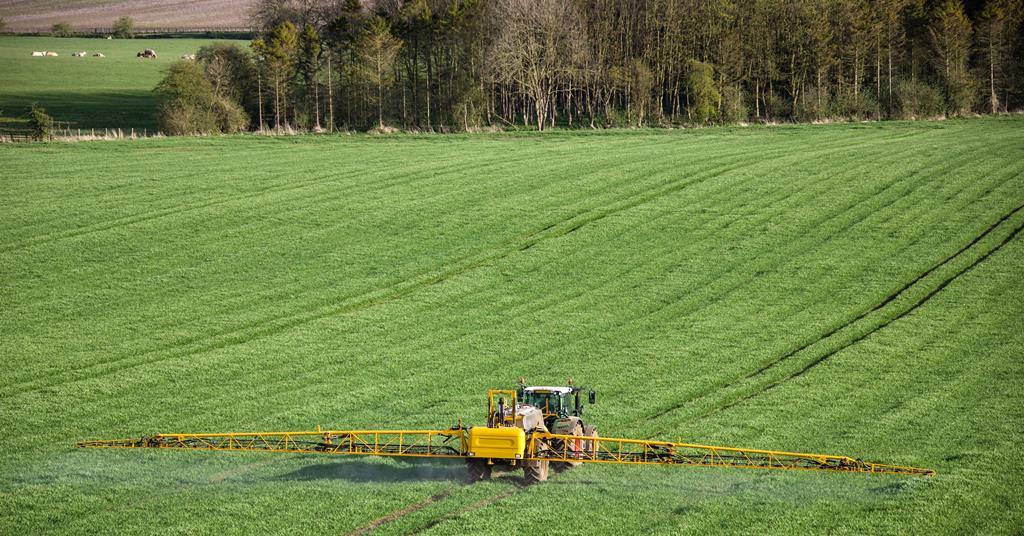
More than £800m a year could be wiped off the profits of already struggling UK farming businesses unless the government safeguards the continued use of vital crop protection products in EU reset negotiations, new research has revealed.
Food production could also fall across key staples, with wheat volumes slumping by as much as 16% in the first year after a sanitary and phytosanitary (SPS) deal was agreed with the bloc, according to modelling by plant protection industry body CropLife UK and consultancy Andersons, published today.
Apple yields could also drop by up to 7%, with potato production shrinking by up to 6%. Barley, oilseed rape, vegetables and fruit would also see big declines in production – unless measures were put in place to implement a “phased transitional approach to alignment with the EU” on the unresolved matter of plant protection products (PPPs), the National Farmers’ Union added.
Since leaving the EU in 2020, Great Britain had been managing its own PPP regulatory regime.
But while the overall legal, scientific, and technical basis for approving crop protection products had not deviated significantly, there was now clear evidence of regulatory divergence – with some PPP approvals having moved faster in GB than the EU, and vice versa, CropLife’s report found.
The industry body highlighted four key products not approved for use in the EU: herbicides Bixlozone (sold under the Isoflex brand) and Cinmethylin (Luximo); plus fungicides Isoflucypram (Iblon) and Pydiflumetofen (Adepidyn), as examples of post-Brexit regulatory divergence.
A further 14 products were still approved for use in the UK but had seen EU approval expire, the report found, while there had also been divergence in maximum residue levels.
British farmers had seen “significant benefits” from the use of these products, CropLife said, particularly in tackling weeds and fungal disease in crops.
“These differences reflect regulatory timing, not weaker safety standards,” the report stressed, pointing to the often politically-driven barriers to approval in the EU.
Threat to UK self-sufficiency
But if the UK were to press ahead with immediately aligning UK PPP rules with existing EU regulations in the proposed UK–EU Sanitary and Phytosanitary (SPS) agreement, these products could be outlawed – with the potential to significantly damage the prospects of the UK farming sector and self-sufficiency, CropLife warned.
Using a worst-case “cliff-edge” alignment scenario – where a ban on such products would come into force as soon as the SPS deal was agreed – the analysis showed that the loss of key crop protection tools “would reduce yields, alter cropping patterns and increase production costs”.
CropLife’s analysis put the loss of profits from such a scenario at between £500m and £810m (equivalent to 7% to 11% of total UK farming income), with a 3% to 6% drop in gross value added levels.
Farming practices would also change, with a shift from winter crops to spring cropping, more fallow land and grass, plus lower yields, higher costs and a greater reliance on imports, the report found.
A “cliff-edge” with a two-year grace period would deliver a similar outcome, with economic shocks “postponed, not avoided”.
EU SPS deal: Dublin route easier for hauliers supplying NI, hauliers warn
Managed alignment – CropLife and the NFU’s preferred scenario – would ensure existing GB decisions remained valid until reviewed under a new UK/EU joint regulatory system.
“Most first-year losses would also be avoided, giving predictability for farmers and supply chains,” CropLife said, while alignment would happen “gradually, as science-based renewals occur”.
“Since leaving the EU, the GB regulatory regime has delivered innovative new chemistry faster than the EU, benefitting GB growers. But these benefits could be thrown away if the government does not negotiate a good SPS deal,” CropLife UK CEO Dave Bench said.
‘Devastating’ impact on food production
“As our report highlights, the impact of a ‘cliff-edge scenario’ on British growers could be devastating,” he added.
“At a time of increasing pressure on farm profitability, this could prove a tipping point for many farmers and growers. While we welcome the government’s commitment to reducing the price of food for consumers [via the proposed SPS deal], it is difficult to see how reducing domestic crop yields could help achieve that aim.”
Bench’s fears were shared by the NFU, which has been lobbying government on the issue. It warned immediate alignment with EU rules by the time the SPS deal was expected to be completed in June 2027, would reduce British growers’ ability to control disease, weeds and pests on farms, “hammering productivity and their ability to operate profitably”.
“An SPS deal is about removing friction and unlocking trade with our largest trading partner, but we have to get it right,” urged NFU president Tom Bradshaw.
“We are grateful for the open dialogue we’ve had with government so far. But implementing appropriate transition periods is absolutely vital to enable farm businesses to adapt,” he added.
Read more: UK national security at ‘high risk’ from ecosystem collapse and biodiversity loss
Growing food took “long-term planning”, said NFU crops board chair Jamie Burrows.
“Many growers will be making planting decisions now which will be impacted if complete alignment is implemented in June 2027 – there simply isn’t enough time to mitigate impacts or change practices.”
The UK government needed to “prioritise the future of the thousands of arable and horticulture businesses that use these critical products to produce the nation’s food – we cannot afford to lose them overnight”, he insisted.
A Defra spokesperson said the SPS negotiations were “ongoing, and we’re working with businesses on the ground to shape our approach and make sure they’re ready to benefit as soon as any new arrangements take effect”.
They added the government would “not provide a running commentary on negotiations” but stressed the proposed deal would “slash red tape, cut costs and delays at the border, and lift barriers on a wider range of UK exports to the EU”.
$(document).ready(function() {
if (window.location.pathname == ‘/advertise’) {
$.getScript(“https://tag.clearbitscripts.com/v1/pk_6c1cac1dc287e45bfaab20867b193dcb/tags.js”);
console.log(“Clearbit Loaded”);
}
});