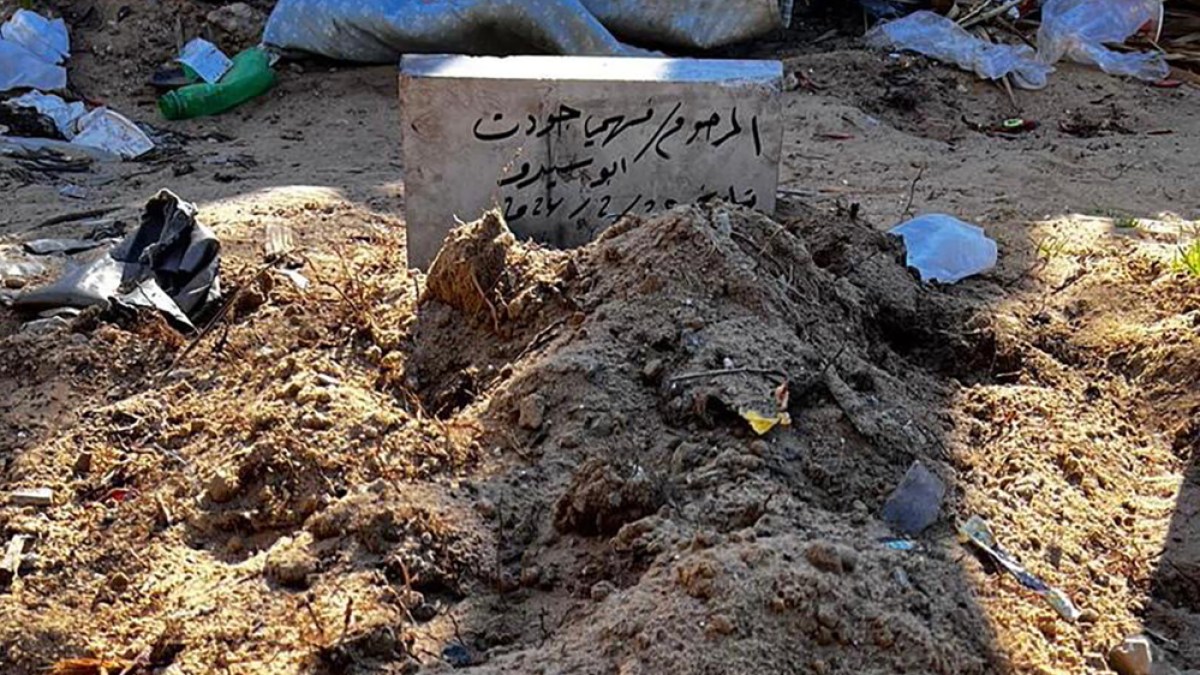
Gaza City – Fatima Abdullah cannot erase the painful images from al-Batsh cemetery, which was excavated and desecrated this week by the Israeli military in the Tuffah neighbourhood east of Gaza City, as the army recovered the last captive’s body.
The cemetery contains the grave of her husband, who was killed during Israel’s genocidal war on Gaza, alongside thousands of other graves belonging to families across the devastated territory.
Recommended Stories list of 4 itemsend of list
Fatima, a mother of three, has told Al Jazeera of the unbearable tension she felt knowing that the Israeli military’s search operations were focused on that cemetery.
“We were all on edge… we knew the operation was at al-Batsh cemetery, and everyone was scared it would be their loved one’s grave next. I imagined the machinery approaching my husband’s grave, and I said, ‘No, God.’”
Fatima’s husband, Mohammad al-Shaarawi, was killed in an Israeli drone strike on December 11, 2024. The attack targeted him with a group of friends in Tuffah. At the time, Fatima and her children were displaced in southern Gaza.
“Even the dead were not spared,” Fatima says, describing a violation of the last remnants of their right to mourn and preserve dignity.
“Corpses scattered, bones, bags thrown … they were bulldozing graves, dumping the remains as if they were nothing.”
During the search and recovery of captive Israeli policeman Ran Gvili, about 250 graves were examined in a short period using heavy military machinery and bulldozers.
The operation led to the exhumation of both old and recent graves, the destruction of many tombstones, and a significant alteration of the cemetery’s landscape, according to aerial images of the site.
“I used to always visit him. On holidays, on his birthday, with the kids. The strange thing is that my children didn’t feel they were going to a sad place; they felt they were really going to visit their father,” Fatima says.
After the forced mass evacuation of tens of thousands from Shujayea in Gaza City amid intensive Israeli attacks in June 2024, Fatima could no longer reach the cemetery, surrounded by rubble, debris and military machinery.
The risk persisted after the ceasefire was declared in October 2025 because the cemetery lies near the so-called “yellow line” under Israeli military control.
“No one knows what they took, what remains were returned … if anything at all,” Fatima says, hoping that phase two of the ceasefire will allow her to visit the cemetery to check on her husband’s grave.
“We, the people of Gaza, didn’t even have the luxury of mourning properly, and now they’ve taken away the graves of our loved ones after death,” she adds.
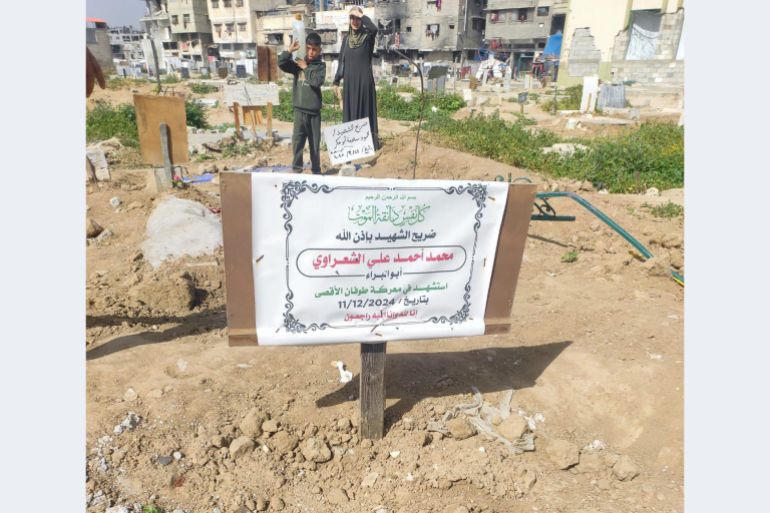 The grave of Mohammed Al-Shaarawi, Fatima Abdullah’a husband, at al-Batch cemetery in the Tuffah neighbourhood, east of Gaza City [Courtesy of Fatma Abdullah]Israel’s history of desecrating cemeteries
The Israeli military has wantonly bombed, bulldozed and desecrated Palestinian graves in Gaza multiple times over the years, drawing condemnation from human rights organisations as a flagrant violation of international humanitarian law.
The Euro-Med Human Rights Monitor documented that the Israeli army has destroyed or severely damaged approximately 21 out of 60 cemeteries in Gaza, exhuming remains, mixing them or causing them to be lost, leaving thousands of Palestinian families with crushing uncertainty about the fate of their relatives’ bodies.
Among instances of Israeli destruction are:
Beit Hanoon cemetery in northern Gaza
Al-Faluja cemetery in Jabalia, northern Gaza
Ali Ibn Marwan cemetery, Gaza City
Sheikh Radwan cemetery, Gaza City
Al Shuhadaa Eastern cemetery, Gaza City
Tunisian cemetery, Gaza City
Cemetery of Church of St Porphyrius, Gaza City
Khan Younis cemetery in the Austrian neighbourhood
The Gaza War Cemetery, in Tuffah, housing fallen soldiers during World Wars I and II from the United Kingdom and several Commonwealth nations, has suffered significant damage from Israeli bombardment but is not yet completely destroyed, according to local assessments. Damage has also been reported to the Deir el-Balah War Cemetery.
Additionally, earlier this month, Euro-Med called for urgent international intervention “to halt the crimes of widespread destruction and land levelling being carried out by the Israeli army in Rafah, in the southern Gaza Strip, until specialised teams and the necessary equipment are allowed to recover the bodies of victims, identify them, and ensure their dignified burial”.
Hamas also condemned the exhumation of hundreds of graves and described the act as “unethical and illegal, reflecting the international system’s failure to hold the occupation accountable for its unprecedented crimes in modern times”.
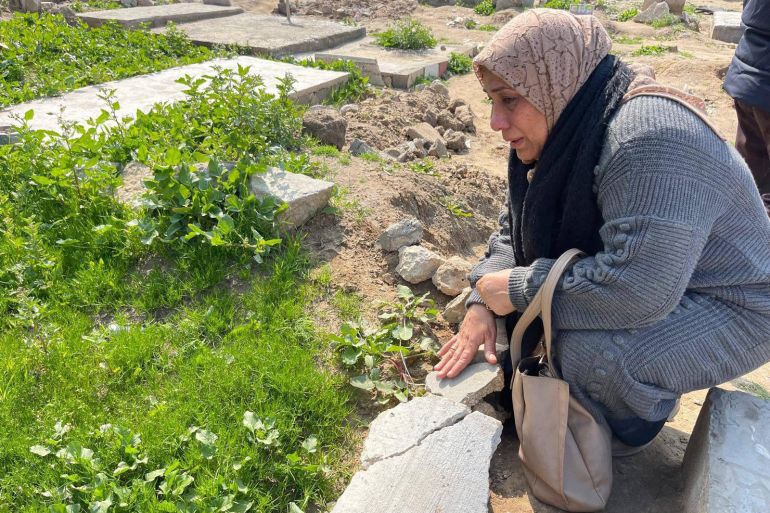 Madeline Shuqayleh stands at her sister’s grave in al-Batch cemetery for the first time, months after her burial [Courtesy of Madeline Shuqayleh]Buried without farewell
For Madeline Shuqayleh, the exhumation of al-Batsh cemetery ripped open the wound of where her sister and niece were buried.
On October 28, 2023, her sister, Maram, and her four-month-old daughter, Yumna, were killed in an Israeli strike in central Gaza. The family did not immediately know of their deaths, as they were displaced in Deir el-Balah, while her sister stayed in the north with her husband’s family.
“Imagine knowing your sister was killed and buried without knowing how, where, or what happened to her. It was a crushing shock in every way.”
Maram and her daughter were buried in al-Batsh cemetery. “After a lot of effort, we found the place. When we visited, the grave was there, the tombstone intact … the pain was immense,” she added. “But now, to this moment, they’ve deprived us … as if they killed her again.”
The family still does not know what happened to the bodies of Maram and her daughter, or whether the exhumed graves were restored.
The UN and international human rights organisations have documented multiple cases of missing bodies and the deterioration of burial sites after cemeteries were bulldozed or destroyed during Israeli military operations.
In April 2024, UN High Commissioner for Human Rights Volker Turk noted the discovery of mass graves at al-Shifa and Nasser hospitals, containing hundreds of corpses, including women, the elderly, and wounded. Some were found bound and naked, raising “serious concerns” over possible grave violations of international humanitarian law.
‘My father has no grave today’
Rola Abu Seedo experienced compounded grief with her family after the bulldozing of her father’s grave by the Israeli army in a temporary cemetery at al-Shifa.
Rola had been displaced to the south with her mother and four siblings, while her father refused to leave and remained in their northern home until his death.
Her father remained in Gaza City under a severe blockade and a collapsed health system, suffering from diabetes, high blood pressure and a previous stroke, relying on medications that were no longer available.
“At that time, there was famine and no medicines,” Rola told Al Jazeera. “The medical report noted respiratory problems, and his condition worsened.”
On April 28, 2024, her father died, and the family did not learn of his death immediately. “Communications were nearly cut off; my father couldn’t charge his phone to reach us.”
A relative performed a burial and preserved the grave location, placing a simple marker sent to the family, who planned to move it later to an official cemetery once conditions stabilised.
But after another major Israeli incursion around al-Shifa in March 2024, bulldozers levelled the cemetery, leaving no grave markers.
“Our relatives went back to find the grave after the operation, but they said they couldn’t locate it and the area where he was buried had been bulldozed,” Rola said.
About a year ago, with news of potential grave transfers from al-Shifa to Beit Lahiya in northern Gaza, a committee of forensic authorities and the Red Crescent participated in digging operations based on residents’ testimonies.
Rola’s family searched for her father’s remains again, but to no avail.
“They dug in the spot we were sure was his grave … but they didn’t find a body.” To this day, the family does not know the whereabouts of her father’s remains.
“We still don’t know if they took the bodies, mixed them, or moved them,” she says. “My father has no grave today.”
“It’s as if they not only deprived us of our loved ones while they were alive, but also denied us the farewell after death.”
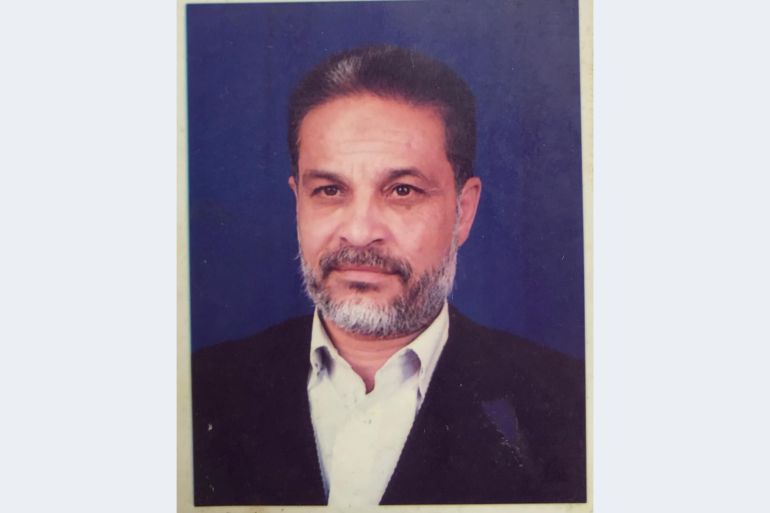 Fahmi Abu Seedo, 65, Rola’s father, who died in northern Gaza during the war after suffering from health complications [Courtesy of Rola Abu Seedo]