語言:
English
Photo Credit: Daniel Torok/White House/Public Domain
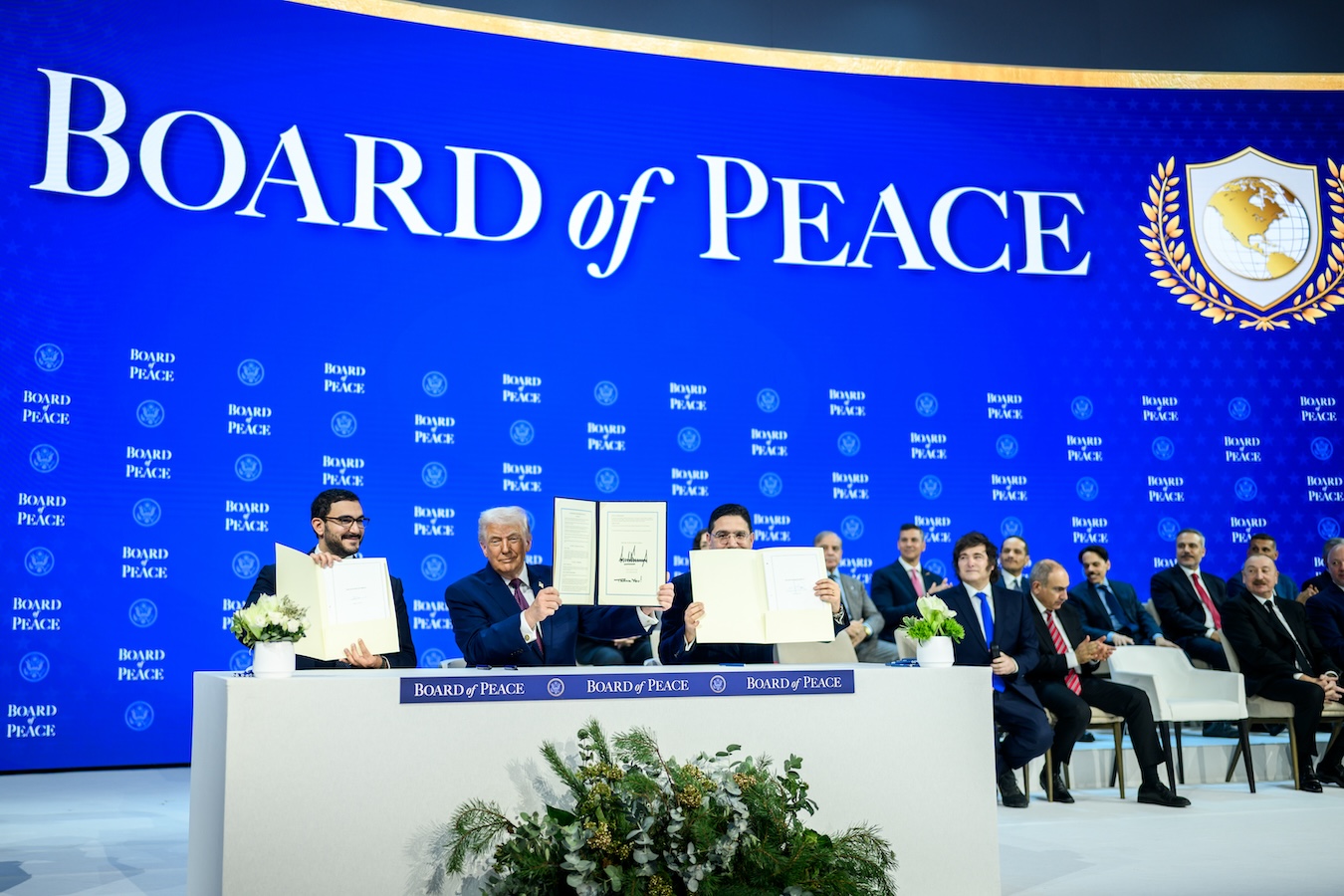
DONALD TRUMP’S “Board for Peace” presents an unusual diplomatic hurdle for Taiwan.
Taiwan normally clamors to join international bodies, given its exclusion from the United Nations (UN). As such, Taiwan has long campaigned for its inclusion in the World Health Organization (WHO), the major global public health body, and the International Civil Aviation Organization, the UN body responsible for air traffic safety. Taiwan has cited the potential dangers to global health and air traffic from its exclusion, given that this results in a substantial loophole in consideration of pandemic prevention, and in consideration of the large amount of air traffic that passes through Taiwan
To this extent, Taiwan normally seeks to shore up diplomatic ties with the US, its major security guarantor from the threat of a Chinese invasion. Taiwan is currently in the process of finalizing negotiations to lower the tariffs imposed upon it by the Trump administration. Taiwan is also in the process of trade talks with the US, with the aim of a bilateral trade agreement.
Even if the US does not officially recognize Taiwan, the US threw its weight behind Taiwan participating as an international observer in the WHO during the first Trump administration and during the second Trump administration. This has been complicated by the fact that the US itself later withdrew from the WHO during the second Trump administration.
Similarly, while Taiwan previously sought accession to the Trans-Pacific Partnership (TPP), as a US-led trade bloc to cement the Asia Pacific against China, this was complicated by the US withdrawal from the TPP. Taiwan has continued to seek accession to the Comprehensive and Progressive Agreement for Trans-Pacific Partnership, the form that the TPP took after the US withdrawal, with the trade agreement now led by Japan.
Trump’s “Board for Peace” seems to be an attempt to outflank the UN. To join requires contributing one billion USD. This takes place in a similar timeframe to Trump undermining NATO through the assertion that his administration intends to annex Greenland.
In consideration of what countries have signed onto Trump’s “Board for Peace,” one notes that they are mostly nations with questionable human rights records who may hope to take advantage of Trump’s transactional approach to international relations. This includes Bahrain, Albania, Armenia, Azerbaijan, Bahrain, Belarus, Hungary, Kazakhstan, Morocco, the United Arab Emirates, and Vietnam. Russia and China have received invitations to join, but have not confirmed that they will. It is probable that Taiwan would seek to avoid joining an alliance of pariah states, even if that might mean closer relations with the US.
The Lai administration would further be disincentivized to join in consideration of that it already faces criticisms domestically over the actions that it has taken to placate the Trump administration. The expansion of TSMC’s investment in the US, as a move to keep the US happy, has been criticized by the KMT and TPP as potentially leading to the loss of Taiwan’s “Silicon Shield.” The “Silicon Shield” refers to the idea that the world’s dependency on Taiwanese semiconductors keeps Western powers invested in Taiwan’s defense, as well as deters a Chinese attack, seeing as China is itself reliant on Taiwanese semiconductors. Moreover, the KMT has also gone on the attack regarding the Lai administration’s efforts to increase defense spending, another demand from the US. The Trump administration has suggested that it will suspend support for Taiwan if Taiwan does not do more for its own defense.
Even so, it is to be seen whether Trump would apply pressure to Taiwan to join. This could prove similar to how Trump behaved toward Japan and South Korea during his first term, pressuring both more to contribute to the US when both countries already pay the US substantial amounts to host American military bases. Japan adopted the unusual approach in response to then-Prime Minister Shinzo Abe attempting to curry favor with Trump by positioning himself as Trump’s sidekick. But Lai is not in a similar position to curry favor with Trump, and he would face criticisms domestically for blind submission to Trump, even as his administration has broadly sought to convince the public that the US still remains reliable as an ally against Chinese aggression.