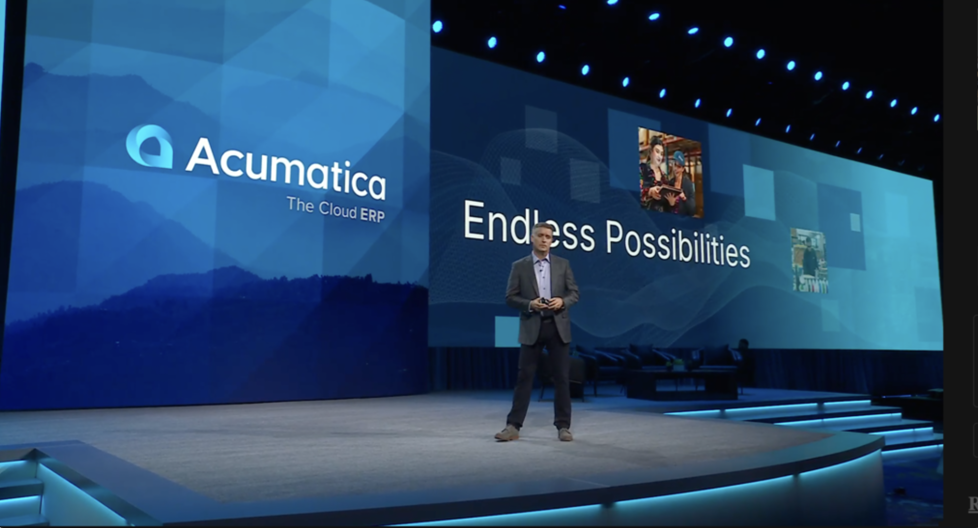
(Acumatica CEO John Case)
Acumatica Summit 2026 took place at a pivotal point in the future of cloud ERP.
As I said in my podcast with Acumatica’s Ali Jani and Miten Mehta on Acumatica’s AI strategy:
ERP is facing a gut check moment. Is ERP even relevant as a product category? Is modern ERP a precursor to better AI or an impediment to transformation?
In its new Seattle event location, Acumatica doubled down on its AI vision: Acumatica Highlights AI-Enabled Innovation and Industry-Focused Enhancements to Kick Off Day 2 of Summit 2026.
Acumatica’s approach to AI for SMBs – will a “system of intelligence” resonate?
Acumatica’s SMB customers provided this feedback: they are looking forward to consuming AI within Acumatica without having to build, train, or otherwise manage LLM architectures themselves – a sensible position given the complexity of these architectures, the moving target of LLM costs, and the intense privacy issues pertaining to utilizing customer data in AI systems, and keeping that data secure.
Like most ERP vendors, Acumatica has embedded different forms of AI for years. But 2026 will be a customer gut check on AI agents, with Acumatica’s AI assistant slated for trial in the upcoming release (R2), and for general availability in R2 (next fall).
It’s no surprise that Acumatica, which has always seen itself as a platform as much as an ERP application, was vocally describing itself as a “system of intelligence” from the keynote stage in Seattle. If you want some deeper views on this, check my AI strategy podcast with Jani and Mehta.
For now, let’s shift gears to the vital show takeaways – and the situation SMBs are facing in general. For that, we turn to a few standouts from my on-site podcast with Josh Greenbaum: Acumatica Summit 2026 – views and reactions on-site.
The state of SMBs – can customers punch above their weight in this economy?
The backdrop of this show is the economic situation SMBs are facing. Acumatica’s customers might be small and medium-sized, but most have complex processes, and a need for adaptability amidst inflation, tariffs, and supply chain visibility. That’s why Greenbaum considers this show a can’t-miss:
This is the pulse of the real economy. We go to a lot of other vendor conferences, and the ones that sell to the global 1000 – and you hear the state of the global economy. But you come here, and you get Main Street, literally Main Street. I literally just had a meeting with someone whose shop is on Main Street in Ann Arbor, Michigan, and you get that; you get that pulse.
What’s interesting about that pulse, as I shared with you when I first got here: a bunch of economic data, macro data on the economy, particularly relating to SMBs. And there was a surprising amount of optimism there.
What inspired Greenbaum this week? Customers “punching above their weight.”
People are here because they need to solve these problems, because at the end of the day, particularly if you’re a small or medium sized company, you’re up against all kinds of big global giants, whether you’re in retail, whether you’re in manufacturing, whether you’re in construction, and you have to be as nimble as them or better, in order to succeed.
You and I have talked about this in the retail space, right? If you’re going to succeed as a retailer, you’ve got to be able to duke it out with the big box guys in the online world, and be successful. Well, folks come here because if you’re in retail, that’s what you want to be able to do too. Maybe it’s as simple as Shopify integration, or some of the new things we saw in terms of Amazon Marketplace integration. But you’ve got to be able to keep alive by staying by looking bigger, you know, by punching above your weight in your market. I think that’s what people come here to do, is to learn how to punch above their weight.
Next-gen tech? Sure – but can you reconfigure your ERP system on the fly?
Greenbaum is one of the fiercest critics of agentic AI amongst the analysts I see on the road. Meanwhile, I hash out the pros and cons of agentic AI frequently. One thing Greenbaum and I agree on: the ability to adapt to new industry conditions, and roll out business models faster than your competitors, is the real key here. Being effective with your human talent and your automation is what counts.
On the other hand, a deep understanding of AI is essential on both an individual and organizational level. You can’t get out in front of AI if you don’t understand it. And if you don’t get out in front, you run the risk of having it imposed upon you, and you won’t have a better frame to present to your team, or your AI-happy leadership. But that’s for another article. To me, the podcast moment was our exchange on how Acumatica customers compete. Start with my side of it:
Talking to customers, I heard [consistent] things about benefits from a single source of truth, a different level of visibility and traceability within their systems. The workflow session I intended was wall to wall [with attendees] – it had nothing to do with AI. It was all about configuring all kinds of synchronous and asynchronous processes…
I was talking with a customer earlier today about their small company, but complex processes, a complex mix of products and services for automotive. And so I got to the gut check question, when you had to add your new service lines and your new products, did you have to build something [for Acumatica]? What did you do? Did you have to go back to your partner? Their partner is heavily involved, but they’re like, ‘No, it was all configurable within Acumatica. We haven’t run into a wall with that yet.’
Greenbaum responded:
I think that’s a true measure of success of your vendors: if your customer’s business expands within the context of the technology platform you provide – and it’s seamless. I’ll give you a great example of that as well. Speaking to one of the customers yesterday, they wanted to go into a new line of business for them, selling into automotive dealer networks. Guess how you interface with an automotive dealer network: EDI. So go back to the last century in terms of a technology standard.
But guess what? There’s a partner with an EDI interface that plugs right into Acumatica: open API, bingo. They’re in business. They’re running a new line of business off of Acumatica. They’ve got the partner thing. I agree – that’s the story that gives you goose bumps.
The persistent challenge of data quality – who wants “garbage in, garbage out” AI?
We did hear one challenge consistently from customers: they are now aware of how important data quality (and governance) is. “Garbage in, garbage out” even came up during keynote interviews. Yes, the discipline of moving to Acumatica is a solid way to help get your data (and process flows) “AI ready,” but that challenge doesn’t stop at go-live. Greenbaum explains:
It’s about data quality, integrity and change management – getting those things right is everything, and nothing happens without that. What was nice about a lot of the conversations I had, and actually, if you read between the lines of a lot of what we heard on the keynote stage today, these are really fundamental to the Acumatica story, as well, as much as they play the game, because they have to AI at the end of the day. They’re talking about data quality, data integrity. They’re talking about what happens when you’re on a single platform of truth, and what that means, independent of whether you can do your amazing AI stuff, you can do the basics of blocking and tackling in a way that you wouldn’t be able to do otherwise.
I was in a couple sessions where the question of ‘What do we do with old data’ came up. One of the partners today said, ‘I’ll migrate two years of your data. And if you need more than two years, let’s talk about it, because you’re going to start over. It’s a fresh start, and it’s a clean start.’ And from that foundation of being on Acumatica, you can do amazing things.
More podcast topics I ran out of time for:
Why Greenbaum says “there is a big hole in the AI story – operations/shop floor.”
The impact of the women in technology panel, and why those open workplace discussions matter – for everyone
Culture, people change and leadership – vivid customer stories
The need for partner (and customer) education/change with Acumatica’s changing platform – and what Acumatica is doing about it
My take – how should Acumatica talk about AI? An agentic AI critic takes the hot seat
After much LinkedIn sparring/debate on the future of ERP versus AI, my position is that modern ERP, and the data discipline/process discipline it imposes, is a necessary foundation for the context that enterprise AI needs. (Though I expect the ‘category’ of ERP to fade into composable workflow libraries, but that’s not going to happen this year, that’s for sure).
True, ERP modernization is not the only way to get that context in place, but it’s one avenue that takes companies smack into process and data improvement. What comes next? I don’t think it’s tech-first. I think it’s really about competing in your industry in new/agile ways, while managing risk via a different level of visibility. And yes, AI of all flavors factors into that. But Acumatica’s AI strategy can wait for the next podcast.
For now, Greenbaum is one of the biggest agentic AI critics amongst the analyst contingent. So I couldn’t miss the chance to put him in the proverbial hot seat. Given that Acumatica is pushing their “intelligent systems,” and given Acumatica has major agentic/gen AI releases next year, how does Greenbaum advise Acumatica to talk about that? Greenbaum:
Again, I feel like everyone should be doing this, not just Acumatica – they should really differentiate between the AI that’s already there, working for them today, and the agentic, the new stuff. Because I think it’s really important to set expectations. New stuff is new. It’s going to take a little time to sort out. I think Jon Pollock, the new CPO, put that on stage during his keynote time, where he actually looked at this the evolution of what they want to do with AI, building up towards a trust model, which I think is really good, and doing it step-wise.
Because I think what we’re seeing with agentic, we’re just seeing too many promises that are going to get broken in the process of fixing a nascent technology. That’s how it works. Meanwhile, some of the basic bottom line stuff that AI is already doing… You look at a field service app and you see that map there: there’s AI directing that field service tech, to the right place at the right time. There’s all kinds of things with reconciling invoices, reconciliation in general, anomaly detection doesn’t need agentic, LLM-based AI to do a really good job. I think they should differentiate and make it clear what is the cool new stuff that you’re going to have to handle a little more carefully, and what’s the robust stuff that you can get in there and really swing for the hills with.
That’s a good place to leave it. I’ll pick this up in my podcast with Brian Sommer, to be issued this weekend – along with more show missives here. Stay tuned…