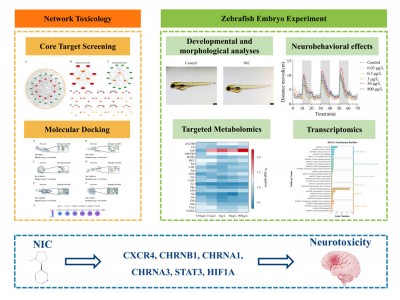
Nicotine is not just a human health concern—it is a widespread aquatic pollutant. Despite its prevalence, exactly how low, environmentally relevant concentrations damage the developing nervous system has remained a black box. To that end, a new study published in Environmental Chemistry and Ecotoxicology (ENCECO) employs a powerful, integrated strategy to crack this code, offering a blueprint for assessing the neurotoxicity of environmental chemicals.
“Traditional methods often look at single points of failure,” explains corresponding author Jian Xu of the Chinese Research Academy of Environmental Sciences. “We combined computational prediction with multi-level experimental validation. This allowed us to move from a list of potential targets to a coherent story of how toxicity unfolds, from the molecule to the whole organism.”
The research team first used network toxicology and molecular docking to predict nicotine’s most likely neurotoxic targets, identifying six core proteins. They then exposed zebrafish larvae—a model organism with a transparent body and genetic similarity to humans—to nicotine at levels as low as 0.03 µg/L, matching real-world contamination.
“Our experiments confirmed the predictions. Even at these low doses, nicotine stunted growth, caused heart rate irregularities, and triggered abnormal behaviors reminiscent of anxiety,” says Xu. “Further, we found a severe imbalance in brain chemicals (neurotransmitters) and activation of specific stress and cell death pathways in the brain.”
The team then weaved these disparate threads into a single, predictive narrative called Adverse Outcome Pathway (AOP).
“AOP shows how nicotine’s initial disruption of communication between brain cells leads to a calcium imbalance, which in turn sparks inflammation, oxidative stress, and ultimately, the death of neurons and the observed developmental defects,” shares first author Yu Kou. “This is more than a mechanism for nicotine—we demonstrate a holistic framework that can be applied to other emerging contaminants. It provides a much-needed strategy to proactively understand ecological risks before they become crises.”
###
References
DOI
Original Source URL
https://doi.org/10.1016/j.enceco.2025.12.014
Funding information
This work was supported by the National Science Fund for Distinguished Young Scholars (42325706).
Jorunal