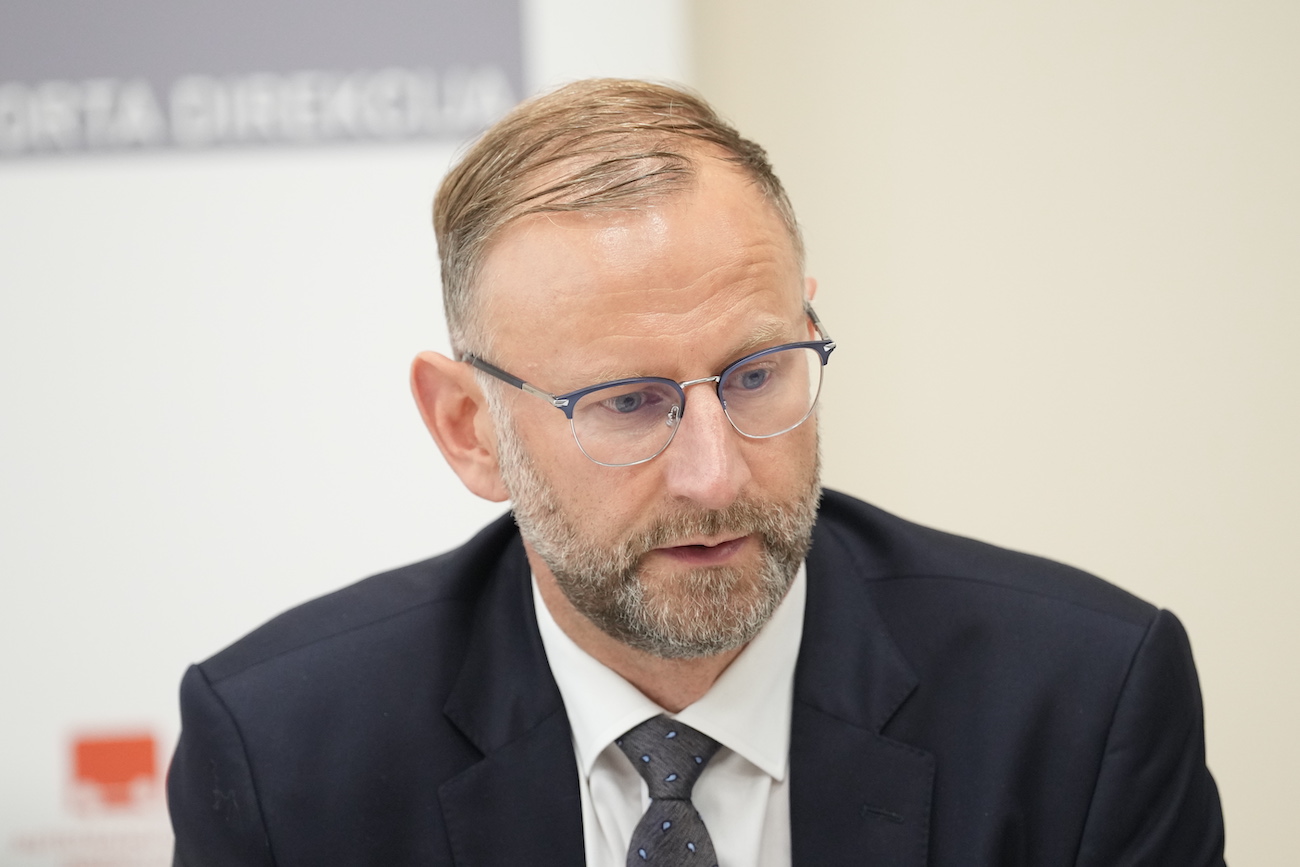
The task of Latvia’s national implementer of the Rail Baltica project, SIA Eiropas dzelzceļa līnijas (EDzL), is to focus on construction rather than speculate about deadlines for the first phase of the project, Transport Minister Atis Švinka (Progressives) said on Latvian Television’s programme Šodienas jautājums.
Earlier, EDzL Management Board Chairman Māris Dzelme said on LTV’s Rīta panorāma that construction of Rail Baltica’s first phase could be delayed by three to five years and that, based on the actual pace of construction and currently available funding, he did not see how the project could be completed by 2030.
Asked whether he acknowledges that completion by 2030 may indeed be impossible, Švinka said on LTV that Dzelme’s remarks reflected a personal opinion. He stressed that EDzL’s primary responsibility is to build, not to voice opinions or engage in speculation.
“I will continue to rely on official documents. There are Cabinet decisions stating that the project must be implemented by 2030. There is also a joint commitment by all three Baltic states. Looking at these goals, they are challenging, and securing the necessary funding is complicated,” the minister said.
Švinka explained that, as minister, he must work within the framework of these documents.
He cannot act on personal preferences or impressions. If decisions have been taken at the policy level, it is his duty to do everything possible to ensure the project is delivered.
As previously reported by LETA, EDzL is currently trying to reach an agreement with the Spanish company Idom, the developer of the existing construction design, on adapting and redesigning the project. If an agreement cannot be reached, EDzL will have to announce a public procurement procedure for redesigning the construction project.
The Rail Baltica project aims to build a European-standard-gauge railway line from Tallinn to the Lithuanian–Polish border, enabling rail connectivity between the Baltic states and the rest of Europe. In the Baltics, the plan is to construct a new 870-kilometre-long railway line with a standard gauge of 1,435 millimetres and a maximum train speed of 240 kilometres per hour. The first phase of Rail Baltica is scheduled for completion by 2030.
At a meeting of the Saeima’s Economic, Agricultural, Environmental and Regional Policy Committee on Tuesday, the 27th of January, it was stated that
an additional 3–4 billion euros is still needed to complete the first phase, or core route, of Rail Baltica.
By early 2026, 33 kilometres of the core route will have been handed over to the construction consortium E.R.B. Rail JV.
According to previous information from RB Rail, the cost of Rail Baltica’s first phase across the Baltic states could reach €14.3 billion, of which €5.5 billion would fall to Latvia. However, there is potential for savings of up to €500 million through optimisation of technical solutions, as well as other possible cost reductions.
Total project costs across the Baltics, based on cost–benefit analysis, could reach €23.8 billion. In an earlier analysis conducted in 2017, the total project cost was estimated at €5.8 billion.