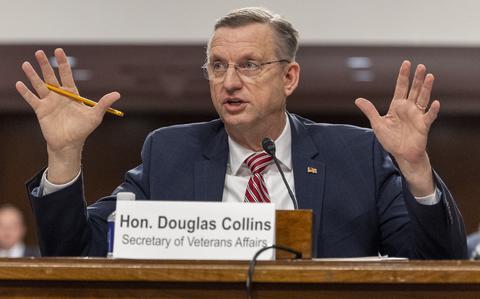
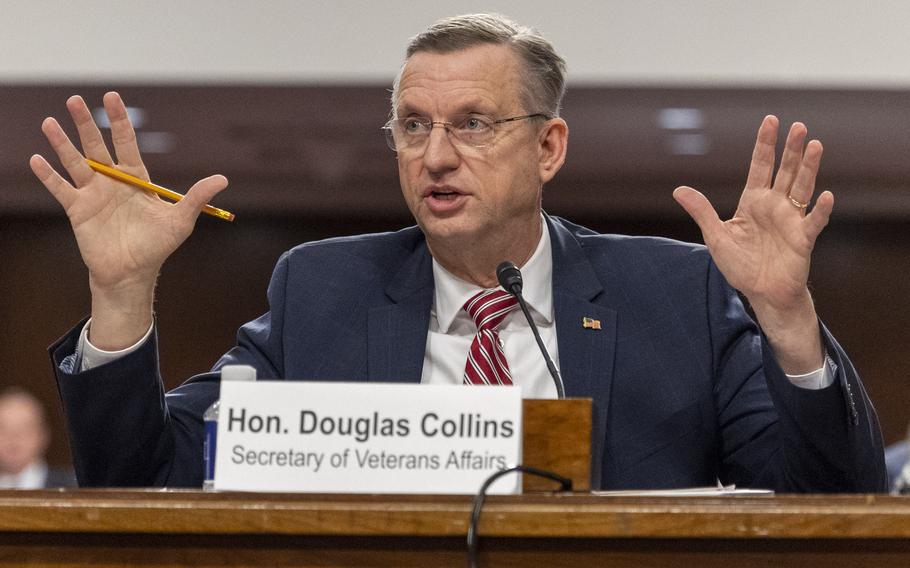
VA Secretary Doug Collins testifies at a Senate Veterans Affairs Committee hearing on Jan. 28, 2026, in Washington. (Eric Kayne/Stars and Stripes)
WASHINGTON — Sen. Richard Blumenthal, of Connecticut, the top Democrat on the Senate Veterans’ Affairs Committee, demanded that Veterans Affairs Secretary Doug Collins give a “full accounting” of how an extra $6 billion Congress provided for veterans care was spent on deferred resignations and voluntary retirements as part of a massive workforce reduction.
“This money was to be used to cover higher-than-expected demand for health care, prescriptions and prosthetics. I want the numbers,” Blumenthal said Wednesday during a Senate Veterans’ Affairs Committee hearing.
“More than 40,000 employees have left the VA since last January,” Blumenthal said, suggesting that the dollars were used to “push out essential providers rather than sustain them.”
Blumenthal asked for a detailed accounting of the number of staff who left, which Collins said he would provide.
“I want numbers … I want the breakdown. We’ve asked for it repeatedly, sir. We have not received it. I’m asking again in this forum — I shouldn’t have to do so,” Blumenthal said.
Collins denied that staff members were “pushed out” or compelled to resign when the Department of Veterans Affairs cut its workforce, as part of President Donald Trump’s downsizing of the federal government in 2025.
The committee met for a two-hour hearing to review the VA’s plans to consolidate administration while enhancing care at VA facilities and with private medical providers in the community.
“We are the largest health care provider in the country, and we haven’t acted like it,” Collins said. “The focus now is on taking better care of veterans.”
Collins said the VA housed more than 50,000 homeless veterans last year and has opened two dozen outpatient clinics that make it easier for veterans to get walk-in care.
But the hearing pivoted to the sweeping cuts the VA made in 2025.
Blumenthal and other Democrats demanded updated numbers on staff reductions at individual hospitals and the impact on services, including wait times for mental health counseling and other appointments.
Democrats also paused to express shock and sadness over the fatal shooting Saturday of VA critical care nurse Alex Pretti by federal agents in Minnesota. No Republican commented on the incident.
Pretti was using his cellphone to film a federal immigration enforcement operation in his Minneapolis neighborhood, when he was tackled by agents and shot multiple times, according to witness videos.
Collins, a military chaplain, offered his “deepest sympathies” to Pretti’s family at the start of the hearing. Pretti, 37, worked at the Minneapolis VA Medical Center for 11 years.
Collins then made his opening statement about a proposal to restructure the VA administration for efficiencies.
Sen. Elissa Slotkin, D-Mich., asked Collins why he waited 30 hours to express condolences to Pretti’s family in a message on social media that also blamed political opponents in Minnesota for the shooting.
“Such tragedies are unfortunately happening in Minnesota because of state and local officials’ refusal to cooperate with the federal government to enforce the law and deport dangerous illegal criminals,” Collins posted to X.
Collins told Slotkin — as well as other Democrats who tried to question him — that he could not comment on the incident, because it was an open investigation.
The hearing focused on the VA’s proposed restructuring and consolidation of its regional administration to improve efficiencies and communications with hospital directors across its vast system of hospitals and clinics.
The VA employs more than 400,000 personnel. But the number of patient appointments and need for care differ by region and community, Collins said.
Collins discussed one VA hospital that increased full-time personnel by more than 30% in recent years, while patient visits rose by less than half of that.
Sen. Dan Sullivan, R-Alaska, emphasized that non-VA community care with private doctors and nurses is important to Alaska veterans, because there is not a full-service VA hospital in the state.
“How are you making sure that you are still focusing on community care?” Sullivan said. “My veterans get to go into the community, because there is no other place for them.”
John Bartrum, VA undersecretary of health, assured Sullivan that VA coverage for private medical care is based on the best needs of veterans.
Collins said the VA is trying to take a hands-on approach to look at how different regions and individual hospital systems operate and not apply a one-size-fits-all approach.