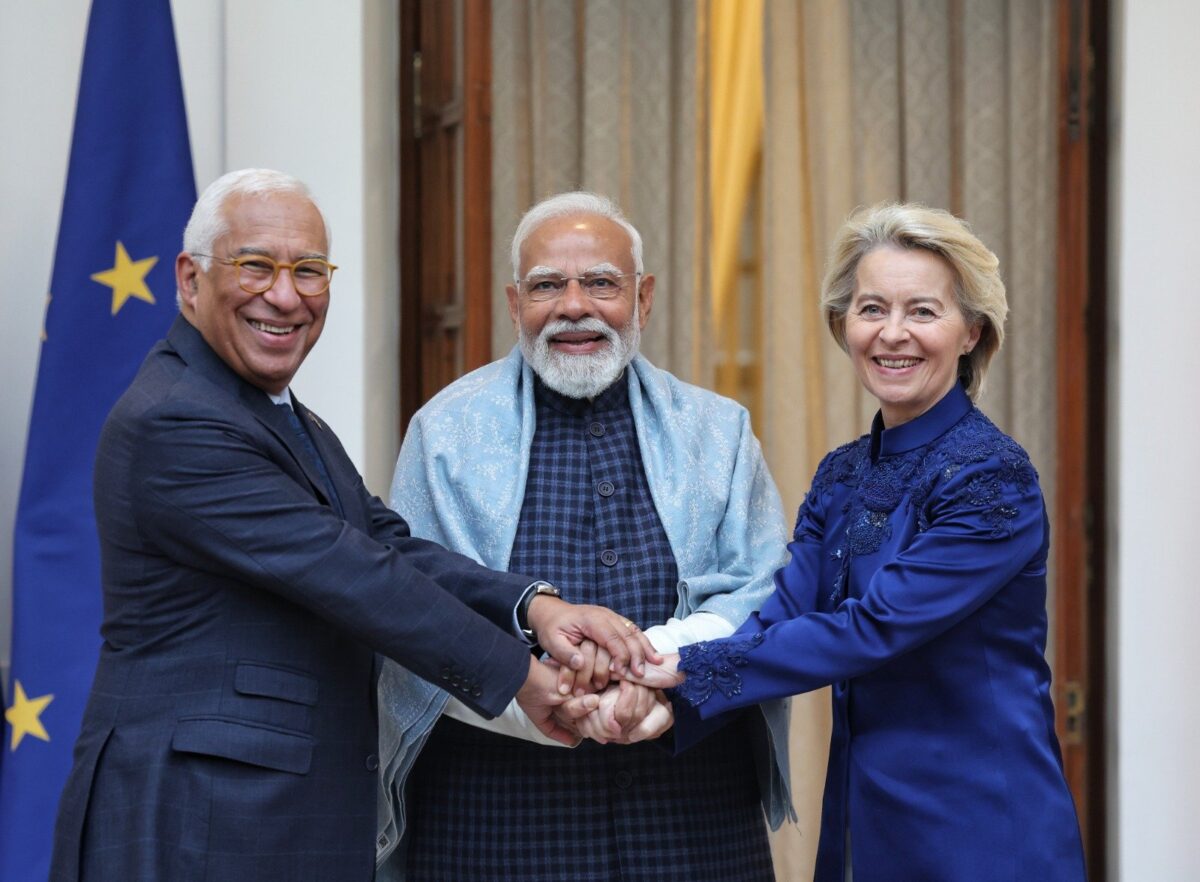
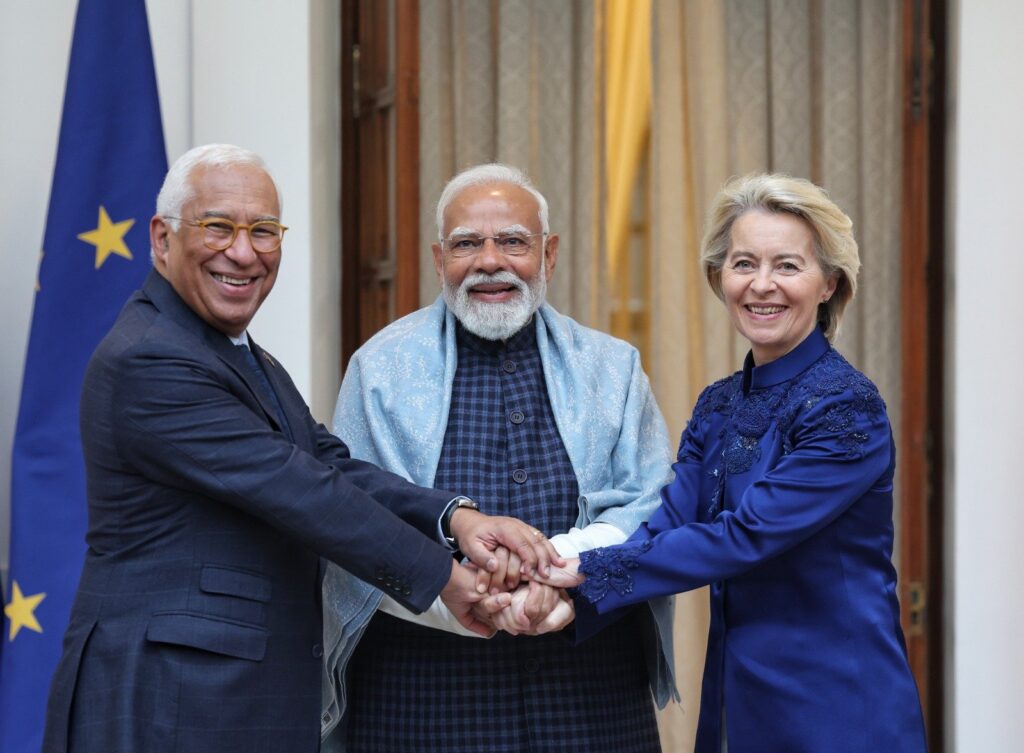
 European Council President António Costa and European Commission President Ursula von der Leyen with PM Modi.
What came after the India–European Union Free Trade Agreement may matter as much as the deal itself.
Reactions across newsrooms, government offices, corporate boardrooms, and policy institutions suggest a shared view: this pact reflects the economic and political moment the world is living through.
Coming after nearly two decades of talks, the agreement links the world’s largest economic bloc with one of its fastest growing major economies, placing trade, supply chains, and long term partnerships at the center of a shifting global order.
International media coverage has focused on the size, scope, and timing of the agreement, with several outlets framing it as a defining moment in global trade.
The Telegraph, in an article by James Crisp, called the pact the “mother of all trade deals” and argued that India has emerged as the key strategic winner.
The paper reported that the deal removes or reduces tariffs on 96.6 percent of European Union exports to India, while the EU will cut tariffs on 99.5 percent of Indian goods over a seven year period.
Bloomberg echoed that framing in an article by Dan Strumpf titled “All Roads Lead to Modi as World Hedges Trump,” writing that the “mother of all deals” between India and the European Union reflects a broader trend, with New Delhi becoming a preferred partner for countries seeking stable economic ties.

The Wall Street Journal placed the agreement in the context of global tariff disruption, describing it as part of a wider move by middle powers to expand alliances amid uncertainty tied to United States trade policy.
The New York Times highlighted the significance of bringing together the European Union and India after years of talks, stressing the economic weight of both partners and the long road to consensus.
The Washington Post described it as a historic agreement with the headline, “India and EU clinch the ‘mother of all deals’ in a historic free trade agreement,” while The Guardian ran a similar line, “Mother of all deals: EU and India sign free trade agreement.”
The BBC followed with “India and EU announce ‘mother of all trade deals’,” reinforcing the shared global framing.
Bloomberg, in a separate report, examined the implications for manufacturing and logistics, noting that duties on cars will fall as low as 10 percent compared to earlier levels above 100 percent, while tariffs on auto components will disappear entirely.
Associated Press underlined the breadth of the pact with its headline stating that India and the European Union have reached a free trade deal representing a third of global trade. Al Jazeera highlighted the combined economic weight with its description, “‘Mother of all deals’: How India–EU trade deal creates $27 trillion market.” Reuters called it a landmark agreement, writing, “India, EU reach landmark trade deal, tariffs to be slashed on most goods.”
The impact beyond Europe also drew attention.
On Fox News, Pakistani journalist Qamar Cheema said India stands to gain substantially as tariffs will fall to zero in several key sectors, adding that neighbouring countries such as Pakistan and Bangladesh will struggle to compete with India in the European market under the new terms.
Political leaders across Europe welcomed the agreement in public statements that emphasized growth, partnership, and global positioning.
Germany’s Chancellor Friedrich Merz described the conclusion of the negotiations as a “very positive sign” and called for rapid implementation to drive growth and prosperity. Finnish President Alexander Stubb called the India–EU FTA historic and the largest trade deal ever concluded by either side, saying it would sharply intensify both economic and political ties.
Swedish Prime Minister Ulf Kristersson said the agreement signals the start of a new era of cooperation that strengthens prosperity, competitiveness, and security through trade and partnership.
Austria’s Chancellor Christian Stocker said the pact creates a free trade zone serving two billion people and described it as a major step for Europe’s resilience in a fast changing global environment. Denmark’s Foreign Minister Lars Løkke Rasmussen voiced full support, calling the deal geopolitically crucial and pointing to the first mover advantage within a combined market of two billion people.
From France, Nicolas Forissier, Minister Delegate for Foreign Trade and Economic Attractiveness, described the EU–India accord as a major political step and said, “this is not an agreement like the others.”
Sandro Gozi, a Member of the European Parliament, said the deal reflects Europe’s push to diversify partnerships and strengthen autonomy and independence, adding that India stands as a major global actor and that the agreement opens significant opportunities for Europeans and Indians alike from a geopolitical and diplomatic perspective.
Business leaders and industry groups operating across India and Europe responded with optimism that matched the political tone, often describing the pact as long awaited.
Jürgen Westermeier, President and Managing Director for India and South Asia at Airbus and President of the Federation of European Business in India, called the agreement a “big moment” after 20 years of discussions and said it will act as an accelerator of opportunities on both sides.
Wouter van Wersch, President of Airbus International, described it as a “fantastic day” and reaffirmed Airbus’ long term commitment to Make in India, technology transfer, defence, space, and advanced manufacturing.
Jan Noether, Director General of the Indo German Chamber of Commerce, said the agreement brings together two billion people and almost a quarter of global GDP, calling it the “mother of all free trade agreements.”
Sebastian Stiezel, President of the Berlin Chamber of Commerce, said the India–EU FTA marks an important opening in an increasingly tense global setting and added that India stands as a market of the present, urging Berlin to seize the opportunities now taking shape.
Industry leaders from major German carmakers including Volkswagen, BMW, and Mercedes Benz welcomed the deal for its potential to lift exports to India and reinforce global supply chains.
Business groups such as the Croatian Employers’ Association and BusinessEurope described the pact as one of the European Union’s most important trade moves at a time of rising protectionism.
Swedish organizations including Svenskt Näringsliv and Företagarna pointed to reduced tariffs and improved market access as key gains. In Ireland, Chambers Ireland and other economic bodies welcomed the agreement as historic, highlighting expanded access and diversification prospects for exporters, especially in machinery and agri food.
Additional business voices joined the chorus. Frank Schlöder, Managing Director of Häfele South Asia, Thomas Wolter, Managing Director of Krones Machinery India, Lars Eric Johansson, Executive Vice President at Oxea GmbH, Jan Olof Jacke, CEO of the Confederation of Swedish Enterprise, and Fredrik Persson, President of BusinessEurope, all described the agreement as a strong signal in support of rules based trade, supply chain strength, small and medium enterprise growth, and long term competitiveness.
Policy experts and research institutions framed the pact as both substantial in content and well placed in timing.
Richard Rossow, Senior Advisor at the Center for Strategic and International Studies, said the deal brings together a quarter of the world’s population and a vast share of global trade, adding that the positive optics rest on strong substance. He also said India’s recent free trade agreements show a clear move toward deeper and more ambitious commitments.
Michael Kugelman, Senior Fellow at the Atlantic Council, called the India–EU FTA the “right deal at the right time,” saying it goes beyond responding to United States tariffs and instead strengthens a wider and fast growing strategic partnership.
Geopolitical strategist Velina Tchakarova described the agreement as one of the most consequential geoeconomic deals of the decade in terms of scale and intent.
The Kiel Institute for the World Economy said deeper integration between the European Union and India could raise bilateral trade by 41 to 65 percent and lift real incomes by about 0.12 to 0.13 percent of GDP on both sides.
The European Council on Foreign Relations described the pact as one of the largest trade agreements concluded in recent years, covering goods, services, investment, digital trade, and regulatory cooperation. The International Institute for Strategic Studies said India’s recent focus on trade agreements with multiple partners signals a move toward a more open economy and supports its longer term development ambitions.
Taken together, the reactions underline a shared view across media, politics, business, and policy circles that the India–EU Free Trade Agreement stands as a defining economic and strategic moment, one that aligns market access, global partnerships, and long range planning at a time when many countries are searching for dependable paths forward.