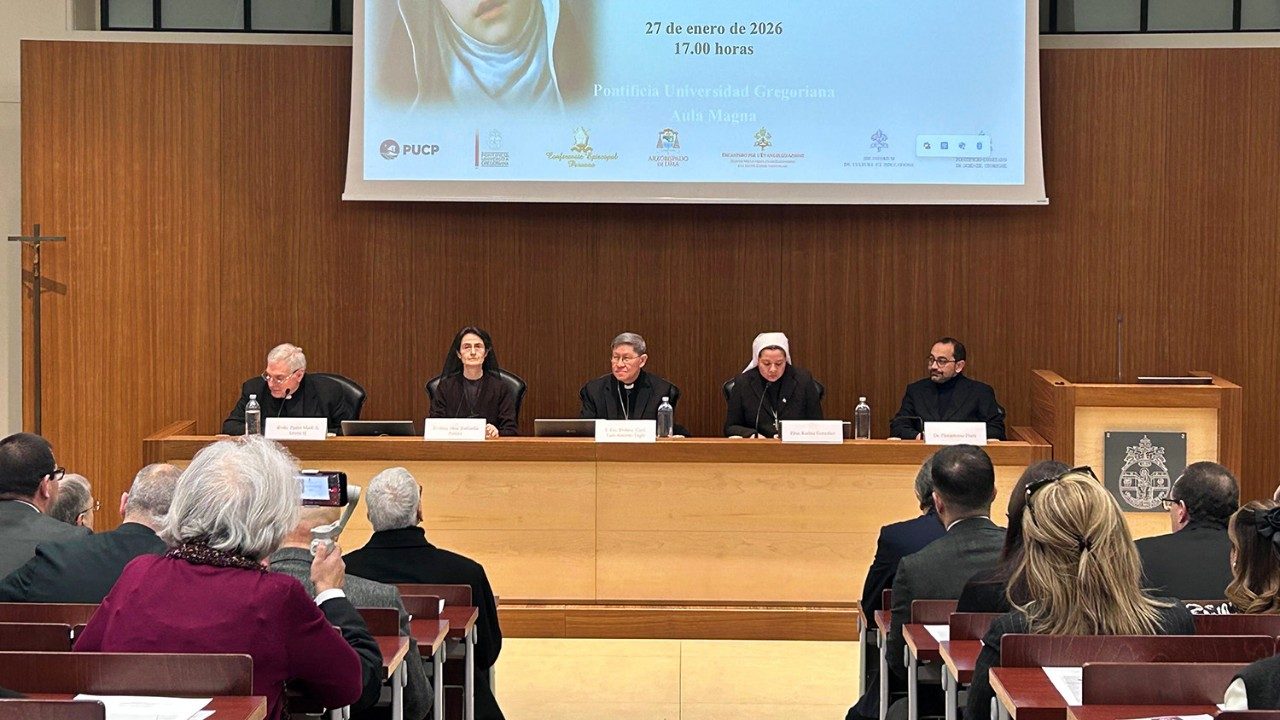
A conference at the Pontifical Gregorian University focuses on the figure of Pervuian saint, Rose of Lima, ahead of the installation of a statue of the saint on January 31 in the Vatican Gardens.
By Edoardo Giribaldi
A conference held at the Pontifical Gregorian University in Rome focused on the figure of the Pervuian saint, Rose of Lima (1586-1617). The event was organized by the Embassy of Peru to the Holy See, with the support of the Pontifical Catholic University of Peru (PUCP).
A missionary who inspires the youth
Opening the event, Cardinal Luis Antonio Gokim Tagle, pro-prefect of the Dicastery for Evangelization, offered a reflection on St. Rose, patroness of Peru and one of the patrons of the Philippines—the cardinal’s homeland.
The news of her sanctity has crossed oceans and generations, becoming a “model” and a “spiritual refuge” for people everywhere, even Southeast Asia. As the cardinal explained, one of the six façades of the Manila Cathedral is dedicated to her. He also shared a personal memory from his time serving in a parish dedicated to the saint, whose devotion spread to the Philippines through Spanish Dominican missionaries.

St. Rose of Lima
Ever since Pope Clement X canonized her in 1671, Cardinal Tagle emphasized that St. Rose remains a “perpetual missionary”. Particularly, she serves as an inspiration to today’s generation, which tends to be guided more by examples than by formal teachings. The pro-prefect expressed hope that this academic event could be a seed for a new “missionary movement.”
“A lily among thorns”
In her greeting to those present, Sister Raffaella Petrini, President of the Governatorate of Vatican City State, described St. Rose of Lima as a figure who is forever young, capable of evoking affection and empathy, spreading the charm of her “example” and “fame” across time and space.
On January 31, a statue will reflect this style of holiness when a statue of St. Rose and a Marian mosaic will be inaugurated in the Vatican Gardens in the presence of Pope Leo XIV. Made from materials entirely sourced from Peru, the works depict the moment when the saint, contemplating the Virgin of the Rosary, had an apparition of Jesus, who offered her a ring and flowers.
The symbolism of the statue, which includes an anchor and the Rosary crown, underscores St. Rose’s earthly journey and presents the “radiant and smiling” face of one who chose to follow Christ.
Bishop Carlos Enrique García Camader, President of the Peruvian Episcopal Conference, was unable to attend in person due to the Peruvian bishops’ Ad Limina visit in Rome. Rather, he sent a video message highlighting the role of St. Rose in the Church’s history and as the patroness of Latin America. He expressed hope that, like St. Rose, the “search for truth” would always be coupled with “charity and service.”

A statue depicting the saint from Lima, Peru
Fr. Mark Andrew Lewis, Rector of the Pontifical Gregorian University, connected the figure of St. Rose to Pope Francis. In 2017, during the fourth centenary of the saint’s death, the Holy Father recalled her love for creation and called her, quoting a passage from the Song of Songs, “a lily among thorns.”
The rector also noted that St. Rose is still invoked by florists and gardeners – professions she devoted much of her life to and which remain highly important in Latin America today.
Grace in daily commitment
Cardinal Carlos Castillo Mattasoglio, Archbishop of Lima and Primate of Peru, focused on the “spiritual theology” of St. Rose, noting that she centered her life on her inner dimension. He quoted a phrase that she often directed to Jesus: “My beloved spouse, help me to work.”
Daily labor became a form of grace. “The main problem,” the cardinal observed, is the opposite of this virtue, when “grace” becomes a “conquest” rather than a gift, due to a lack of the “spiritual foundation” that characterized St. Rose’s life. “Then it is no longer grace, but disgrace.”
In closing, Jorge Ponce San Román, Ambassador of Peru to the Holy See, thanked the attendees and institutions that made the event possible. He also highlighted a previous screening at the Vatican Film Library of the documentary “Una Rosa per il Mondo” (“A Rose for the World”), directed by Peruvian filmmaker Luis Enrique Cam.
The documentary is spreading the example of this saint who remains highly relevant and influential today. In a time “before the internet,” the Ambassador noted, three-quarters of Lima’s population participated in the procession of her coffin.