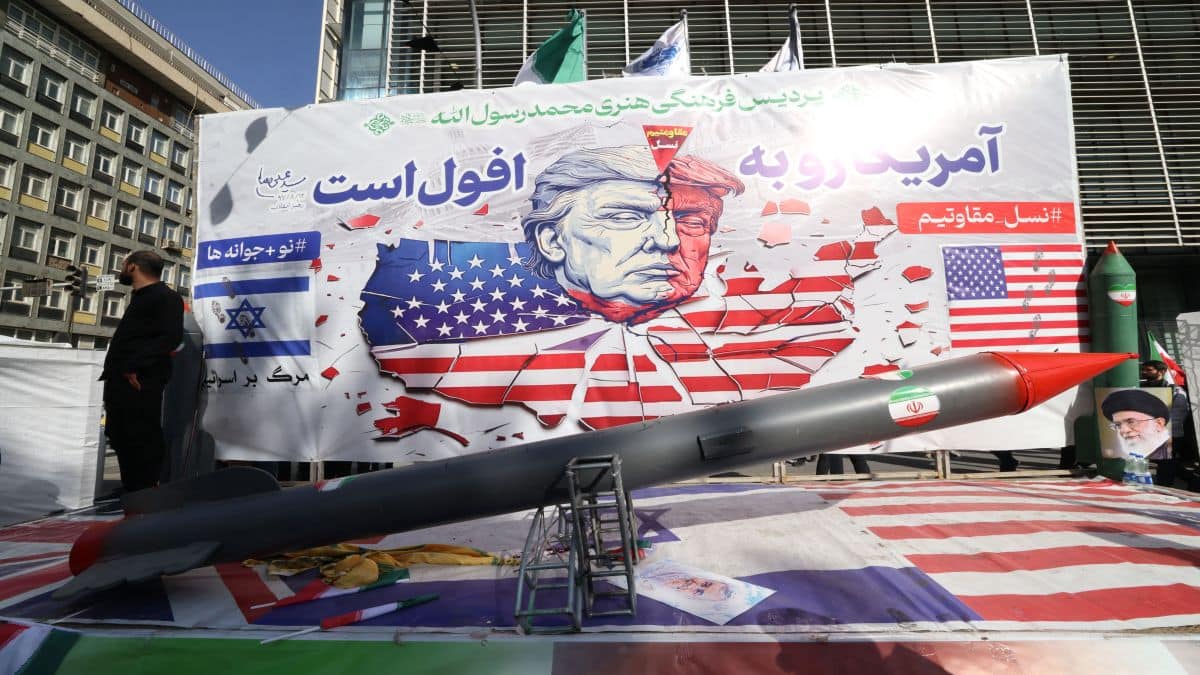
Will he, won’t he… That’s the question on everyone’s mind as Donald Trump continues to weigh his options against Iran. In another series of mixed signals, the US president on Thursday said he planned to speak to Tehran, even as America dispatched another warship and Pentagon chief Pete Hegseth saying that the military would be ready to carry out whatever the president decided.
As Trump gathered for his first Cabinet meeting of 2026, it was reported that the US president has been presented with an expanded list of potential military options against Iran aimed at doing further damage to the country’s nuclear and missile facilities or weakening Supreme Leader Ayatollah Ali Khamenei’s hold on the Islamic Republic.
According to the New York Times, the current set of options even includes the potential for American forces to carry out raids on sites inside Iran.
So, what happens if Trump does decide to launch an attack against Tehran? What would be the regime’s response? We analyse the ongoing situation and present the possible scenarios that could play out if the US president decides to go ahead with military action against Iran.
A possible US strike on Iran
Amid the
protests that swept Iran in the early weeks of January, the Trump administration warned of action if the blood of demonstrators were spilled. The US president then abruptly ruled out military action after Iranian authorities said they
cancelled hundreds of scheduled executions, and Israel and Arab nations asked the president to defer any strikes.
However, in the past few days, Trump has been indicating of a possible
military action by
deploying an ‘armada’ in the West Asia region. On Wednesday, Trump wrote on his social media site, “A massive Armada is heading to Iran. It is moving quickly, with great power, enthusiasm, and purpose. It is a larger fleet, headed by the great Aircraft Carrier Abraham Lincoln, than that sent to Venezuela. Like with Venezuela, it is, ready, willing, and able to rapidly fulfill its mission, with speed and violence, if necessary.”
“Hopefully Iran will quickly ‘come to the table’ and negotiate a fair and equitable deal — no nuclear weapons — one that is good for all parties,” he further wrote, adding, “time is running out”.
But on Thursday at the Cabinet meeting, Trump noted that he planned to speak to Iran. However, the American leader failed to provide details on the nature or timing of any dialogue or say who from Washington would lead the negotiations.
When Defence Secretary Pete Hegseth was asked about Iran, Hegseth noted, “They should not pursue nuclear capabilities. We will be prepared to deliver whatever this president expects of the War Department.”
Iran’s possible options
For nearly half a century, Iran has prepared for a war against its rival, the United States of America. And even though the Islamic Republic may not be able to match the US when it comes to military power, Tehran has a range of options to hit back, experts say, including attacking US interests and Israel, mobilising allied groups and launching economic retaliation that could trigger global turmoil.
Deploying its missiles and drones: If the US strikes and Iran chooses to respond, it could opt to deploy its vast arsenal of
missiles and drones.
The Islamic Republic is believed to have thousands of missiles and drones in its arsenal, which could cause the US some serious harm. In fact, Iran’s missile strength was visible during the 12-day war last year against Israel — Tehran launched wave after wave of ballistic missiles and drones at Israel that inflicted damage by bypassing Israel’s sophisticated air defences.
An Iranian man and a child visit an exhibition showcasing missile and drone achievements in Tehran. Iran is believed to have thousands of missiles and drones within range of US troops based in a number of countries in West Asia. File image/AFP
In fact, the US has acknowledged the threat that Iran’s missiles and drones pose to American troops. US Secretary of State Marco Rubio earlier this week noted, “We have 30 to 40,000 American troops stationed across eight or nine facilities in that region. All are within the reach of an array of thousands of Iranian one-way UAVs (drones) and Iranian (short-range) ballistic missiles that threaten our troop presence.”
Attack US bases and allies: Another option for Iran would be to direct its attacks against US forces and bases in the West Asia region or go after American allies such as Israel. As BBC reports, there are US bases and facilities dotted along the Arabian side of the Gulf, notably in Bahrain and Qatar, but Iran could also, if it chose, target some of the critical infrastructure of any nation it considered was complicit in a US attack, such as Jordan or Israel.
In fact, Iran has warned that any US strike would result in an “unprecedented” retaliation, including “at the heart of Tel Aviv.” In posts on X both in Persian and in Hebrew, Ali Shamkhani, secretary of Iran’s Supreme National Security Council, said: “A limited [US] strike is an illusion. Any military action by America, of any kind and at any level, will be considered the start of a war, and the response will be immediate, comprehensive, and unprecedented, directed at the aggressor, at the heart of Tel Aviv, and at all who support the aggressor.”
Mobilise its proxies: Over the years, Iran has built a
network of proxies across West Asia; there’s Hezbollah in Lebanon, Hamas and Islamic Jihad in the Gaza Strip, Shi’ite militias in Syria and Iraq, and the Houthis in Yemen.
Hezbollah fighters in on Beirut’s southern suburbs. File image/AFP
And they are all committed to defend Iran. Earlier, on Sunday, Abu Hussein al-Hamidawi, the commander of Kataeb Hezbollah, called on Iran’s loyalists “across the globe … to prepare for all-out war in support of the Islamic Republic.”
The problem, however, is that many of these proxies have been weakened. The Hezbollah has been significantly weakened as a result of its 13-month war with Israel. The Houthi group in Yemen has been targeted by both Israel and the US.
Laying mines in the Gulf region: Iran could mine the shipping lanes, posing a formidable threat to global shipping and oil trade.
The narrow
Strait of Hormuz between Iran and Oman is a critical chokepoint. Around 20 per cent of the world’s Liquified Natural Gas (LNG) exports and between 20-25 per cent of oil and oil byproducts pass through this strait each year. Iran has conducted exercises in rapidly deploying sea mines. If it did so, then it would inevitably impact world trade and oil prices.
Women walk on a beach in Khasab, on northern Oman’s Musandam Peninsula, overlooking the Strait of Hormuz. File image/AFP
Negotiate with Trump: It seems unlikely but if Trump chose to attack Iran, one of the options for the regime would be to hold talks and negotiate. However, Iranian officials are wary of this even now, citing the US president’s decision to withdraw from the 2015 nuclear deal and Israel’s surprise attack in June just days before the US and Iran were set to meet for another round of talks.
Moreover, Iran seems to be in mood to relent on Trump’s demands of halting domestic enrichment of nuclear fuel, handing over its stockpile of uranium, accepting limits on its ballistic-missile arsenal and abandoning its support for militias in the region.
As Danny Citrinowicz, a former Israeli intelligence officer and a senior researcher at the Tel Aviv-based Institute for National Security Studies, told the Wall Street Journal, “The supreme leader is able to do compromises, but those compromises cannot touch the basic pillars of the regime, meaning he won’t forgo a missile build-up, he won’t forgo helping proxies and he won’t forgo enrichment.”
But it seems for Iran, any choice would be the losing one. If Khamenei acceded to Trump’s demands, it would expose Tehran as a weak state. But, if the Islamic Republic chooses to respond either militarily or by choking trade routes, it could be even more damaging.
The mood is on tenterhooks, as of now.
With inputs from agencies