
New plans are underway to create a subway that would connect Jerusalem with nearby suburbs, Natan Elnatan, Chairman of the National Planning and Construction Council, revealed for the first time last week.
He made the announcement at the Jerusalem Future Plans Conference, organized by the Nadlan Center in collaboration with the Jerusalem municipality.
“Soon they’ll start planning the metro for Jerusalem,” Elnatan said, echoing the name for Tel Aviv’s massive subway project launched last year. “We are talking about an underground line that would run inside Jerusalem and connect it to Beit Shemesh and Mevaseret Zion. This is still on the drafting table in the early stages of planning, and we haven’t really started talking about it publicly yet.”
The plans are being developed for after the completion of the capital’s light rail network and optimization of transportation options.
Officials at the conference said the city continues to plan for rapid growth in the future as the rise in Jerusalem home prices exponentially outstripped the national average last year, with recent data from the Central Bureau of Statistics indicating that home prices in Jerusalem continued to soar during 2025, even as other markets stagnated.
Get The Times of Israel’s Daily Edition
by email and never miss our top stories
By signing up, you agree to the terms
In the last 12 months for which it has data, from November 2024 to November 2025, prices have risen by 9.4% in Jerusalem while declining by some 2.9% in Tel Aviv and the center of the country. Prices rose 5.4% in the north, 1.2% in the south, and 0.5% in Haifa during that period, the CBS noted.
An “unprecedented ” 8,445 permits for new housing units were issued in 2025, with about half inside buildings undergoing urban renewal projects, the city said. In addition, 142,000 square meters of offices and campuses designated for high-tech received building permits and will be built in the coming years, alongside approximately 2 million square meters of commercial and office space currently under construction throughout Jerusalem.

Jerusalem Mayor Moshe Lion at the Jerusalem Future Plans Conference, January 21, 2026. (Neo Media)
“These apartments are intended for a [financially] strong population,” Lion commented. “I don’t know anyone who is financially weak who could buy an apartment in one of the projects here.”
There is still plenty of demand in Jerusalem, and an expected influx of Jewish immigrants from Europe and the United States will ensure that housing prices in the city won’t start to fall for a long time, Elnatan added.

Natan Elnatan, Chairman of the National Planning and Construction Council, at the Jerusalem Future Plans Conference, January 21, 2026 (Zev Stub/Times of Israel)
Jerusalem Mayor Moshe Lion also commented on housing and transportation issues, saying he was optimistic about Jerusalem’s light rail network after testing began last week on part of the city’s new Green Line, the city’s second light rail route. That portion of the line, running between the International Convention Center and the Malcha neighborhood, will become fully operational in May, Lion said.
The full route of the Green Line, which was originally meant to be completed in 2025, will eventually stretch from Mount Scopus in the north of the city to the Gilo neighborhood in the south, and is expected to carry 400,000 people a day when it opens in summer 2027, significantly easing traffic in the city, even as it clogs traffic now, Lion noted.
Jerusalem’s first light rail line, known as the Red Line, is seen as highly successful, with more than 200,000 daily riders on the route from Ein Kerem to Neve Yaakov. Construction of the third line, known as the Blue Line, which will connect the Ramot neighborhood to Gilo, began this year and is expected to be completed in 2030.
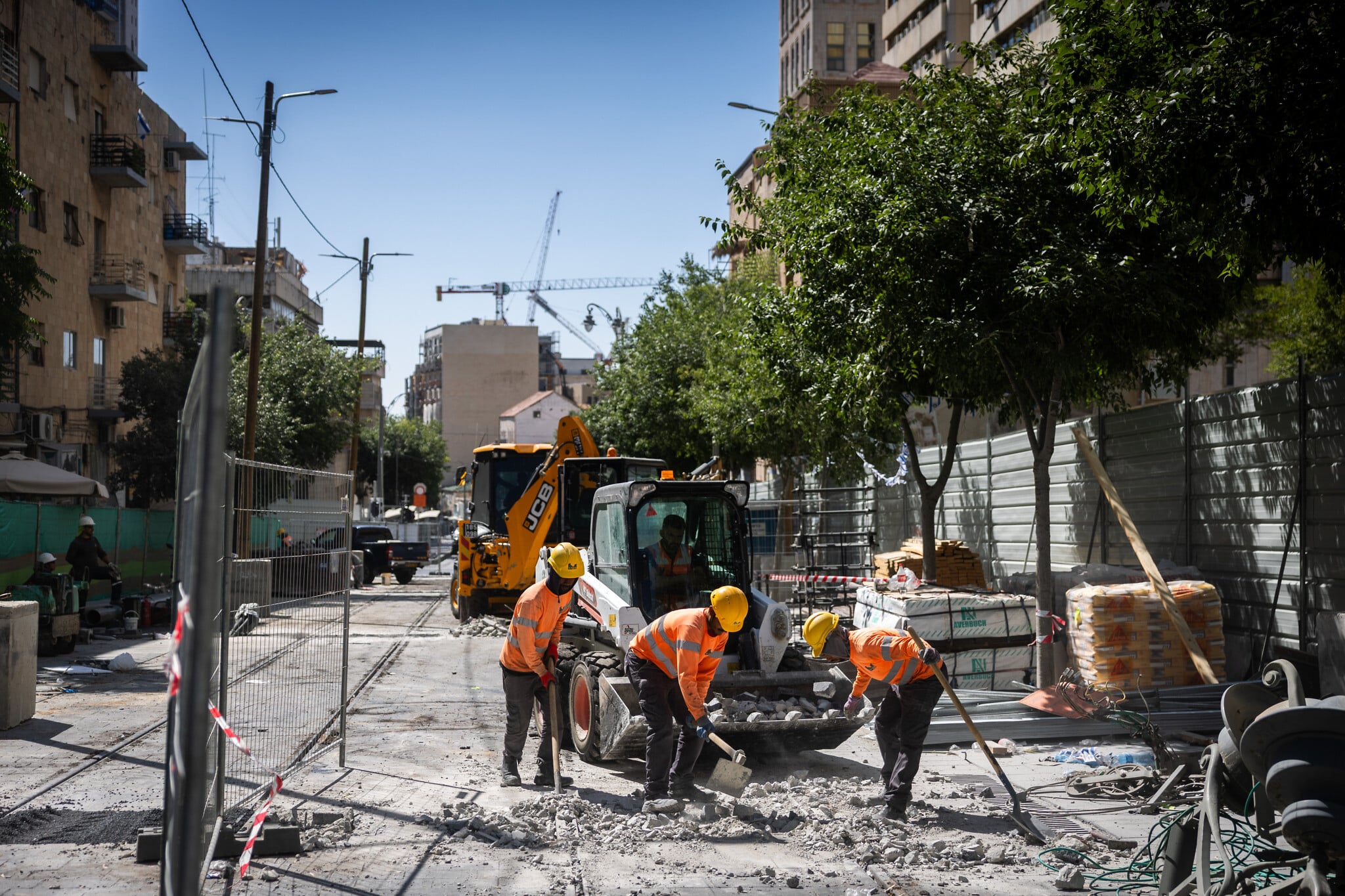
Work on the Jerusalem Light Rail in central Jerusalem, May 30, 2025. (Chaim Goldberg/Flash90)
“This is a transportation revolution in the city,” Lion said. He has previously said that Jerusalem will be the first city in Israel to “be done with traffic jams,” as it develops the transportation infrastructure to support the city’s rapid growth. As in much of the country, Jerusalem is plagued by congestion nearly around the clock.
Lion has said in the past that Jerusalem may implement a congestion charge for cars driving into the capital once the transportation network is complete.
Green spaces can stay green
As the city announced that it had issued a record number of building permits for homes in 2025, Lion also revealed that he had found a solution to a controversial building plan that would harm the natural green spaces in the Reches Lavan site in the southwestern part of the city.
Lion said he was coerced when he took office to commit to building approximately 5,200 housing units in Reches Lavan, a popular, pastoral site of agricultural terraces and springs near the Jerusalem Zoo and the southwest neighborhoods, despite the area’s important environmental benefits to the city.

Reches Lavan, or White Ridge, west of Jerusalem. (Dov Greenblat, Society for the Protection of Nature in Israel)
Now, however, that plan has changed. “We have enough land for building, and there is no reason to destroy such a beautiful natural place, so I’ve canceled that plan,” he said. Instead, a new plan will allow for the creation of 6,200 new apartments in the area without cutting down trees or blocking water access, he stated, without providing further details.
“It’s a beautiful land with springs and open spaces,” Lion said. “Green spaces in Jerusalem are as essential as the sea for Tel Aviv.”
Meanwhile, Jerusalem continues to build toward the heavens, with some 500 towers of 18 stories or more in different phases of planning or construction. While the urban congestion they create is a sensitive issue, even the city’s ultra-Orthodox communities, which traditionally prefer low-rise apartments, will eventually accept them, Elnatan said.
“In Jerusalem, they are building 12-13 floors for the Haredi population with the community’s consent, unlike in Bnei Brak,” He said. “Within 20 years, everyone will have them, and rabbinic rulings allowing Shabbat elevators will be broadly accepted.”

An artist’s rendering of the Jerusalem Gateway project to build new residential and commercial districts at the western entrance to the city. (Photo by Eden, the Jerusalem Municipality’s economic development company, via The Israel Land Authority)
Developers will soon be able get building plans approved much more quickly with new self-licensing regulations, Elnatan said.
“Today, there are 300 architects licensed to issue permits throughout the country [through recent reforms,] and I hope that this will also be the case here,” Elnatan said. “For Jerusalem, this will be a world-changing reform.”
However, city engineer Yoel Even said he was “a little worried” about self-licensing.

Yoel Even, Jerusalem city engineer. (Sharon Gabbay)
“We would like to see that the developers understand what we want, and that they understand that dialogue with us is important,” he said. “Self-licensing works well when there is a well-concluded urban development plan and when everything is clear in the permit stage.”
Even said Jerusalem’s urban renewal, transportation, and employment growth are all interrelated.
“Jerusalem is the only city that puts public infrastructure before housing units,” he said. “There is a direct and unambiguous connection between transportation and the rate of growth in Jerusalem. Wherever there is a light rail line, we see high demand along the route. The light rail and high-speed rail connect employment, the historic city, green areas, and educational institutions.”
Providing adequate housing and transportation will strengthen Jerusalem’s strong foundations in academia, research hospitals, and cultural institutions, said Tzachi Namir, CEO of the Jerusalem Development Authority.
“Now that these are present together, this is perfect ground for companies to grow here,” he said.