By Hollie Younger / Staff writer, with CNA
The US Senate Foreign Relations Committee yesterday advanced three Taiwan-related bills, although the Taiwan Symbols of Sovereignty Act was tabled for later discussion.
The act would allow Taiwanese diplomats and military personnel to display symbols of sovereignty such as flags and military insignia during official visits to the US, lifting restrictions dating back to the administration of former US president Barack Obama.
The bill was introduced in October last year by Republican Senator Ted Cruz, who yesterday asked the Senate to imagine meeting with French diplomats and requesting that they not use the French flag.
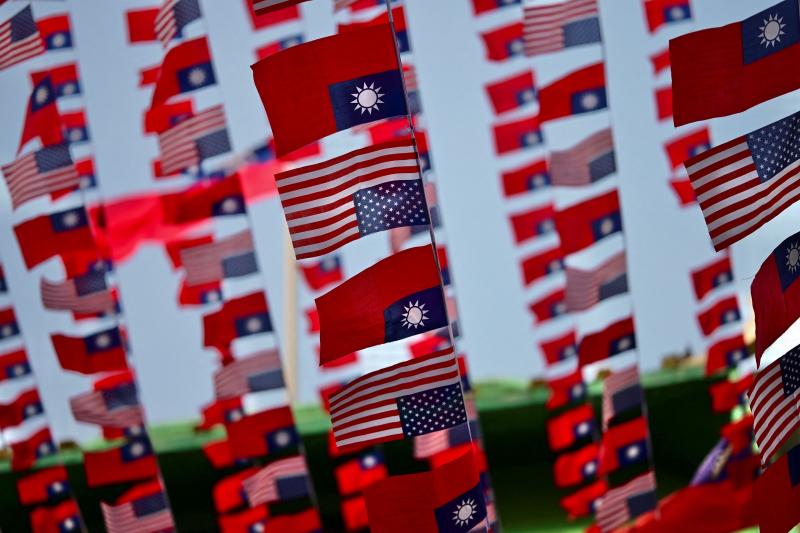
Photo: Reuters
Senators tabled the act over fears of angering China, saying that Taiwan had never requested a change in policy.
Under the proposal, the US secretaries of state and defense would be required to allow members of the Taiwanese armed forces and government representatives, or the Taipei Economic and Cultural Representative Office in the US (TECRO), to display symbols of sovereignty while on official business in the US.
The three measures passed were the Taiwan Energy Security and Anti-Embargo Act, the Taiwan Undersea Cable Resilience Initiative Act and the Taiwan Allies Fund Act.
The Taiwan Energy Security and Anti-Embargo Act would authorize expanded US exports of liquefied natural gas and encourage use of nuclear energy to alleviate Taiwan’s vulnerability to coercion by the Chinese Communist Party (CCP).
The Taiwan Undersea Cable Resilience Initiative Act would coordinate navy cooperation with Taiwan’s Coast Guard Administration, impose sanctions on those who damage undersea cables and provide intelligence warnings.
Finally, the Taiwan Allies Fund Act would authorize the executive branch to establish a fund totaling US$120 million over three years to assist Taiwan’s diplomatic allies and unofficial partners facing pressure from the CCP.
The three bills would now be passed to the full Senate for consideration before referral to the House of Representatives and finally signed into law by the president if passed.
As for the Taiwan Symbols of Sovereignty Act, Democratic Senator Tammy Duckworth said that the measure was not supported by the US Department of State, to which Cruz said that he had not received such information, but nevertheless the Senate does not answer to the Department of State.
Democratic Senator Jeff Merkley also questioned to what extent the act would assist Taiwan in resisting Chinese coercion and whether the move would anger China.
Democratic Senator Jeanne Shaheen said that — as much as she recognizes the importance of symbolism — Taiwan has not requested the US make such a move.
Republican Senator Bill Hagerty said he hoped that the bill would not fail in its final review stages, while Democratic Senator Brian Schatz suggested delaying the vote until a consensus is reached.
Republican Senator Rand Paul said he would vote against the bill unless Taiwan gives a statement on the issue.
Cruz agreed to delay the vote if it meant there was a greater possibility of the bill being passed.
Republican Senator Steve Daines said that a consensus should be reached before upcoming summits between US President Donald Trump and Chinese President Xi Jinping (習近平).
In the committee, even one member can block a bill and delay discussions until the next hearing.
A date has not yet been set to continue discussions of the Taiwan Symbols of Sovereignty Act.
TECRO said today in a news release that its goal has always been to strengthen US-Taiwan relations, and thanked the Senate for passing legislation that reflects its steadfast support for Taiwan.
It added that it would continue to maintain close communication with the US and build on the already strong foundation to deepen the partnership between the two countries.