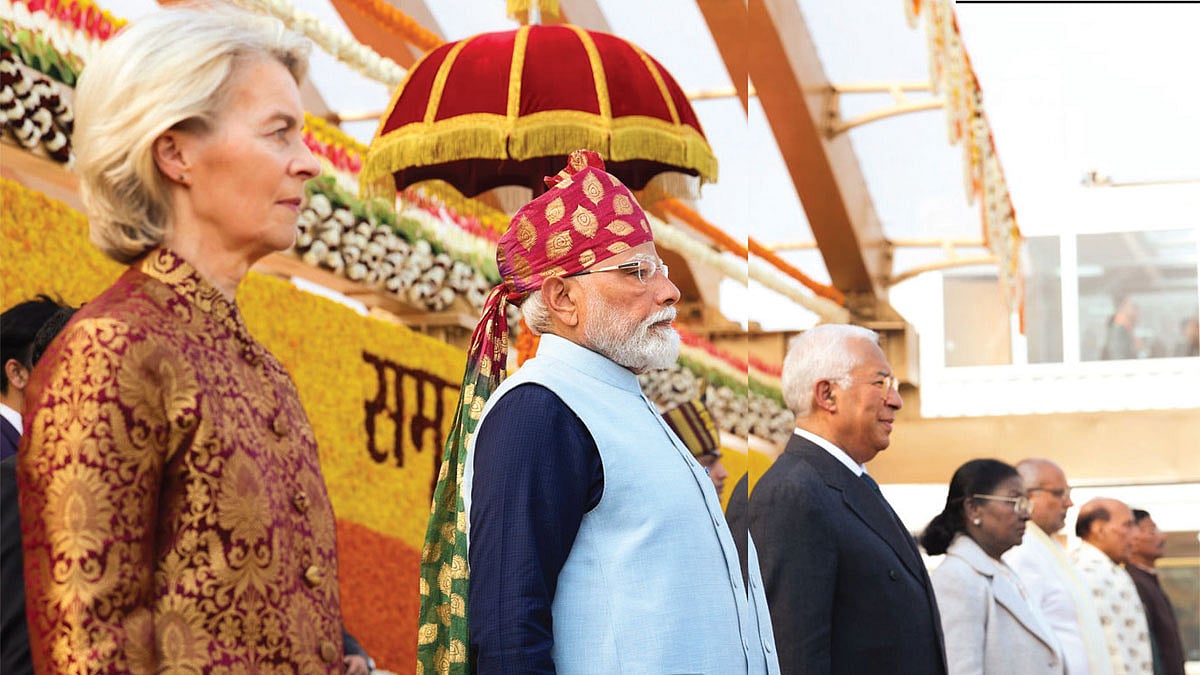
With the backing of the political executives, solutions were found to contentious matters like the EU’s Carbon Border Adjustment Mechanism (CBAM) by working out commitments towards technical dialogues and a pledge that any concession extended to other parties would apply to the India FTA as well. Indian negotiators are confident that the final outcome will not impact India’s interests and point out that European businesses are also finding the new carbon regime onerous. “They feel the rules are reducing their competitiveness,” said a source. Similarly, the discussions on Indian steel are likely to result in arrangements that will ensure minimal impact on exports at the current level. Both sides have reposed faith in mechanisms provided by the FTA to address complaints or conflicts of views that impact market access and hinder the deal’s operationalisation.
As the larger dimensions of the deal become apparent, the terms on which India is ready to negotiate and conclude trade deals have become clear and have a bearing on the stalemated India-US Bilateral Trade Agreement. US trade representative Jamieson Greer, in his initial reaction to the India-EU FTA, said that India seemed to have come out on top. He complained that Europe was “doubling down” on globalisation while the US was trying to fix problems at home. Indian officials maintained that discussions with the US were continuing on a “cordial” note and a deal would be inked as soon as a fair balance of interests was achieved and green-lighted by the respective leaderships. It does seem that sealing deals with major developed economies will strengthen the Modi government’s determination on keeping certain sectors out of trade deals even as officials point out that the Trump tariffs are hurting less than anticipated. Meanwhile, the access provided by the EU FTA is a boost for precisely some sectors like marine food, leather goods, and textiles hit by the US tariffs. This does the National Democratic Alliance (NDA) no harm ahead of state elections in Tamil Nadu where these industries have a major imprint.
The FTA with the EU has a strong inward dimension even as it aims to open EU markets to Indian goods and services. Indian businesses will need to meet quality specifications to access new markets and this requires abandoning over time a dependence on import-duty protections and becoming competitive. Modi’s January 25 radio talk Mann ki Baat began with an exhortation. “Today through my talk I want to say to youths associated with industry and startups that India’s economy is growing rapidly and the world’s eyes are on India… all of us share a big responsibility to concentrate on quality. Things will happen, things will get by… this era is over. Let’s give priority to quality. Our mantra this year should be quality, quality, and only quality,” he said. This was not the first time Modi had made the point, but the reference was not casual.
As an Indian official put it, the benefits of the deal and those signed with other nations will require Indian enterprises to abandon a play safe mentality. In 2025 decisions like the reduction of Goods and Services Tax (GST) rates and slabs, implementation of the labour codes, and opening nuclear energy to private and foreign participation helped beat any downturn in consumer sentiment that might well have happened after the Trump tariffs.
The India-EU FTA can be expected to help maintain an upbeat mood and a sense of anticipation about the Indian economy. The FTAs concluded with the UK and with the European Free Trade Association (EFTA, comprising Iceland, Liechtenstein, Norway, and Switzerland) now potentially provide access to the entire European continent. The Modi government will be busy hereafter completing trade agreements with Chile and revising previous deals with Japan and ASEAN. The FTAs signed in recent months will go through a process of legal scrubbing but their rollout on the ground may not take too long. In the case of the EU FTA, there is a role of bilateral diplomacy in quickening ratification and India has improved ties with the 27-nation bloc. For example, events such as the India-Nordic Summit regularly bring together India and Denmark, Iceland, Sweden, Finland, and Norway. The India-EU FTA is a crowning moment as the bold political moves have opened the path for India’s rise to the global high table.