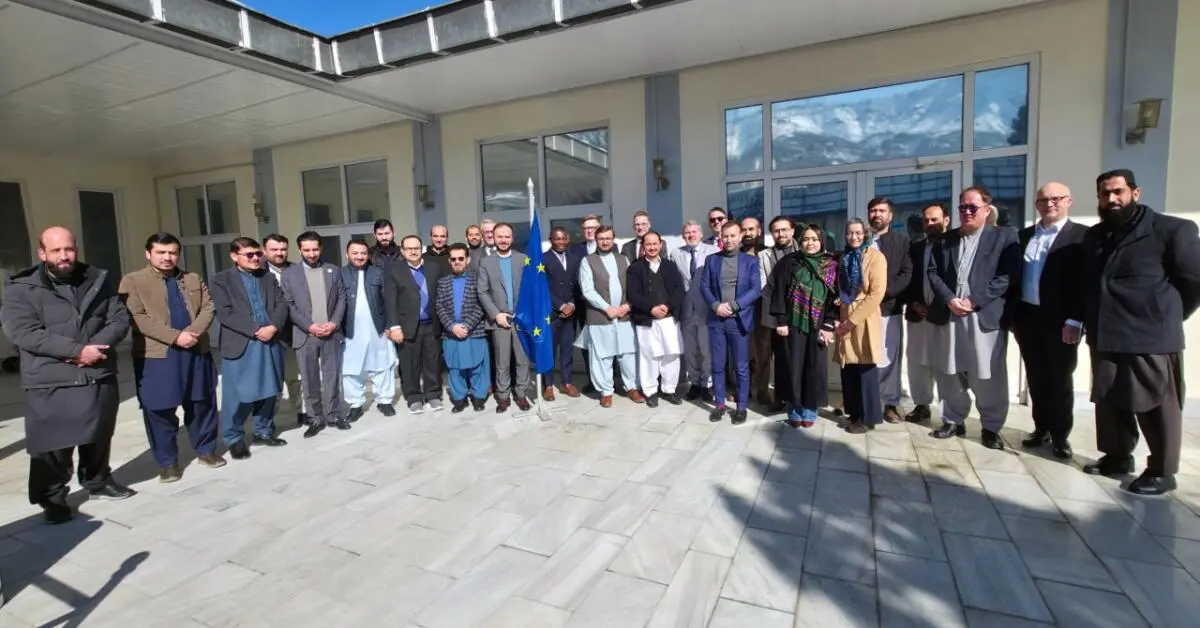
KABUL, AFGHANISTAN – The European Union has announced a combined €31 million investment aimed at supporting Afghanistan’s fragile economy and health sector, as the country continues to face deep humanitarian and development challenges under Taliban rule.
According to the EU Delegation to Afghanistan, €15 million has been allocated to support small, micro, and medium-sized enterprises (MSMEs) by improving their access to financial resources. The funding is being implemented in partnership with the Afghanistan Credit Guarantee Foundation (ACGF) through the second phase of a program designed to help businesses sustain livelihoods across the country.
The initiative builds on the first phase of the program, which was successfully completed in 2025. During that phase, more than 55,000 jobs were supported and €68 million in financing was mobilized, according to the EU.
The second phase places special emphasizes on green and climate finance, returnees, agricultural workers, and women-led businesses, particularly in underserved and economically marginalized regions. The EU says the program is intended to strengthen economic resilience, encourage innovation, and promote inclusive growth in a country where unemployment and poverty remain widespread.
Erik Beum, Head of Cooperation at the EU Delegation to Afghanistan, said the bloc remains committed to economic growth and job creation in the country, stressing the importance of affordable and sustainable access to finance for vulnerable communities.
Alongside economic support, the European Union has also invested €16 million in Afghanistan’s health sector, contributing to the establishment of a cancer diagnosis and treatment hospital in Kabul. The facility, which also addresses non-communicable diseases (NCDs), was inaugurated on Thursday in the presence of Taliban officials, EU representatives, and the World Health Organization (WHO).
In a statement posted on X (formerly Twitter), the EU said the center is the first of its kind in Afghanistan, focusing on cancer prevention, diagnosis, and treatment—areas that have long been neglected due to limited infrastructure and resources.
The EU Delegation highlighted its support for Afghanistan’s healthcare workers, both women and men, describing their expertise and dedication as vital to saving lives and strengthening the country’s weakened health system.
Abdul Wali Haqqani, Deputy Minister for Health Services at the Taliban-run Ministry of Public Health, described the opening of the cancer hospital as a major development for the health sector. He noted that for years, Afghan patients were forced to travel abroad for cancer diagnosis and treatment due to the lack of domestic facilities.
Medical travel outside Afghanistan has placed a heavy financial burden on families, while visa restrictions and high treatment costs have made access to care increasingly difficult for many patients.
Afghanistan’s healthcare system has struggled for decades due to conflict, sanctions, and reduced international engagement. Since the Taliban returned to power in August 2021, international aid has largely shifted from development to humanitarian assistance, with limited funding for long-term infrastructure.
The EU’s latest investments signal continued engagement in critical sectors, despite political constraints, focusing on livelihoods, public health, and support for women and vulnerable populations.