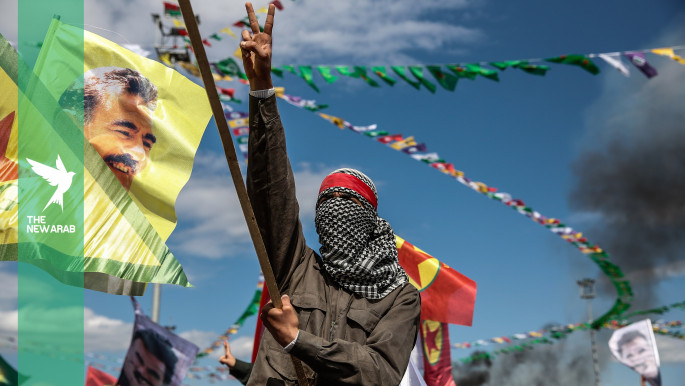
Urog denied that the Kurdistan Workers’ Party (PKK) is fighting alongside the Syrian Democratic Forces (SDF), describing claims that PKK members lead combat within the SDF as “pure fabrication”. [Getty]
The co-chair of Turkey’s Kurdish Democratic Party (DEM), Tulay Hatim Oglari Urog, told The New Arab during an interview that the Arab world could take meaningful steps to change its perception of Kurds and build a shared life between the two historic peoples.
She said Turkey’s stance on attacks against Kurds in Syria would affect the ongoing peace process, and if Ankara used its influence over the Syrian Interim Government to develop policies that protect Kurds and guarantee their constitutional rights, millions of Kurds in Turkey would welcome it, and the peace process would gain momentum.
Urog also denied that the Kurdistan Workers’ Party (PKK) is fighting alongside the Syrian Democratic Forces (SDF), describing claims that PKK members lead combat within the SDF as “pure fabrication”. She said some Syrian Kurds had previously joined the PKK, but later left to join the SDF during the Syrian conflict.
Tulay Hatim Oglari Urog was born in 1977 in Samandag, Hatay, near the Syrian border. She studied economics at Anadolu University and became interested in politics in high school. She has worked to revive the Arabic language through projects and founded a workshop for Arab theatre and music in 1995.
Furthermore, she helped found the Arab Peoples Research Institute in 2015, the Amargi Women’s Academy in 2000, and the Women’s Work Complex in 2007. Elected to Turkey’s 27th and 28th parliaments, she represents Adana, serves on the Foreign Affairs Committee, and co-chairs the Democratic Party with Tunger Bekirhan.
What follows is an edited version of the interview:
You and your party, along with PKK affiliates, have repeatedly warned that military developments in Syria between the SDF and the government could negatively affect the Kurdish peace process in Turkey. Could PKK leader Abdullah Ocalan and his party reconsider disarmament or dissolution if Syria’s events take a more violent turn?
Certainly, Turkey’s stance on attacks against Kurds in Syria will affect the peace process. Millions of people long for peace and have been working tirelessly since the start of this phase. It is natural to take legitimate democratic measures against any deliberate attempts to undermine it.
The logic of “Kurds are brothers in Turkey but enemies across the border” is unacceptable. If Turkey leverages its influence on the Syrian Interim Government to craft policies that protect Kurds and guarantee their constitutional rights, millions of Kurds in Turkey will be pleased, and the peace process will gain momentum.
If Turkey’s peace process advances toward democracy, it will positively influence political developments and the climate in Syria. Ocalan and the PKK have repeatedly stated that disarmament and party dissolution are strategic, not tactical or temporary, matters. Both Ocalan and the party have issued numerous warnings to preserve this phase, and their concrete steps so far demonstrate their intentions, which, we hope, will be considered.
Have you discussed Syrian developments related to the SDF with Ocalan during your visits to him in prison? Did he express concern over the possible collapse of the Turkish-Kurdish peace process due to Syrian events?
We were with Ocalan on 27 January. His call for PKK dissolution and disarmament did not directly address Syria’s existing structures but referred indirectly and, in principle, suggesting solutions for Syria through democratic negotiations. Ocalan’s ideas and leadership hold significant influence among Kurds in northeastern Syria, and his proposals could help greatly to resolve the Syrian crisis.
There is an even graver scenario than the potential collapse of peace: forces are working toward a Kurdish-Arab war. During our recent visit, officials from the Autonomous Administration said they withdrew quickly from areas such as Raqqa and Tabqa to prevent this dangerous scenario, where the risks were severe. Syria has never experienced a Kurdish-Arab war, but conditions were being prepared.
Kurds reject both a Kurdish-Arab war in Syria and a Turkish-Kurdish conflict in Turkey. This scenario, pitting Kurds and Arabs against each other, must never happen, as it would be disastrous for the Middle East. For Ocalan, the historical dimension of Turkish-Kurdish relations is central and underpins nearly all his statements over the past two years. Understanding this history is essential to grasping the present.
The PKK is accused of sending fighters to support the SDF against the Syrian government. Based on your knowledge of the party and its leadership, as an intermediary with Turkey, can you confirm or deny this?
The idea that PKK members lead combat within the SDF is entirely fabricated. Some Syrian Kurds had previously joined the PKK, but later left to join the SDF during the Syrian civil war.
Moreover, the PKK has repeatedly stated that it has dissolved itself, is undergoing transformation, and has no links to Rojava (Also known as Ayn al-Arab) or Syria. There is manipulation against Kurds in Rojava and the SDF, attempting to criminalise their struggle. All SDF factions fought ISIS and defended Kurdish rights.
The Syrian government also accuses the PKK of coordinating with former regime figures to support the SDF militarily. Do you have information from SDF leadership on this?
At the DEM Party, it is neither appropriate nor correct for us to receive information on such military matters. We follow discussions through media sources. This appears to be propaganda aimed at influencing public opinion and justifying military operations in Rojava. There may be ideological proximity between the SDF and PKK, but both organisations have repeatedly affirmed their independence.
What obstacles hindered the implementation of the integration agreement between the Syrian government and the SDF amid reports of divisions within SDF decision-making? Did internal currents in the SDF affect this process?
The primary responsibility for the non-implementation of the 10 March 2025 agreement lies with the Damascus government, whose main motive was to attack Kurdish areas when the opportunity arose.
I visited northeastern Syria on 21 January this year, 2026, when attacks were at their peak. Officials from the Autonomous Administration reported that an agreement was reached in Damascus on 4 January between the SDF and the Damascus authorities, with the signing to follow.
However, temporary government officials delayed the signing, and on 6 January, attacks began on Kurdish neighbourhoods in Aleppo. Political calculations and internal decisions in Damascus must be considered. The government withdrew from negotiations before attacking Aleppo.
Regional Kurdish intermediaries, such as Kurdistan Democratic Party leader Masoud Barzani, mediated the Damascus–SDF crisis. Did your party play a role? Did you contribute to mediation between the sides, or is it entirely left to the Americans, represented by U.S. envoy Tom Barrett and Barzani?
Barzani’s active diplomatic efforts, his statements, and the Kurdish uprising in Iraq’s Kurdistan Region were key in preventing attacks. Kurds, their allies, rebels, and the international community, particularly in Turkey and beyond, mobilised to counterattacks on northeastern Syria. The international community, and especially Kurdish grassroots diplomacy, played a crucial role in largely preventing attacks and initiating negotiations between Damascus and the SDF.
Our party also participated in multifaceted efforts throughout this process. Immediately after the Aleppo offensive began, we formed a crisis management team, demonstrated democratic responses, and held intensive meetings with political parties in Turkey. We also conducted extensive diplomatic discussions regarding Rojava and participated directly or indirectly in these operations. We visited the Rojava region but did not participate directly in meetings in Erbil.
Our proposals and positions are public, and we actively encourage them. The framework we follow is clear: it operates within peace diplomacy. We have carried out official and public diplomatic efforts worldwide, particularly in Europe, to draw attention to the humanitarian crisis caused by ongoing factional attacks despite the ceasefire.
We gathered thousands of tonnes of food and medical aid, but no border crossings allow us to deliver this assistance. We demand the urgent reopening of the Murshed Binar and Nusaybin crossings between Turkey and Syria. Furthermore, we are in close contact with government officials, but no agreement has yet been reached. A humanitarian corridor from Turkey must be opened urgently. Our efforts and activities within Turkey continue in parallel.
Given developments in Syria and your role in Turkey’s peace process, will you engage with the Syrian government to accelerate the integration agreement with the SDF?
Politics is a space for dialogue. We are open to discussions that contribute to negotiations in Syria. We will meet anyone who recognises the rights of people in Syria—Kurds, Arabs, Turkmen, Assyrians, Alawis, Druze, and Christians—within a democratic and secular framework. If conditions allow, we will meet with the Syrian government.
Since Tom Barrett also serves as the US ambassador to Turkey, has your party met with him since the outbreak of violence between Damascus and the SDF? Did he inform you in advance that Washington considers the SDF’s functional role, fighting ISIS, to be over, as he announced a few days ago?
We have held meetings with US representatives at various levels, but have not yet communicated directly with Barrett. We hope that any meeting held with him soon will yield results beneficial to all parties. We followed the media coverage in which he stated that the SDF’s functional role—fighting ISIS—has ended.
These forces are indeed open to integration into a system that guarantees the rights of Kurds and all other communities living in Syria under its laws. Under such integration, the SDF would cease to exist, as its leaders have repeatedly confirmed.
However, Barrett’s statement, made at a time when attacks and massacres are at their peak, is unacceptable. It demonstrates a lack of understanding of both the political and social realities. We hope this statement is not turned into policy, as it would be a regrettable approach that would exacerbate problems rather than solve them. The reality of the Middle East must be considered comprehensively, and a solution model must exist that guarantees the rights of Kurds and their laws in northeastern Syria.
The threat of ISIS also remains. It should not be forgotten that the forces strengthened during attempts to weaken the Kurdish population and administration in Rojava are allied with Hayat Tahrir al-Sham and ISIS. ISIS itself has been strengthened by flawed policies pursued in Syria. It poses a grave threat, not only to Syria but also to countries in the region, Europe, the United States, and the world. Everyone must act with this awareness in mind.
Before Kurdish events escalated in Syria, the peace process seemed to progress slowly. What is the status of proposed laws?
The parliamentary committee on the peace process held a historic meeting with Ocalan, consulting academics, civil society, and war victims. The committee is preparing a report, expected to be completed before the end of January, that includes concrete legal proposals. Laws and regulations should be enacted immediately. Priority includes a law addressing the PKK, ending the party and its consequences, which would be a significant step.
Kurds have been denied fundamental rights for a century. Language and cultural freedoms must be protected, and equal citizenship should be defined to include all communities and faiths. Local governments need to be empowered, trusteeships in municipalities abolished, and local administrations run by elected, rather than appointed, officials.
Thousands remain imprisoned for their political views, including sick detainees, journalists, academics, and elected officials, punished for exercising their rights to assembly and free expression. It is time to release these prisoners and end the isolation imposed on Ocalan, who has been held for 27 years. He must be given hope and the conditions to work and communicate freely.
Turkey and the wider Middle East need Ocalan’s progressive ideas. Above all, negotiations cannot continue under terms dictated by only one side.
Have you considered alliances for Turkey’s 2028 presidential elections? Are you already preparing to join an opposition front against the Justice and Development Party, as you did in the previous election, or will your decisions depend on developments in the Turkish-Kurdish peace process?
It is too early to discuss elections in Turkey. No elections are currently on our agenda.
The parliamentary committee is expected to complete its work soon. Do you think its role has been positive? Will it provide a framework acceptable to the Turkish and Kurdish public in Turkey for adopting the committee’s proposals? What are the main elements of this framework?
I believe the committee has played a highly positive role, providing valuable findings and statements, which helped clarify the nature of the problems and potential solutions. The committee’s mandate, and our expectations of it, include proposing legal guarantees to parliament on disarmament, democracy, and freedoms. This is its role. While we recognise that the committee cannot resolve all issues arising from the Kurdish question, our work ensures these proposals are put forward. We will observe in practice whether the committee operates within this framework.
Finally, I would add the following: the Kurdish people, particularly in Syria, but also in Turkey, Iraq, and Iran, value living under democratic principles with equal citizenship. No historic community in this region should be treated unfairly. Kurds seek to live in Syria alongside Arabs, Turkmen, Alawis, and Druze on a legal and equal basis. The Arab world can also take meaningful steps to change its perception of Kurds and build a shared life between the two historic peoples. Such steps would contribute significantly to achieving peace and democracy in a region long plagued by tragedy.