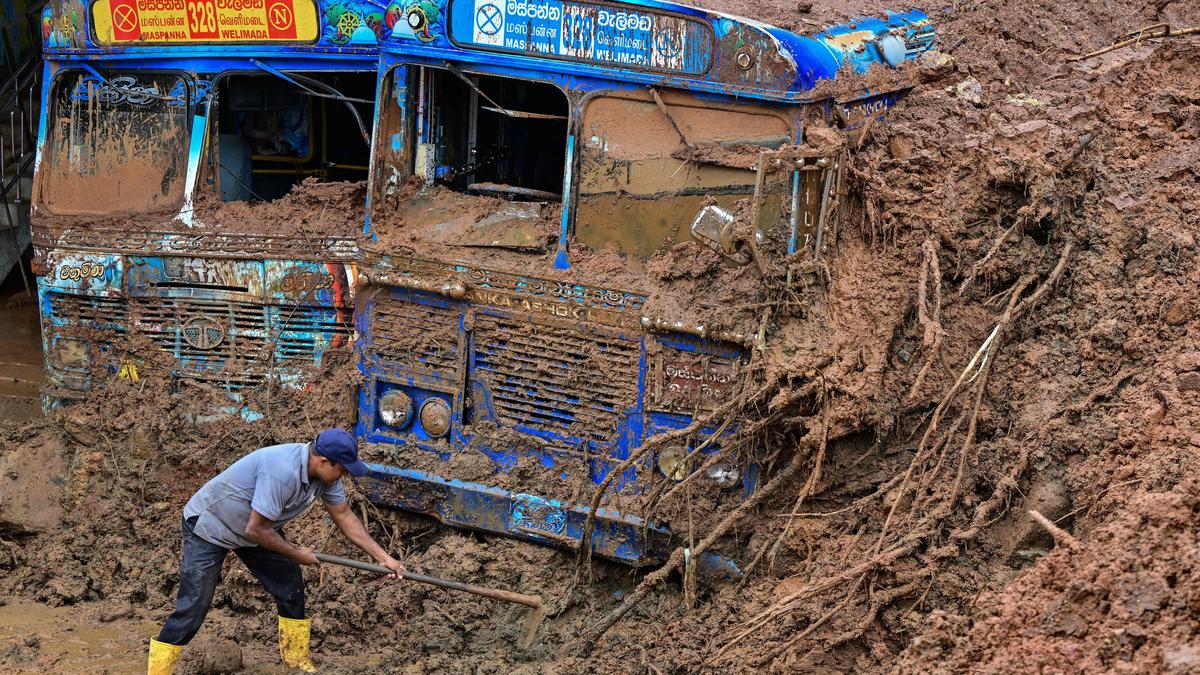

A worker removes mud accumulated around buses near a landslide-affected area in the aftermath of Cyclone Ditwah, in Maspanna on December 13, 2025.
| Photo Credit: AFP
Sri Lanka will press ahead with the ongoing International Monetary Fund (IMF) programme — criticised by sections for imposing painful austerity on ordinary people — despite the devastation caused by Cyclone Ditwah that struck the island nation in late November 2025.
Following President Anura Kumara Dissanayake’s meeting with a visiting IMF delegation earlier this week, his office said that the Fund pointed to Sri Lanka moving “in the right economic direction despite facing a severe disaster situation” and stated that there would be “no changes to the agreement”, on the Extended Fund Facility (EFF) programme.

Cyclone Ditwah is the worst climate shock event the island has witnessed since the Indian Ocean tsunami of 2004. The torrential rains, record flooding, and multiple landslides have claimed at least 649 lives until now, while as many as 173 persons remain missing for two months. With huge losses to public infrastructure, homes, and livelihoods, the devastation is widely seen as a huge setback for a country getting out of a grave economic crisis that spiralled in 2022.
Also read | Cyclone Ditwah damage in Sri Lanka | The long path from wreckage to recovery
Early that year, then-President Gotabaya Rajapaksa sought the IMF’s help to cope with a serious balance of payments problem, as his government ran out of dollars to import essential items, including food grains. Forced to contend with long power cuts, food and medicine shortages, citizens took to the streets demanding that Mr. Gotabaya quit office. In April that year, his government announced Sri Lanka’s first sovereign default. In March 2023, the IMF approved $2.9 billion for Sri Lanka, then helmed by President Ranil Wickremesinghe, who replaced Mr. Gotabaya after citizens unseated him.

President Dissanayake, who was elected to office in September 2024, promised not to derail the IMF programme aimed at achieving macroeconomic stability, even as some in Sri Lanka flagged crushing austerity measures linked to the programme, including a drastic drop in value of ordinary people’s pension funds, tax hikes, rise in fuel and electricity prices, and a high cost of living that persists as a consequence.
In the wake of the cyclone, over 70 civil society groups and activists across Sri Lanka called for the renegotiation of the IMF deal, accusing the Dissanayake government of becoming a “prisoner” of the ongoing IMF programme. “The IMF controlling government spending not only restricts the ability of the government to respond to the ongoing humanitarian crisis, but severely impedes investment in infrastructure, recuperating livelihoods, and adapting to further climate change impacts,” they contended. A group of globally renowned economists, including Nobel laureate Joseph Stiglitz, echoed this demand and called for a halt to Sri Lanka’s debt repayments.
In his recent interaction with the Fund’s representatives, President Dissanayake noted that the disaster had most severely affected poor rural communities, with rural infrastructure and livelihoods suffering extensive damage. A total of LKR 500 billion had been allocated to protect rural livelihoods and restore income-generating activities, he further told them, emphasising that this measure did not “in anyway signify a departure from proper financial management or fiscal responsibility.” Both the IMF and the Sri Lankan government agreed to continue implementing the Extended Fund Facility programme without making any changes to the existing agreement, the statement issued by the Presidential Media Division said.
Meanwhile, following a request from Colombo, the IMF’s Executive Board also approved around $200 million under its Rapid Financing Instrument (RFI) facility to “help address urgent balance-of-payments and fiscal pressures” arising from the catastrophic Cyclone Ditwah.
Published – January 30, 2026 10:44 pm IST