WINNIPEG, MB, Jan. 30, 2026 /CNW/ – Our global landscape is rapidly changing, leaving economies, businesses, and workers under a cloud of uncertainty. In response, Canada’s new government is focused on what we can control: building a stronger economy to make life more affordable for Canadians. Affordability pressures—especially those related to food—require immediate support for Canadians.

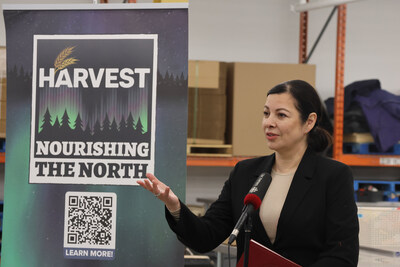
The Honourable Rebecca Chartrand, Minister of Northern and Arctic Affairs, makes an announcement at Harvest Manitoba, highlighting the new Canada Groceries and Essentials Benefit. (CNW Group/Crown-Indigenous Relations and Northern Affairs Canada)
Today in Winnipeg, the Minister for Northern and Arctic Affairs, the Honourable Rebecca Chartrand, visited Harvest Manitoba and their Asihcikan project to highlight how the Government of Canada is helping to put more money back in the pockets of those most affected by the rising price of food, and to tackle food insecurity across a range of fronts.
As announced by the Prime Minister on January 26, the Government of Canada is proposing a new Canada Groceries and Essentials Benefit to help more than 12 million low- and modest-income Canadians afford everyday necessities. This includes approximately 475,000 Manitobans. The benefit is expected to begin in spring 2026, pending Royal Assent.
Legislation introduced in Parliament to implement the Canada Groceries and Essentials Benefit would:
provide a one-time top-up payment to be paid as early as possible this spring and no later than June 2026 (subject to Royal Assent)—equal to a 50% increase in the annual 2025-26 value of the GST Credit. This investment would deliver $3.1 billion in immediate assistance to individuals and families who currently receive the GST Credit.
increase the value of the Canada Groceries and Essentials Benefit by 25% for five years starting in July 2026 (subject to Royal Assent). This increase would provide $8.6 billion in additional support over the 2026-27 to 2030-31 period, including support for 500,000 additional individuals and families.
Taken together, these measures would provide up to an additional $402 to a single individual without children, $527 to a couple, and $805 to a couple with two children. At these levels, Canada’s new government would be helping to offset grocery prices beyond overall inflation since the pandemic.
Other federal programs also continue to address the challenges of grocery costs and food affordability. Nutrition North Canada works with trusted delivery partners, such as Harvest Manitoba, to help lower the cost of transporting and distributing nutritious food and essential goods to eligible northern communities, including 16 isolated communities in northern Manitoba. Food banks serving remote areas can also access the Nutrition North Canada subsidy. Isolated communities have further support through the Harvesters Support Grant and the Community Food Programs Fund, which help strengthen local and traditional food production, including through investments in food harvesting and storage infrastructure.