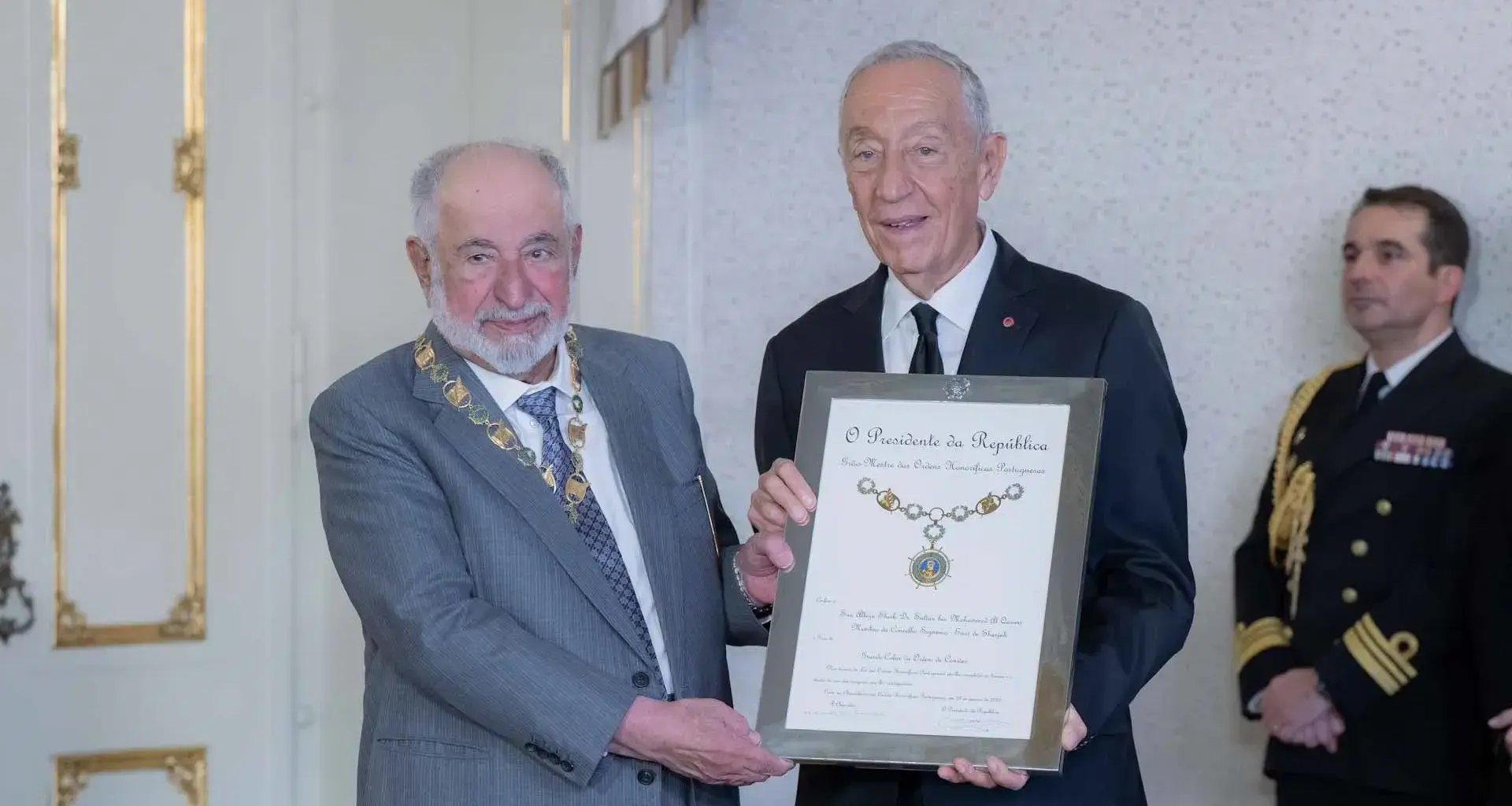
Seeing Portugal award the Grande Colar da Ordem de Camões to Sheikh Sultan bin Mohammed Al Qasimi is, first and foremost, a moment of genuine pride. It is an honor that every Arab should feel happy to witness, as it marks a long overdue recognition of Arab contributions to culture and knowledge. Sheikh Sultan fully deserves this distinction; his lifelong commitment to education, culture, and dialogue is beyond question. What follows is not a criticism of this gesture, nor of the man who received it, but a reflection on how such an important moment could be the beginning of something broader, how Portuguese cultural diplomacy, having taken this step, could still do better.
For those who have worked for years on Portuguese Arab relations, especially from the Moroccan side, this moment inevitably invites reflection. Portugal’s relationship with the Arab world did not begin with this award, nor has it been shaped solely by high level gestures. It rests on a much longer and deeper history, one that includes sustained academic work, cultural exchange, and a shared past that continues to be explored and reinterpreted.
Morocco occupies a particular place in this history. The peace treaty signed between Morocco and Portugal in the eighteenth century, one of the oldest still in force in the world, is not merely a diplomatic curiosity. It represents a turning point from conflict to dialogue, and it laid the groundwork for a relationship that has endured across centuries. In the contemporary era, this relationship has been actively nurtured, especially under the leadership of King Mohammed VI, whose approach to diplomacy has consistently emphasized culture, education, and long term intellectual cooperation.
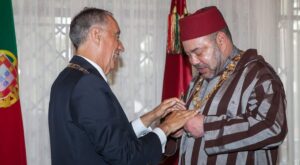 President Marcel Rebelo de Sousa awarding the Grand Cross of the Order of Santiago to King Mohammed VI.
Photograph: Presidency of the Portuguese Republic. Credits : Sic Notícias
This commitment is visible on the ground. Morocco is today the only Arab country to host university departments dedicated to Portuguese studies, as well as Camões Centres that operate on a sustained and institutional basis. These spaces exist because Moroccan scholars and institutions chose to invest in the Portuguese language and its cultural world, often without expecting recognition or reward. Over the years, Moroccan researchers have worked extensively in Portuguese archives, contributed to the study of shared maritime and colonial histories, and opened Lusophone literature to Arab readers.
Some milestones are worth recalling. The first Arab scholar to defend bachelor’s, master’s, and doctoral theses entirely in Portuguese emerged from this academic environment. Additionally, the first two Arab scholars to defend their doctoral theses in the Portuguese language were Moroccan Others have dedicated decades to translation, teaching, and research that quietly strengthened ties between Portugal, North Africa, and the Arab world. Their work rarely makes headlines, yet it embodies precisely the values of dialogue, cultural transmission, and mutual understanding that the Camões Order is meant to honor.
None of this calls into question the legitimacy of Sheikh Sultan’s distinction. Rather, it raises a simple point. Cultural diplomacy gains depth when it recognizes continuity, not just singular moments. Honoring one eminent figure is meaningful, but acknowledging the broader intellectual and historical landscape would give such gestures greater resonance.
Portugal has taken an important step by extending this honor to an Arab figure. The opportunity now is to widen the lens, to recognize long standing partners, sustained scholarly engagement, and the quiet labor that has connected Portugal to the Arab world for generations. Recognition, after all, should not be the culmination of dialogue, but part of its ongoing work.