
During the week of January 26 to January 30, 2026, the international crude oil market experienced a strong upward trend driven by escalating geopolitical tensions. The West Texas Intermediate (WTI) crude oil continuous contract achieved four consecutive daily gains starting Monday, closing at $65.51 per barrel on Friday, with a weekly increase of 7.28%, marking the highest weekly closing price in nearly six months. The Brent crude oil continuous contract also performed strongly, briefly breaking through the psychological threshold of $70 this week, and ultimately closing at $69.64 per barrel, with a weekly gain of 5.48%.

From a technical perspective, the WTI crude oil daily chart shows that the middle band of the Bollinger Bands (26, 2) is located at $59.72, and the upper band is at $64.67. The closing price on Friday remained stable near the upper band of the Bollinger Bands, indicating significant short-term strength. The 50-day moving average (MA50) is at $58.98, providing solid technical support for oil prices. The MACD indicator (26, 12, 9) shows that the DIFF value is 1.55, the DEA value is 0.90, and the MACD histogram is 1.32, all positioned above the zero axis and showing a divergent trend, indicating continuously increasing bullish momentum.
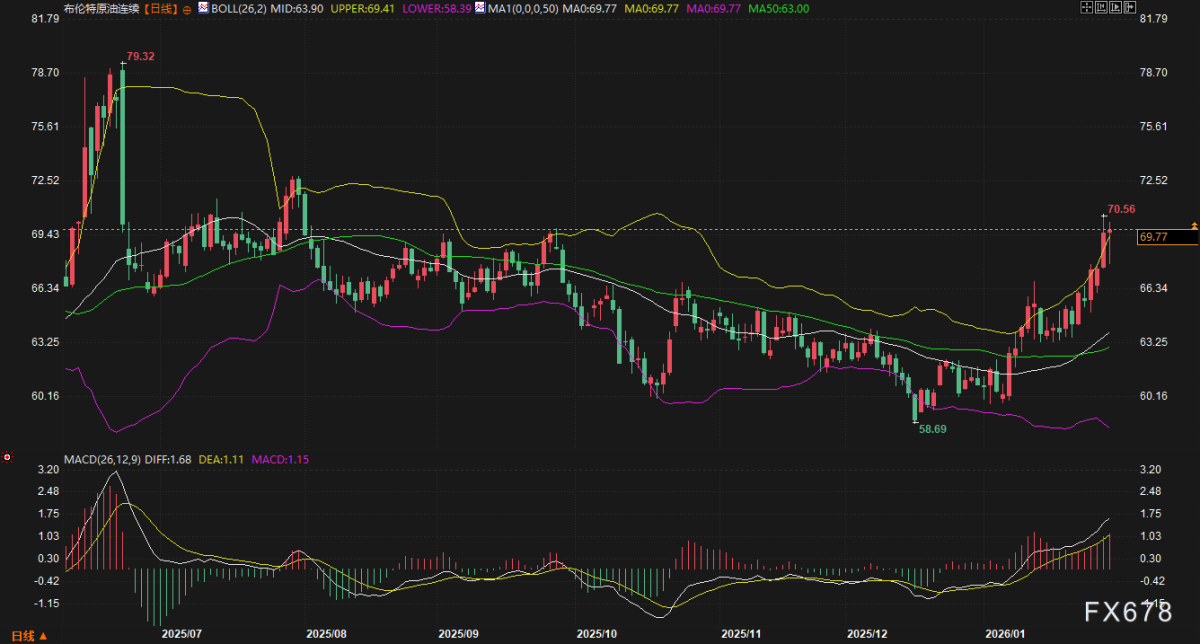
The technical pattern of Brent crude oil is largely synchronized with WTI. The daily Bollinger Bands (26, 2) middle band is at $63.90, and the upper band is at $69.41; the closing price has reached the resistance area near the upper band. The MA50 moving average is at $63.00, also constituting important support. In the MACD indicator, the DIFF value is 1.68, the DEA value is 1.11, and the MACD histogram is 1.15, maintaining a complete bullish arrangement.

Core Driving Factors: Escalation of US-Iran Standoff and Evolution of Market Sentiment
 Geopolitical risks have become the absolute dominant factor.
The core driver of the oil market this week was entirely due to the sharp escalation of tensions between the US and Iran. On Thursday, multiple reports indicated that President Trump was considering military action against Iran, including targeted strikes, which directly triggered market concerns about potential disruptions to Middle Eastern oil supplies. Although both the US and Iran have expressed willingness to engage in dialogue, the Iranian Foreign Ministry explicitly stated on Friday that its defensive capabilities should not be part of any negotiation agenda, making the situation more complex with this firm stance.
The US has recently strengthened its military deployment in the Middle East and imposed a new round of sanctions on seven Iranian citizens and at least one entity. John Kilduff, a partner at Again Capital, commented: “The market’s focus is entirely on the Iran issue right now. While the market has already factored in Iran’s geopolitical risks, it is difficult to quantify the specific impact at this stage. The key question is: if action is taken against Iran, how will Iran respond?”
US Dollar Movement and Fundamental Factors
In addition to geopolitical factors, the movement of the US dollar also had some impact on oil prices. The US Dollar Index rebounded from a four-year low touched earlier in the week, with Friday’s strength mainly attributed to Trump’s announcement that he would appoint former Federal Reserve Governor Kevin Warsh to succeed Powell as the next Federal Reserve Chair. A stronger dollar typically pressures oil prices denominated in dollars, as it increases the purchasing cost for buyers using other currencies.
On the supply side, industry data estimates show that the peak period for annual maintenance at Russia’s primary refineries is expected to occur this month and in September, potentially causing seasonal impacts on global crude oil supply. On the demand side, the market continues to monitor economic data performance from major global economies, but these factors were overshadowed by geopolitical risks this week.
Institutional Views Summary: Cautious Expectations Amid Mixed Factors
Divergence in the Assessment of Geopolitical Risks
The majority of analysts expect oil prices to remain around $60 per barrel in 2026. Analysts generally believe that the prospect of a global crude oil market surplus will offset potential supply disruptions caused by geopolitical tensions. However, regarding the current U.S.-Iran tensions, there is a noticeable divergence in institutional views.
Some analysts pointed out that the market may have overpriced geopolitical risks. The director of energy research at Morgan Stanley stated in a report: ‘While the situation in the Middle East is indeed concerning, we need to differentiate between short-term risk premiums and long-term fundamentals. Currently, global crude oil inventories remain at healthy levels, and U.S. shale oil production maintains resilience, which may limit the upside potential for oil prices.’
Another perspective argues that risks are being underestimated. The Goldman Sachs commodities research team stated: ‘If U.S.-Iran tensions escalate further, the shipping security of the Strait of Hormuz will face a substantial threat. This strait accounts for approximately 30% of the world’s seaborne oil trade daily, and any disruption would have a significant impact on the global oil market.’
Analysis of Supply and Demand Fundamentals
In terms of supply and demand analysis, the International Energy Agency (IEA) maintained its forecast for moderate growth in global crude oil demand in 2026 in a report released this week, predicting an increase of approximately 1.2 million barrels per day. On the supply side, data from the U.S. Energy Information Administration (EIA) shows that U.S. crude oil production remains near record highs, although growth has slowed significantly.
The head of commodities research at Citigroup noted: ‘The key variable for the oil market in 2026 might not be geopolitics but rather the trajectory of global economic growth. If major economies can avoid recession, demand will provide support for oil prices; conversely, any signs of economic slowdown will put downward pressure on oil prices.’
Regarding the impact of the Trump administration’s trade policies, analysts generally analyze from the perspective of market sentiment. A commodities analyst at UBS Wealth Management stated: ‘Market participants continue to focus on how changes in the trade environment affect global economic growth and energy demand. Recent developments have added uncertainty to the economic outlook, potentially restraining further upward momentum for oil prices.’
Outlook for Next Week: Market Direction Amid Multiple Interwoven Factors
Looking ahead to next week, the crude oil market will face multiple tests:
Geopolitical developments remain the focus
The market will continue to closely monitor the dynamics between the United States and Iran. Any signs of escalation or de-escalation could trigger significant fluctuations in oil prices. Investors are particularly focused on whether Iran might take actions that affect shipping safety and the potential response from the United States.
Economic data and demand signals
Next week, PMI data for manufacturing and services across several countries will be released, providing the latest clues about the health of the global economy. Data from China and Europe, in particular, will significantly influence market assessments of the outlook for crude oil demand.
Key technical levels
From a technical analysis perspective, WTI crude faces significant resistance in the $65-66 range. A decisive breakout could open up potential gains toward the $68-70 range. Initial support is seen at $63.50 (the recent breakout level), followed by $62 (near the middle Bollinger Band). For Brent crude, key resistance lies in the $70-71 area, with support at $68 and $66.50.
Impact of the US dollar’s movement
Market reactions triggered by the nomination of the Federal Reserve Chair will continue to unfold. The trajectory of the US Dollar Index will indirectly affect crude oil prices. If the dollar continues to strengthen, it may exert downward pressure on oil prices; conversely, if the dollar weakens, it could provide additional support for oil prices.
The tug-of-war between risk premiums and fundamentals
Overall, the crude oil market in the last week of January 2026 was completely dominated by geopolitical risks. The escalation of tensions between the US and Iran injected a significant risk premium into oil prices, pushing the two benchmark crude oil prices to their highest levels in nearly six months. However, after consecutive increases, signs of consolidation appeared in the market on Friday, indicating that investors remained somewhat cautious while weighing the risk premium against fundamental factors.
From a broader perspective, the current oil market is in a complex interplay of multiple factors including geopolitical risks, supply and demand fundamentals, the movement of the US dollar, and expectations for global economic growth. While heightened tensions may continue to support oil prices in the short term, the long-term trend will ultimately revert to supply and demand fundamentals. Market participants need to closely monitor developments while keeping an eye on global economic data and inventory changes to make prudent decisions in an increasingly volatile market environment.
In the coming week, whether oil prices can hold onto recent gains and move higher will depend on whether there are any substantive changes in the situation between the US and Iran, the performance of global economic data, and the outcome of the struggle over key technical levels. In this eventful winter, volatility in the crude oil market is likely to remain elevated.