
Iran on Saturday attempted to project stability after weeks of unrest and fears of a looming US military strike, publishing rare images of Supreme Leader Ali Khamenei in public as officials warned the United States and Israel against military action.
Against the backdrop of mounting tensions, Iranian media published images on Saturday showing Khamenei in public for the first since the protests erupted — attending prayers at the tomb of Islamic Republic founder Ruhollah Khomeini to mark 47 years since the Islamic Revolution.
The photos appeared aimed at countering opposition claims earlier this month that Khamenei had been moved to an underground bunker for fear of a potential US strike.
Also Saturday, Iranian army chief Amir Hatami warned the US and Israel against an attack, saying his country’s forces were on high alert following Washington’s heavy military deployments in the Gulf.
He also insisted the Islamic republic’s nuclear expertise could not be eliminated, after Trump said he expected Tehran to seek a deal to avoid US strikes.
Get The Times of Israel’s Daily Edition
by email and never miss our top stories
By signing up, you agree to the terms
“If the enemy makes a mistake, without a doubt it will endanger its own security, the security of the region, and the security of the Zionist regime,” Hatami said, according to the official IRNA news agency.
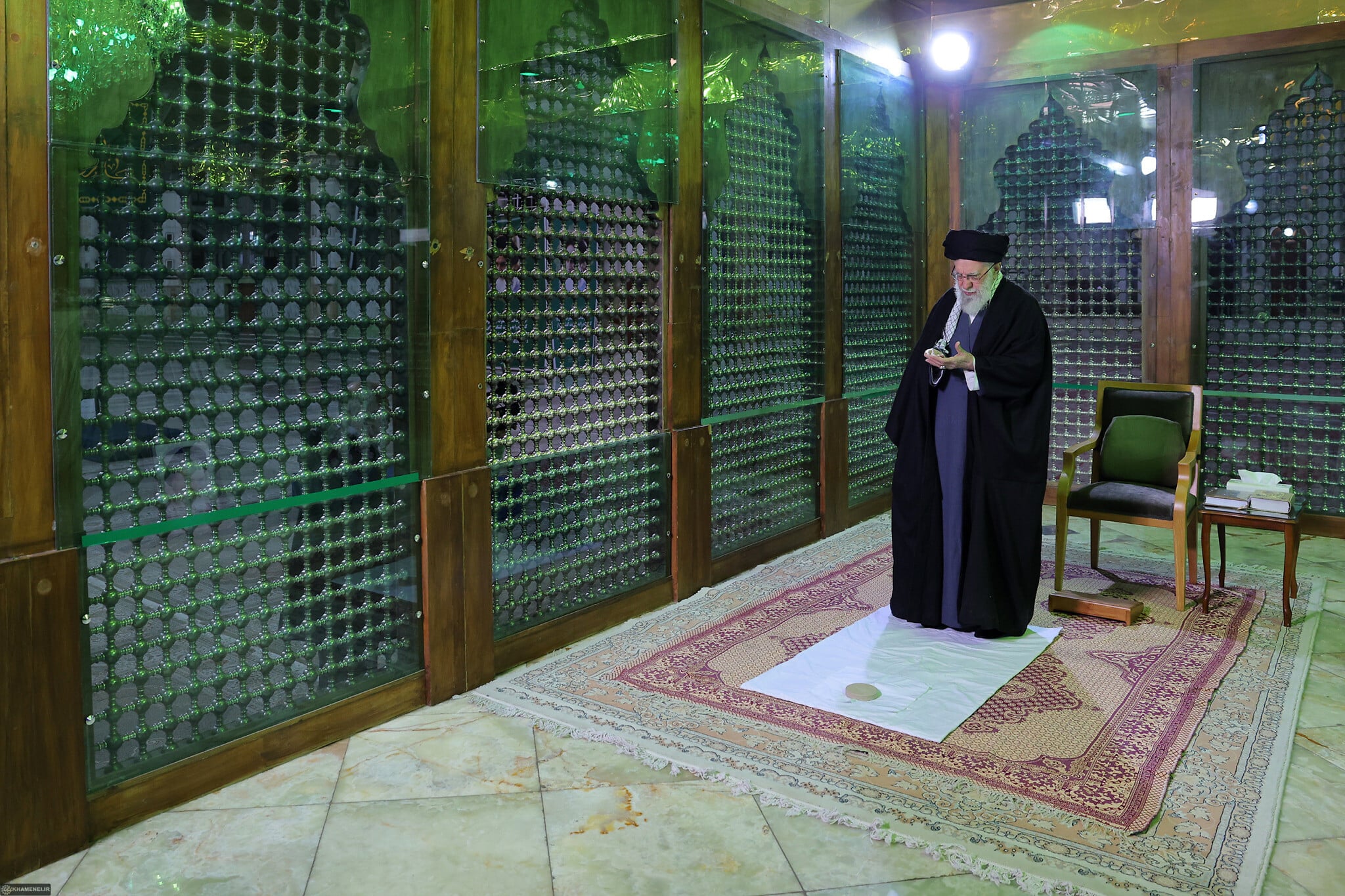
In this photo released by an official website of the office of the Iranian supreme leader, Supreme Leader Ayatollah Ali Khamenei prays at the grave of the late revolutionary founder Ayatollah Khomeini, commemorating the 47th anniversary of his return from exile during the 1979 Islamic Revolution, just outside Tehran, Iran, Saturday, Jan. 31, 2026. (Office of the Iranian Supreme Leader via AP)
He noted that Iran’s armed forces were “at full defensive and military readiness.”
Washington sent a naval strike group to the Middle East led by the USS Abraham Lincoln aircraft carrier, with Trump threatening to intervene militarily after a deadly crackdown by Iranian authorities on two weeks of anti-government protests.
The deployment has raised fears of a possible direct confrontation with Iran, which has warned it would respond with missile strikes on US bases, ships and allies — notably Israel — in the event of an attack.
On Friday, Trump said he predicted that Iran would seek to negotiate a deal over its nuclear and missile programs rather than face American military action.
Iranian Foreign Minister Abbas Araghchi had said earlier that Tehran was ready for nuclear talks, but its missiles and defense “will never be negotiated.”
The US carried out strikes on key Iranian nuclear sites in June when it briefly joined Israel’s 12-day war against its regional foe.
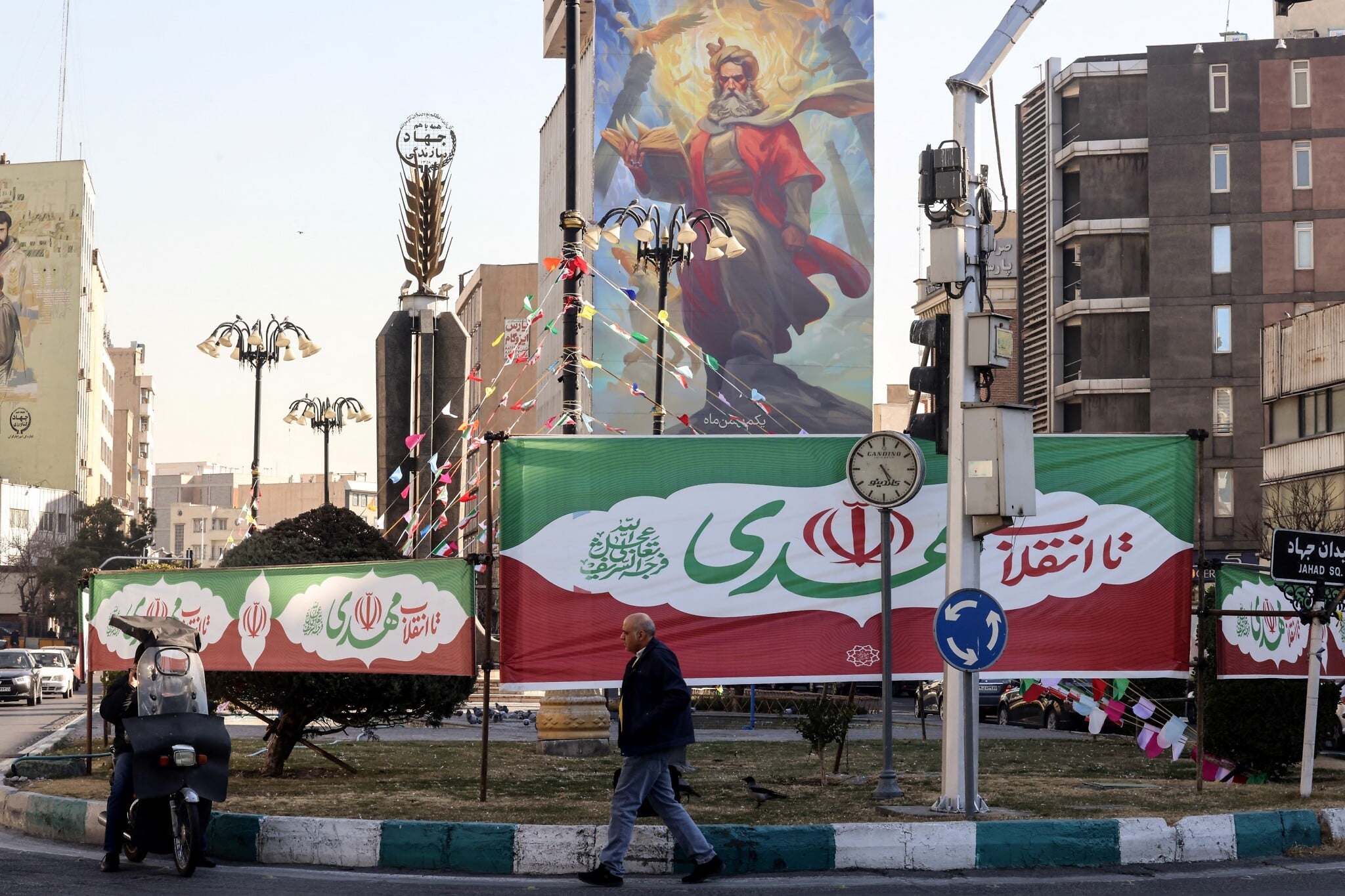
Banners in the colors of the Iranian flag adorn a roundabout as a man walks past in the Iranian capital Tehran on January 31, 2026, ahead of the 47th anniversary of the 1979 Islamic Revolution. (Photo by Atta KENARE / AFP)
Israeli attacks also hit military sites across the country and killed senior officers and top nuclear scientists.
But Hatami on Saturday insisted that Iran’s nuclear technology “cannot be eliminated, even if scientists and sons of this nation are martyred.”
On Friday, US Central Command (CENTCOM) said Iran’s Islamic Revolutionary Guard Corps (IRGC) would conduct “a two-day live-fire naval exercise” in the Strait of Hormuz, a key transit hub for global energy supplies.
In a statement, CENTCOM warned the IRGC against “any unsafe and unprofessional behavior near US forces.”
The United States designated the IRGC a terrorist organization in 2019, a move the European Union followed on Thursday.
The EU decision drew angry reactions from Tehran, which vowed to reciprocate.
Nationwide protests against the rising cost of living erupted in Iran on December 28, before turning into a broader anti-government movement that peaked on January 8 and 9.
The two-week-long nationwide protests, which began in late December over an economic crisis marked by soaring inflation and rising living costs, have largely subsided following a bloody crackdown. Iran’s National Security Council said last week that 3,117 were killed, while the opposition-affiliated Iran International put the death toll at more than 36,000.
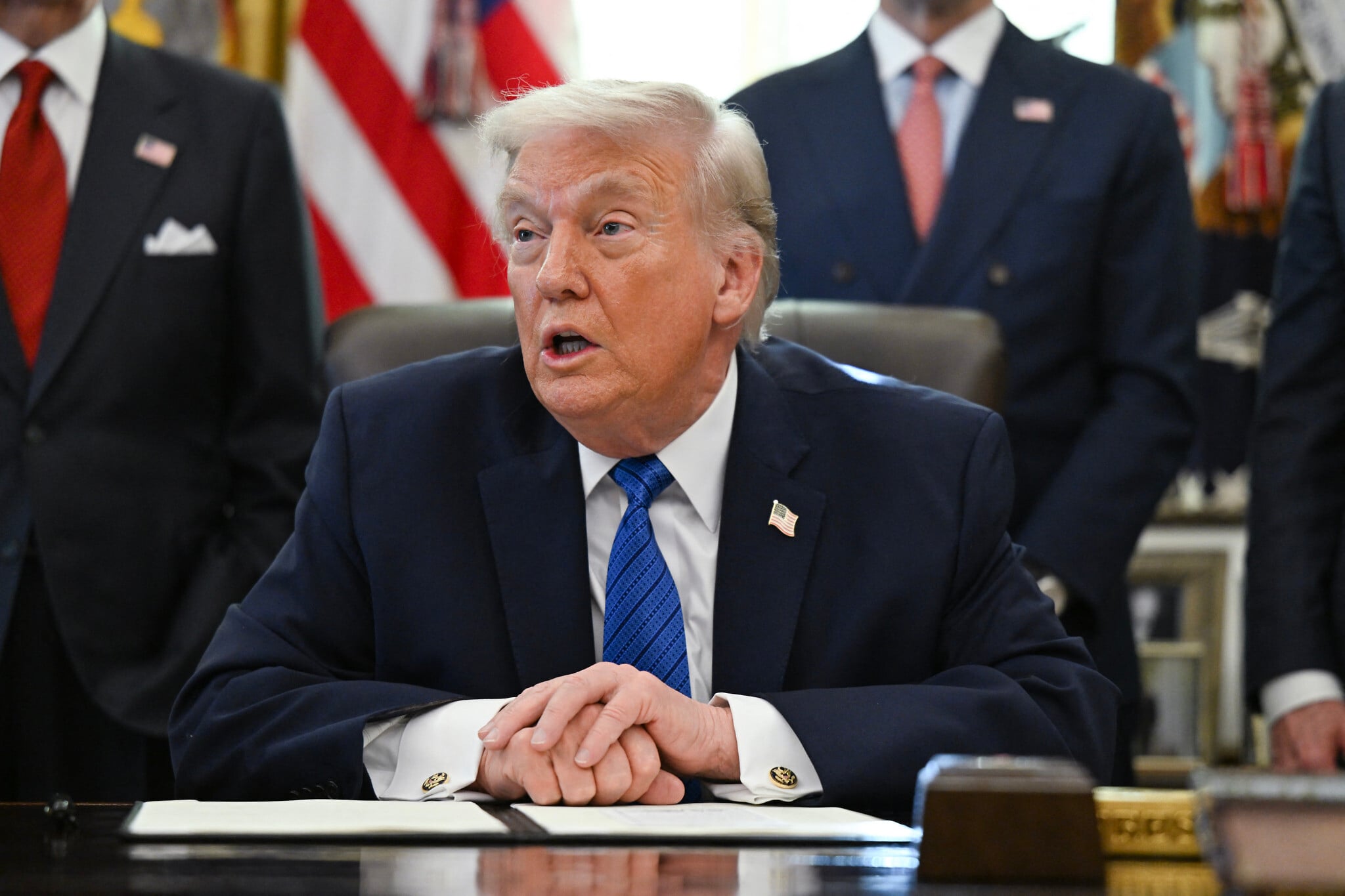
US President Donald Trump speaks before signing executive orders in the Oval Office in the White House in Washington, DC, on January 30, 2026. (Annabelle Gordon/AFP)
On Saturday, Iran’s President Masoud Pezeshkian reiterated Tehran’s accusations that outside forces had fomented the protests.
Pezeshkian said that US, Israeli and European leaders had exploited Iran’s economic problems, incited unrest and provided people with the means to “tear the nation apart” in recent protests.
The foreign powers had tried to “provoke, create division, and supplied resources, drawing some innocent people into this movement,” Pezeshkian said in a live state TV broadcast.
Trump, Israeli Prime Minister Benjamin Netanyahu and Europeans “rode on our problems, provoked, and were seeking — and still seek — to fragment society,” said Pezeshkian.
“They brought them into the streets and wanted, as they said, to tear this country apart, to sow conflict and hatred among the people and create division,” Pezeshkian said.
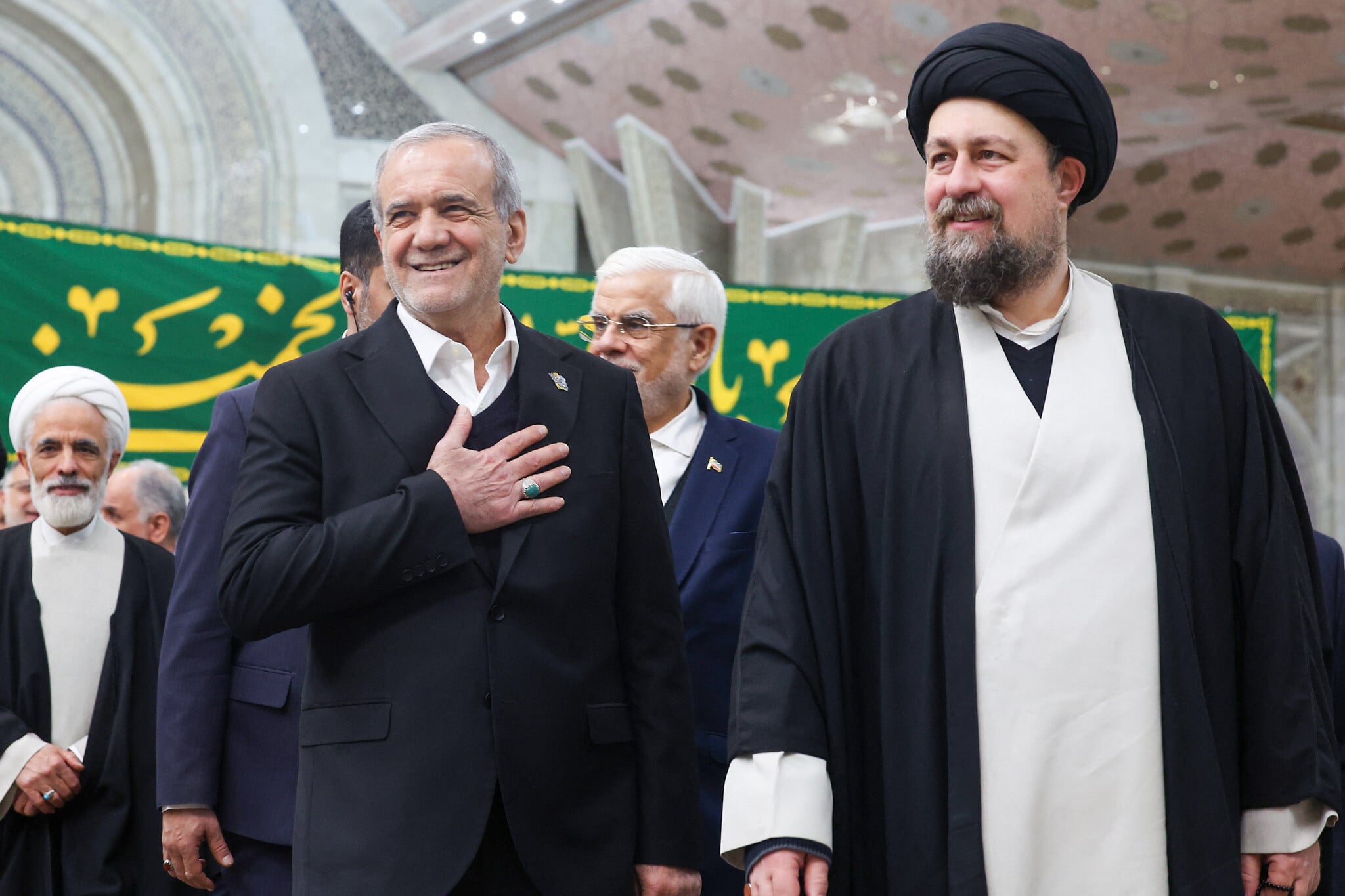
In this handout picture provided by the Iranian presidency, Iran’s President Masoud Pezeshkian (L), accompanied by Hasan Khomeni (R), the grandson of late supreme leader Ayatollah Ruhollah Khomeini and cabinet members, visit of the tomb of Khomeini, in Tehran on January 31, 2026, ahead of the 47th anniversary of the 1979 Islamic Revolution. (Photo by Handout / Iranian Presidency / AFP)
“Everyone knows that the issue was not just a social protest,” he added.
However, he also urged his government to heed public grievances after the demonstrations.
“We must work with the people and for the people and serve the people as much as possible,” Pezeshkian said in a speech broadcast on state TV.
“If we act justly, the people will see it and will accept it, and under such conditions, no power can cripple a government, a society, or a nation that acts justly, fairly, and on the basis of rights.”
Iran also acknowledged for the first time that children were among those detained in the crackdown, according to The New York Times. The deputy chairman of Iran’s parliamentary education commission Farshad Ebrahimpour said a “number” of students under 18 were arrested, as rights groups estimate at least 300 children and adolescents remain in custody.
You appreciate our journalism

You clearly find our careful reporting valuable, in a time when facts are often distorted and news coverage often lacks context.
Your support is essential to continue our work. We want to continue delivering the professional journalism you value, even as the demands on our newsroom have grown dramatically since October 7.
So today, please consider joining our reader support group, The Times of Israel Community. For as little as $6 a month you’ll become our partners while enjoying The Times of Israel AD-FREE, as well as accessing exclusive content available only to Times of Israel Community members.
Thank you,
David Horovitz, Founding Editor of The Times of Israel
Already a member? Sign in to stop seeing this