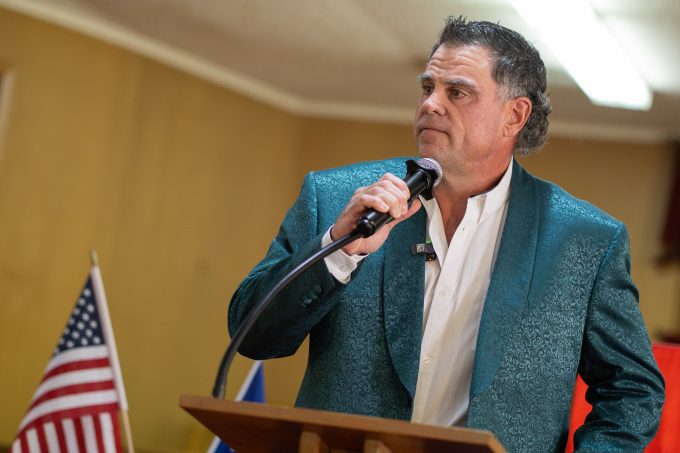
Longview native and longtime oilfield worker Hawk Dunlap recently told East Texas Republicans that he’ll prioritize public safety and groundwater protection if elected to the state agency regulating the oil and gas industry.
First and foremost, he’ll do that by addressing the growing health and safety risks posed by abandoned, idled and orphaned oil wells, which can leak cancer-causing water and gases into groundwater, soil and air – posing serious threats to human health.
Dunlap is running for the seat on the Railroad Commission held by incumbent Jim Wright, who is seeking reelection. Dunlap, Katherine Culbert, Bo French and James Matlock also are running as Republicans for the seat. All will appear on the March 3 primary ballot.
Wearing his custom green sport coat, a tribute to his Longview Lobo heritage, Dunlap was one of several candidates who spoke during a recent forum hosted by the Republican Party of Gregg County at New Zion Baptist Church. Dunlap mounted an unsuccessful bid for the commission in 2024 as a Libertarian.
“I’ve been fighting major oil companies, the Railroad Commission and other operators to make them clean up their mess,” Dunlap said. “I go where I’m led to go.”
Dunlap began his oilfield career in Spring Hill 35 years ago, and he has traveled to 103 countries working on oil wells and fighting oil well fires and blowouts. All that, of course, was after he was unofficially voted “Most Likely Never to Leave Gregg County” when he graduated from Longview High School, he said jokingly.
For the past four years, Dunlap has spent much of his time at the Antina Ranch in West Texas, where nearly 100 decades-old oil wells drilled by Chevron and its predecessors have been leaking saltwater, crude oil, toxic gasses and other substances that destroy land and kill vegetation.
“I spent the last four years of my life fighting for landowners’ rights and trying to get people to do the right thing,” he said.
Dunlap and incumbent Railroad Commissioner Christi Craddick, who is running to be the state’s next comptroller, have said the state’s large volume of abandoned and orphaned oil wells pose serious threats to groundwater supplies.
When an oil well is no longer in operation, operators are supposed to plug the well by filling it with concrete and other materials to keep what’s below from coming up. But the cost of plugging wells is high, and by the time an oil well is no longer profitable to operate, the companies that run them often go bankrupt and don’t pay to have the wells plugged. Those wells then become wards of the state known as “orphaned wells,” and it’s up to the Railroad Commission to plug them.
The number of orphaned wells in Texas is 10,000 or more, according to data from the commission. Craddick previously told the Texas Tribune the number of orphan wells is increasing faster than the agency can plug them, and the cost to do so is rising. She said the average cost to plug a well is about $57,000, but some wells – such as one in Odessa that blew out – cost $2.5 million. While the state requires oil companies to pay a bond that generates plugging revenue, those bond funds are less than the cost of plugging.
Dunlap, however, said he believes the number of orphaned wells could be 11,000 or more.
“We’ve got more coming down the pike,” he said. “We really need to change the way that we’re plugging wells and the way that we do risk assessments on which wells get plugged first.”
Dunlap proposes requiring all companies that have operated a given well to share in the cost of plugging it – not just the company that owns it when it is abandoned. He’s also proposed a $1 tax on every barrel of oil, with that money going toward well-plugging costs, and requiring producers to pay a $250,000 bond that can be used to plug the well later on.
Dangerous oil wells, however, are only some of the problems the state faces.
The oil industry injects roughly 30 million barrels of salt water per day into the ground that are unearthed as a result of oil production. Injecting that water, often called produced water or wastewater, back into the earth via disposal wells has been linked to plugged well blowouts, and it could be contaminating freshwater that people drink, opponents say.
Dunlap said the state needs to push the industry to recycle that water instead. He also proposes placing a 10-cent-per-barrel tariff on every barrel of produced water in Texas; the revenue would go toward the cost of plugging abandoned and orphaned wells. At 30 million barrels per day, the state would collect $3 million per day and $21 million per week to help pay for the cost of well-plugging.
“We need the industry to start being self-sufficient and self-supporting,” he said.
J. Blake Scott, an attendee at the forum, noted that two orphaned wells within the city limits are less than one mile from the church where the forum took place. He asked Dunlap how he proposes to plug wells more quickly.
Dunlap suggests using AI to project the cost of plugging wells and determine which ones are the most high-risk. The first wells to be plugged should be those near schools and homes.
“There are orphaned and idled wells all over the county and in close proximity to neighborhoods, to schools, actually,” Dunlap said.
Dunlap also voiced his opposition to a solid waste disposal facility near Elysian Fields that has drawn the ire of many East Texans. The Railroad Commission voted 2-1 in early 2025 to grant permits for oilfield waste to be disposed of in the county, with Craddick being the lone “no” vote. Railroad Commission staff, however, said the agency should not approve permits for the facility because the operator, McBride Operating, has numerous regulatory violations.
Dunlap said he wants to protect Lake O’ The Pines, Caddo Lake and the Cypress River Basin from such waste.
“We need a place to go with the solid waste,” he said. “Let’s be logical about it. Let’s be reasonable. But setting it on the Cypress watershed and putting it in environmentally sensitive areas is not the answer. We have other places in the state.”
Groundwater contamination across the state is an emerging issue, and the advent of AI data centers – which use large volumes of water – will require solutions, Dunlap said.
“We have way too much to do,” he said.