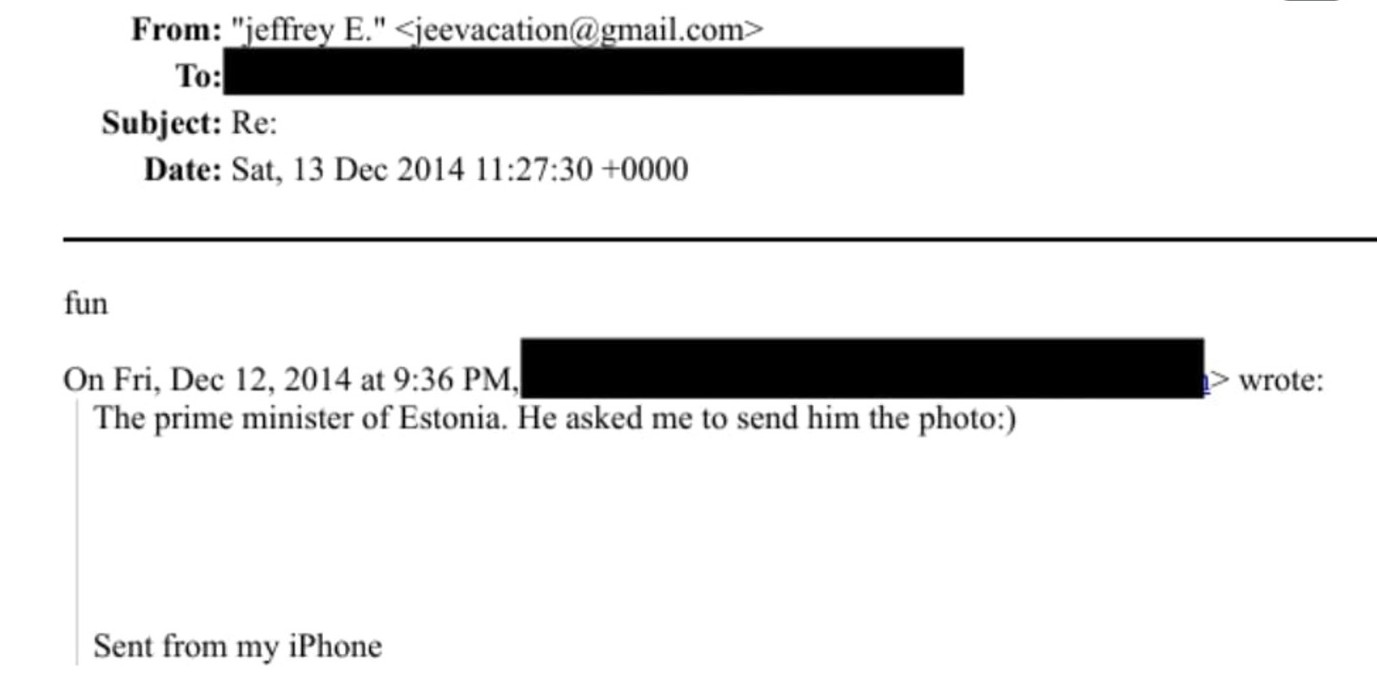
Newly released documents connected to the disgraced financier and convicted sex offender Jeffrey Epstein mention Estonia more than 200 times, according to an examination of files published this week by the United States Department of Justice; among the material is a brief 2014 reference to an “Estonian prime minister”, prompting questions about whether the remark relates to the country’s former head of government.
The files are part of a vast disclosure ordered under legislation passed by the US Congress, requiring the Justice Department to make public millions of pages of documents, along with thousands of photographs and videos, linked to Epstein and his network. While more than 600,000 documents have so far been released, officials have confirmed that a significant portion of the material remains unpublished.
A fleeting reference
One document drawing particular attention is an email sent to Epstein in mid-December 2014 by a sender whose identity has been redacted. The message reads simply: “The Estonian Prime Minister. He asked me to send him this photo :)”. No image is visible in the publicly available version of the file, nor is there a subject line. Epstein’s reply the following day consists of a single word: “fun”.
At the time, Estonia’s prime minister was Taavi Rõivas, who served in the role from March 2014 to April 2015. Asked by Estonian online portal Delfi whether the reference could relate to him, Rõivas said he did not know. He stated that he had never had any direct or indirect contact with Epstein and had no knowledge of the photograph mentioned in the email.
Rõivas was in the United States on an official visit with a business delegation from 6 to 14 December 2014 – dates that coincide with the timing of the correspondence. According to the Prime Minister’s Office, the visit focused on economic cooperation, bilateral relations between Estonia and the US, and security matters.
Repetition and ambiguity
The Justice Department has cautioned that many documents in the database appear multiple times, often in slightly different versions, and that some files lack sender information or complete metadata. In one version of the 2014 email, a filename for the missing image appears, but the photograph itself has not been made public.
Other Estonia-related references in the files are fragmentary and ambiguous. Searches linked to the image filename lead to later correspondence referring to photographs of “crew clean up inside the tunnel storage room”, without any explanation of the location or context. Another email mentions “GSJ: Stone road”, accompanied by references to renovation and construction work, though its significance remains unclear.
Travel, logistics – and troubling tone
Estonia appears throughout the files largely in the context of travel planning and logistics among Epstein’s associates. In July 2011, Epstein wrote to an unidentified correspondent asking what impression Riga and Estonia had made. A reply from Ramsey Elkholy described Latvia in explicitly sexualised terms and mentioned a possible onward trip to Estonia.
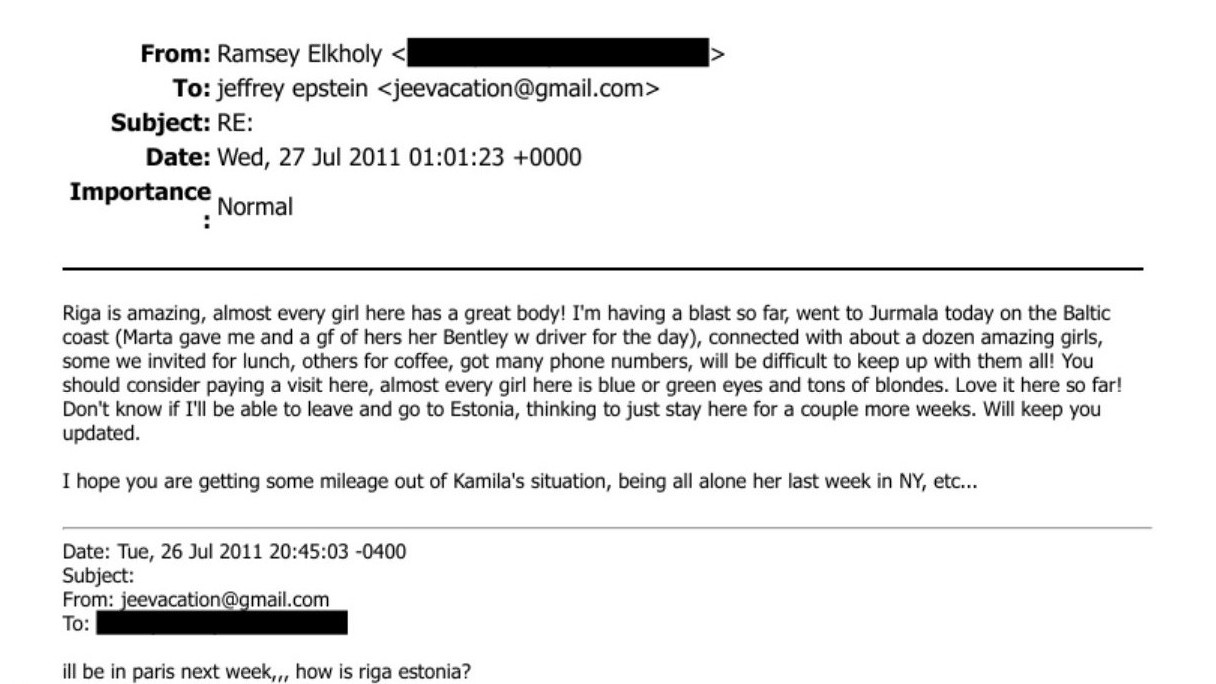 A reply from Ramsey Elkholy described Latvia in explicitly sexualised terms and mentioned a possible onward trip to Estonia. Source: US Justice Department.
Other emails note visa requirements – or the lack of them – for travel by US and UK citizens to countries including Estonia, Latvia, Lithuania and Ukraine. In one exchange, Epstein listed a series of destinations under the heading “Coordinating = European countries”, including Estonia.
In 2016, a man named David Stern wrote to Epstein about plans to visit Estonia, following up days later with an exclamation-laden message. Epstein subsequently asked him about photographs.
The database also contains academic correspondence unrelated to Epstein’s criminal activities, including emails about recruiting scientists from Eastern Europe, where Estonia is mentioned alongside other countries in the region.
The wider Epstein scandal
Epstein, who died in a New York jail in 2019 while awaiting trial on federal sex trafficking charges, had long been accused of exploiting underage girls and cultivating relationships with powerful figures in politics, business and academia. His associate Ghislaine Maxwell was convicted in 2021 of helping to recruit and abuse minors.
 Massage room with a massage table in Epstein’s NYC townhouse in 2019. Public domain.
Speaking on the release of the files, US Deputy Attorney General Todd Blanche said the full archive comprises around six million pages. Materials containing victims’ personal data, medical records, or graphic depictions of violence – including child sexual abuse material – have been withheld.
Blanche also confirmed that the released material includes a large volume of pornographic images and videos seized from Epstein’s devices. While investigators believe Epstein may not have personally saved all of the material, some appears to have been stored by him or by members of his close circle. To protect victims, faces in the images and videos have been heavily blurred, with the exception of Maxwell’s.
No implication of wrongdoing
While Estonia is mentioned frequently in the documents, there is no indication in the released material that Estonian officials or institutions were involved in Epstein’s crimes. The references range from logistical notes and travel discussions to isolated, unexplained remarks.
As further documents are released in the coming months, scrutiny of Epstein’s international connections – and the many unanswered questions surrounding them – is likely to continue.