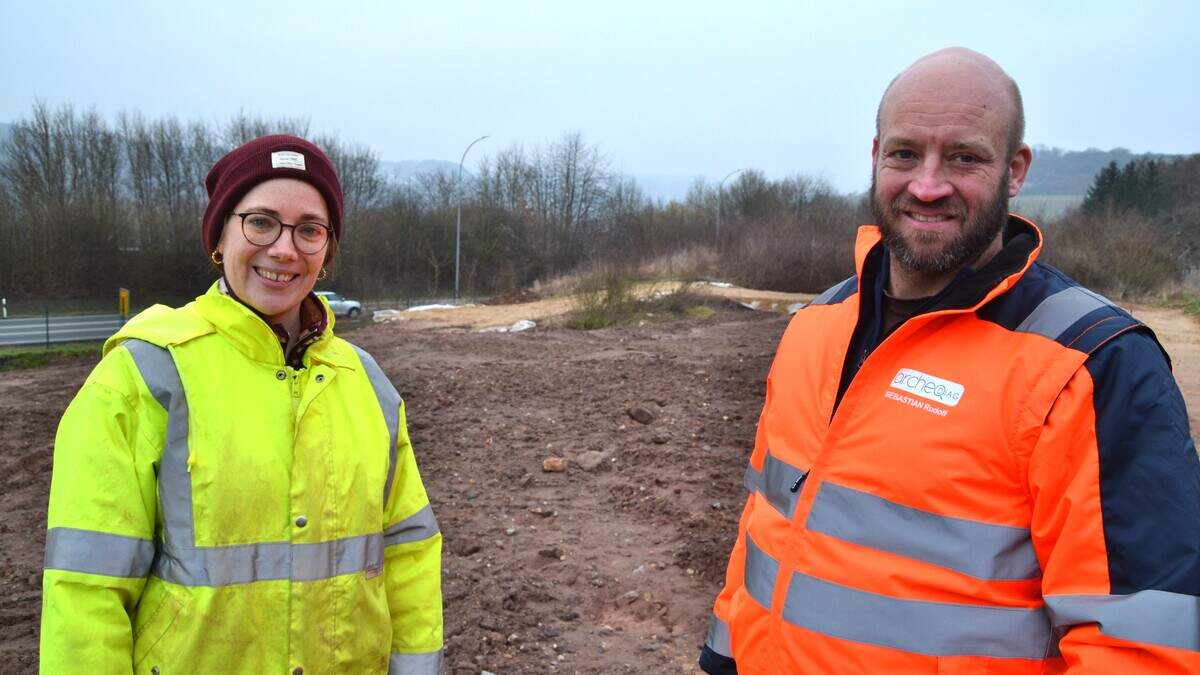
Archaelogists are working to preserve the site of a Roman villa located just a short distance from planned construction work to widen a bypass in Schieren.
For many years, drivers on the Schieren bypass have had the opportunity to observe the excavation site right next to the carriageway.
Work to widen the road to two lanes on the B7 in each direction between Schieren and Ettelbruck will begin in September. The construction of a new viaduct at Schieren marks the start of a three-year project, with an estimated cost of nearly €80 million.
Although the project will turn the focus away from the excavations, the archaeologists’ work will not be finished any time soon.
“Now that we have uncovered the remains of the Gallo-Roman villa in this area and inventoried them, we are in the process of taking conservation measures,” said Johanna Steffestun from the Institut national de recherches archéologiques (National Institute for Archaeological Research, INRA).
The excavations are covered with plastic sheeting before they are backfilled © Photo credit: Frank Weyrich
The plastic tarpaulins covering the excavations before they are filled in again. © Photo credit: Frank Weyrich
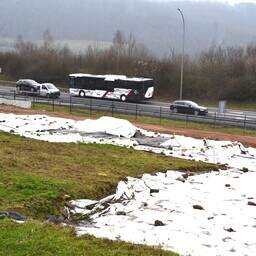
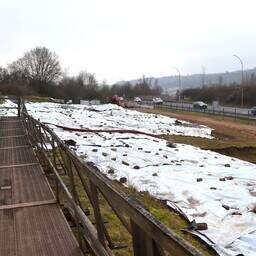
This means that the excavated and documented structures are covered with earth again. However, this isn’t simply a matter of dumping soil on top.
Due to the fragile nature of the ruins, they are first covered with a geo-textile membrane, followed by a layer of sand, before finally the actual layer of earth is applied.
Also read:Here are the main roadworks and motorway projects planned for 2026
When asked why sand is placed on top of the geo-textile first, Steffestun offered a simple explanation: “In this context, we refer to it as an indicator layer. Should someone dig at this spot again in the future, the layer of sand clearly indicates that there is something special underneath.”
One shovel at a time
On the question of whether it breaks the archaeologists’ hearts to see painstakingly unearthed relics disappear underground again, they are in agreement that it is for the best.
“By backfilling, I’m certain the villa is in the best possible place,” said Steffestun. For Rudolf Sebastian, who is overseeing the work on site, the matter is equally clear: “The very best thing would have been if it had never been excavated at all. Therefore, this is the second-best solution.”
But backfilling is far from as simple as it sounds. Getting the soil there is almost the easiest part. In Ettelbrück, the new tunnel at the train station is currently under construction, through which the N7 will run from 2028 onwards.
Some of the earth excavated there is transported by truck to the Roman villa site and unloaded. Small excavators then distribute the soil in the designated areas before the final layer is carefully applied by hand with shovels – to ensure that the underlying walls are not damaged.
It will therefore take some time until the entire area is completely covered again.
Johanna Steffestun shows the traces of a fire that caused the villa’s ceiling to collapse many years ago © Photo credit: Frank Weyrich
The exposed wall shows the protective measures in place before the final earth covering is applied © Photo credit: Frank Weyrich
Shovel by shovel, the remains of the Roman villa are covered over © Photo credit: Frank Weyrich
Moreover, the highly visible white tent will remain standing for quite some time.
Beneath it lies, in a sense, the heart of the site – the central and most interesting area of the Roman villa for research.
Furthermore, the excavations have not yet progressed to the boundaries of the site, as work had to be halted during the Covid-19 pandemic.
How the site and the history of the villa will be made accessible to the public is still unclear.
To illustrate the scale of the entire area, Steffestun offers a vivid comparison: “The entire area covers around 80,000 square meters – that corresponds to more than 15 football fields.”
“The very first traces of the villa were discovered as early as 1991, when the bypass was built. Even then, it was covered over again in order to build the noise barrier over it,” she said.
Today there are trees here, and when the four-lane expansion is completed in the coming years, the future motorway will once again run over the Roman tracks discovered almost four decades ago.
(This article was originally published by the Luxemburger Wort. Machine translated using AI, with editing and adaptation by John Monaghan.)