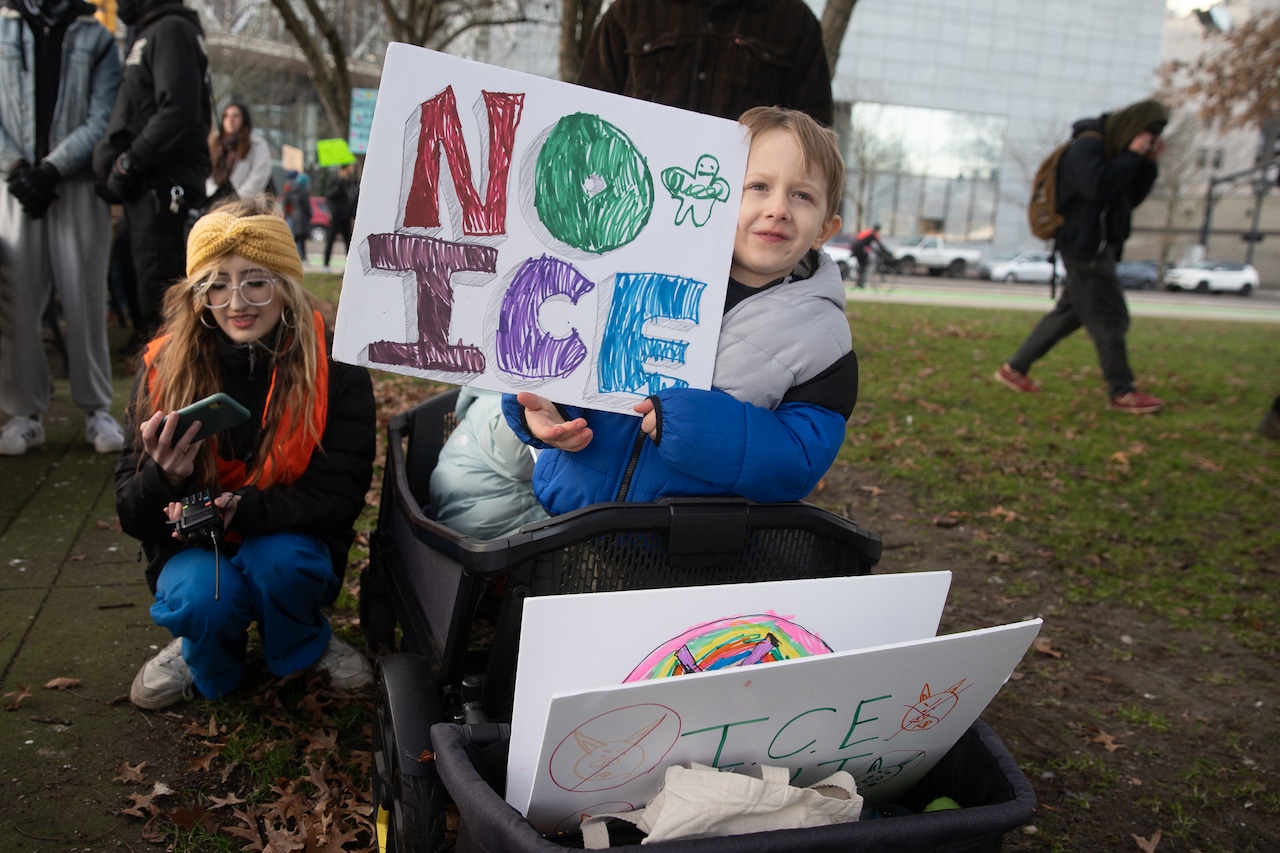
While immigration arrests appear to have fallen dramatically in January in Oregon, the people who help document the Trump administration’s sweep are on high alert for a possible surge in the state.
Volunteer observers say they remain hyper-vigilant in the wake of the killing of Alex Pretti a week ago in Minneapolis and a cryptic comment in a media report that “Oregon was next.”
The Portland Immigrant Rights Coalition has seen a sharp increase of people who want to help, said Alyssa Walker Keller, a coordinator with the group that tracks and verifies immigration arrests in Oregon.
“I would be lying if I said that people aren’t afraid,” Walker Keller said. “I think a lot of people are looking at this as one of those moments that scared is what brave is for.”
Immigration arrests in Oregon appear to have almost doubled overall from years past – to more than 2,000 – but only rough comparisons are possible given little information released by U.S. Homeland Security officials.
Since July, the Portland Immigrant Rights Coalition has received reports of 1,146 arrests in Oregon – a likely undercount, Walker Keller said. But in January, the hotline logged only 78 arrest reports compared to 251 in December. Most arrests have been in Multnomah, Washington and Marion counties, according to the group’s data.
Walker Killer said immigrant rights advocates attribute the recent downward trend to the federal government’s “Operation Metro Surge” in Minnesota, where thousands of agents have converged.
Last Saturday, agents beat and shot Pretti on a Minneapolis street as he held a phone and tried to help a fellow observer off the ground after she was pushed by an officer. Pretti’s death followed the fatal shooting two weeks earlier of Renee Good by a U.S. Immigration and Customs Enforcement agent in Minneapolis as she tried to drive away.
Video footage from witnesses to both shootings contradict federal accounts of the killings, which have ignited a national backlash of protests, the ousting of the Border Patrol commander from Minnesota and more calls to impeach Homeland Security Secretary Kristi Noem.
NBC News on Wednesday quoted an unnamed former White House official saying that Oregon was next in line for a targeted sweep.
“I think it shows why it’s important that we’re out here,” said a 30-year-old volunteer who typically works as an observer in the Aloha area. “It shows that there’s danger in being out here, but it also shows why it’s necessary because we wouldn’t know about these shootings if there weren’t other folks out there filming.”
The volunteer asked not to be named because of fear of retribution by federal authorities.
In Salem on Thursday, Latinos Unidos Siempre, reported that ICE officers smashed the window of a U.S. citizen during a random traffic stop after apparently racially profiling the driver.
Sandra Hernández, director of the immigrant rights group, said the woman was injured after agents smashed her car window and dragged her out. They left her in the middle of the street after she showed the agents her passport card, Hernández said.
She said the woman asked not to release her name because she was still recovering.
On Saturday, Oregon’s largest labor union, SEIU 503, identified the woman by only her first name, Maria, and said she suffered a concussion, a torn rotator cuff and bruised ribs. She’s a member of the union, which represents some state workers, home care givers and other health care workers. Maria was on her way to pay rent and to buy a cake for her grandson’s birthday when the incident happened, the union said.
“We know there’s a possibility of ICE becoming more active in the community,” Hernández said. “It’s important that folks know what resources are available.”
2,100 arrests in Oregon
In the first public disclosure of overall immigration enforcement numbers in Oregon, a Homeland Security spokesperson said this week that agents have arrest more than 2,100 people in the state since President Donald Trump took office.
That’s close to twice as many the 1,171 ICE arrests in Oregon in 2017, the last year of full data from theTransactional Records Access Clearinghouse at Syracuse University, which used to track national immigration data.
Tricia McLaughlin, Homeland Security assistant secretary for public affairs, didn’t answer questions about potential plans for a large-scale immigration operation in Oregon.
She said the arrests likely would be higher if Oregon weren’t a sanctuary state. In 1987, Oregon became the first in the nation to prohibit local law enforcement cooperation with federal authorities for immigration enforcement.
Walker Keller said more people have contacted with the Portland Immigrant Rights Coalition over the last week wanting to become legal observers or community-based watchers.
Legal observers undergo more intensive training to collect documentation on the ground that may be used in an immigrant’s legal case. Migra Watch volunteers typically are part of a rapid-response network that go to scenes of immigration arrests to monitor for safety and support.
“It’s kind of like earthquake preparedness or fire drills,” Walker Keller said. “We want to be prepared so that we’re not figuring it out on the fly. Muscle memory is really helpful in those situations when they’re really stressful.”
U.S. Rep. Andrea Salinas, D-Oregon, recently did a two-hour ride-along with a volunteer in Yamhill County and said the teams play a critical accountability role.
“It takes three different bucks. It is going to take Congress, it is going to take the court, and is is going to take community to be able to hold this administration, to hold ICE and Customs and Border Patrol accountable for their murderous action,” Salinas said. “When the three work in tandem, this will work and we will keep our community safe.”
A 44-year-old volunteer observer in the Beaverton area said she had a message for ICE: “We’re ready to protect our neighbors, because it’s the right thing to do. We outnumber you, and we always will. And that’s why we will win.”
A 23-year-old volunteer observer in Woodburn said she and others in Oregon see themselves in Good and Pretti.
“We start to think like that could have been us, that could have been anybody,” she said. “I know personally, I see myself a lot in Alex because he was a health care worker, I’m a health care worker. We are built different … if someone is in need, we run towards them, not away. We don’t necessarily stop if there’s any danger. It’s kind of the last thing we think of.”
Both observers also asked not to be named for safety reasons.
‘We’ve had some wins’
Volunteers in Minneapolis this week offered tips for others across the country in a call-in training meeting, organized by Showing Up for Racial Justice, that drew more than 2,000 listeners. The national group organizes white people across the country to fight for racial and economic justice.
A volunteer in Minneapolis who identified herself only as Sophie urged people to take action in their cities. She and others said their work is starting to make a difference.
“We’ve had some wins, this administration has take a step, maybe a half step back and we won this battle,” she said. “But we’re still very much at work. We’ve been building power and we are literally seeing it come to fruition in real time.”
In Oregon, Walker Keller said people should have the Portland Immigrant Rights Coalition hotline – 888-622-1510 – saved on their phones and continue to record immigration activity from a safe distance, she said.
People who could be at risk should work on a family preparedness plan and make sure people they trust have all their biographical information and their immigration case information, immigrant advocates said.
They should identify who will take care of their children, who will pick up the car and who has an extra set of keys to their home, for example.
People can also call the Oregon Department of Justice’s sanctuary hotline to report violations of the law by local officials and law enforcement officers at 844-626-7276. The hotline saw a significant increase of calls from June through the end of the year, with a total of 278 calls during those seven months.
People also should take time to care for themselves, Walker Keller said.
“We will lose the movement if we lose our capacity for joy,” she said. “It’s really important right now to make sure that we’re prioritizing what we’re fighting for, not just what we’re fighting against.”