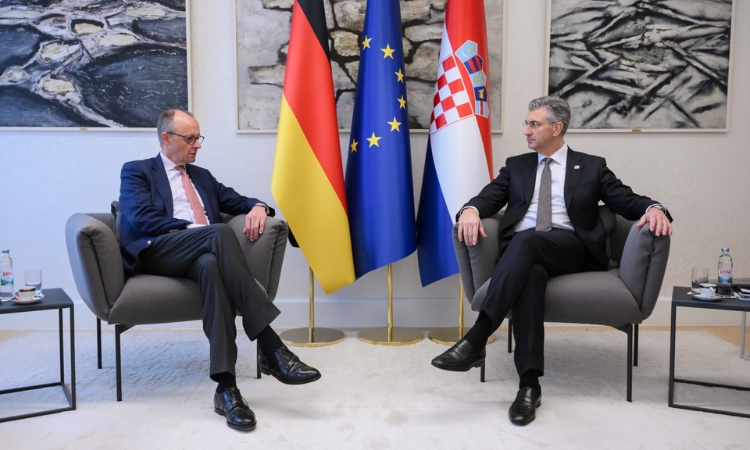
ZAGREB — Leaders of Europe’s largest political family gathered in Croatia’s capital this weekend to confront what they described as a defining moment for the European Union—one shaped not only by demographic decline and economic competitiveness, but by mounting security pressures and a shifting transatlantic relationship.
At an informal meeting of the European People’s Party, Prime Minister Andrej Plenković of Croatia and Manfred Weber said Europe’s ageing population had emerged as a strategic concern with far-reaching consequences for labour markets, economic growth and political stability.
“Without demographic revitalisation, there is no competitiveness,” Mr. Plenković said, noting that the average age across both Croatia and the European Union now approaches 45.
The two-day gathering brought together some of Europe’s most powerful figures, including Ursula von der Leyen, Roberta Metsola, German Chancellor Friedrich Merz, and Polish Prime Minister Donald Tusk. Much of the discussion took place behind closed doors, underscoring the sensitivity of the issues at hand.
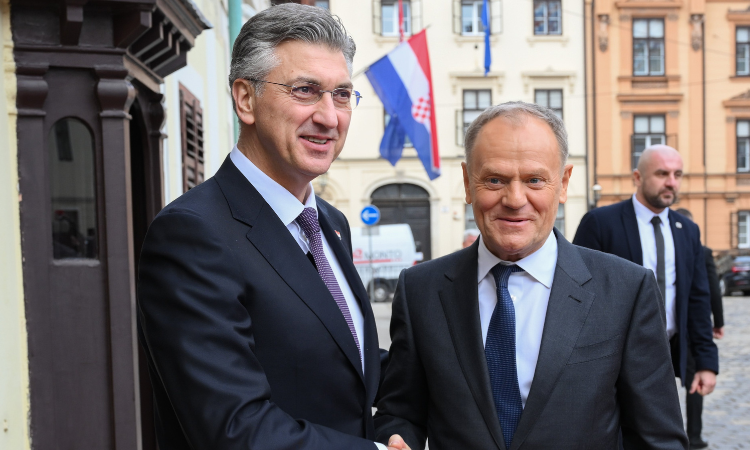
Plenković and Tusk in Zagreb – Photo – Vlada X
While demography and competitiveness dominated the public messaging, security concerns loomed large. Europe, Mr. Weber said, is facing a historic test of its preparedness—four years into Russia’s invasion of Ukraine and amid renewed uncertainty in relations with Washington following tensions involving President Donald Trump.
Both leaders reaffirmed their commitment to supporting Kyiv, arguing that any peace must be “just and lasting” and must not set a precedent that weakens territorial integrity elsewhere in Europe.
Security debates also touched on the European Union’s own legal foundations. Mr. Weber pointed to Article 42.7 of the Lisbon Treaty, which commits member states to mutual assistance in the event of armed aggression—arguing that its language is, on paper, stronger than NATO’s Article 5, even if its practical application remains unclear.
Mr. Plenković, referencing what he called “tectonic changes” in global politics—from war and terrorism to migration—said Europe must respond with greater unity. While avoiding direct criticism, he alluded to persistent divisions within the bloc that sometimes prevent a fully unified stance.
Discussions also turned to energy costs and living standards, with Mr. Weber arguing that European policies must translate into tangible benefits for citizens, including lower energy bills. Competitiveness, he said, must be measured not only in technological terms but in everyday affordability.
The meeting, the third of its kind after Athens and Berlin, coincided with the 50th anniversary of the European People’s Party—an occasion marked less by celebration than by sober reflection.
As Europe grapples with demographic decline, geopolitical instability and economic pressures, the gathering in Zagreb offered a glimpse into how its conservative leaders are attempting to recalibrate priorities for a more uncertain era.