
Summary and Key Points: Ukrainian air defense units were credited with downing two Russian Sukhoi aircraft on January 29, including one over the Black Sea. Early claims of two Su-34 losses were later clarified by Ukrainian officials as one Su-34 fighter-bomber and one Su-30SM multirole fighter.
-The shootdowns were attributed to U.S.-made Patriot PAC-3 interceptors defeating aircraft equipped with Khibiny-family electronic warfare pods.
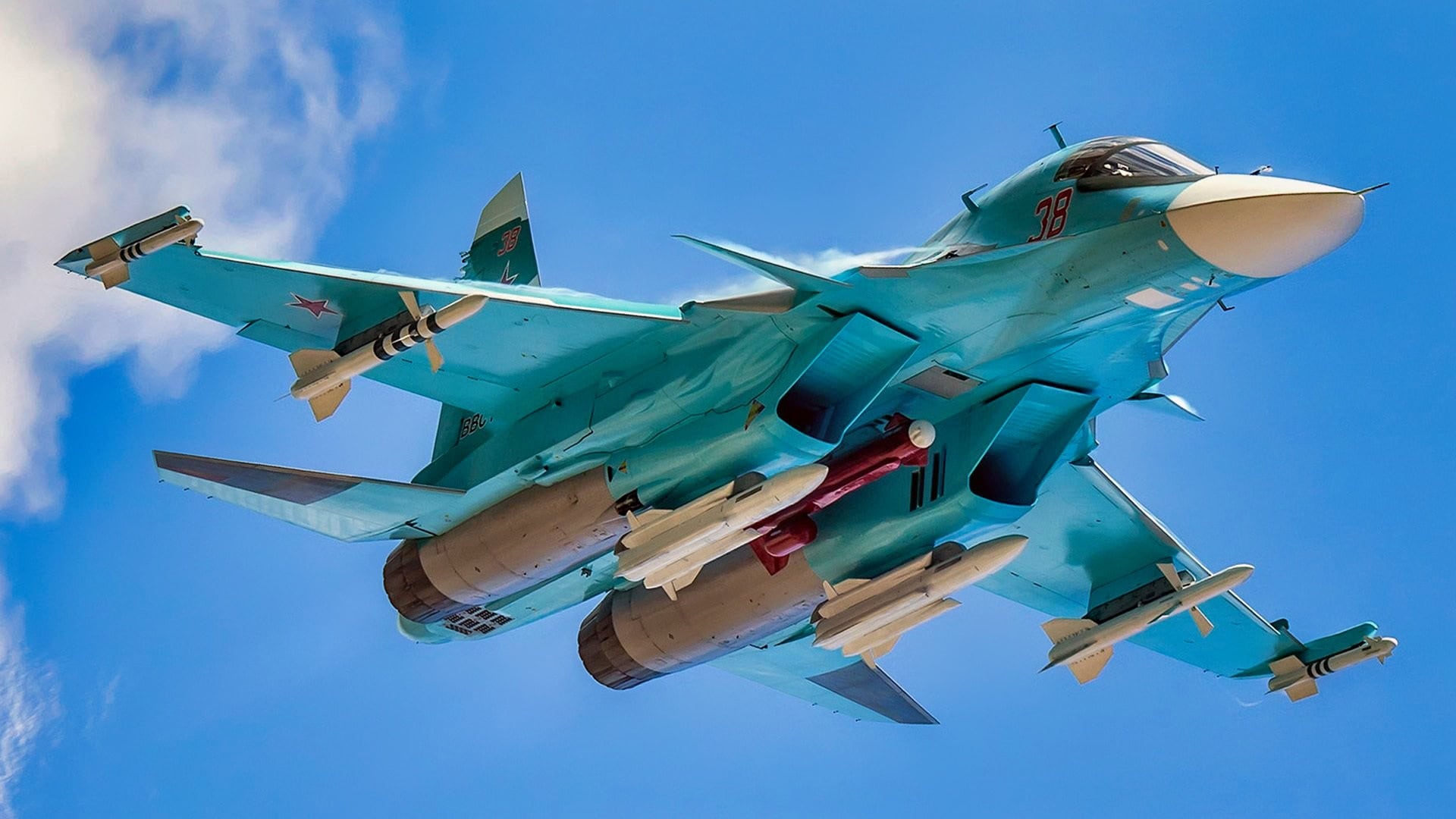
Su-34 Fullback. Image Credit: Creative Commons.
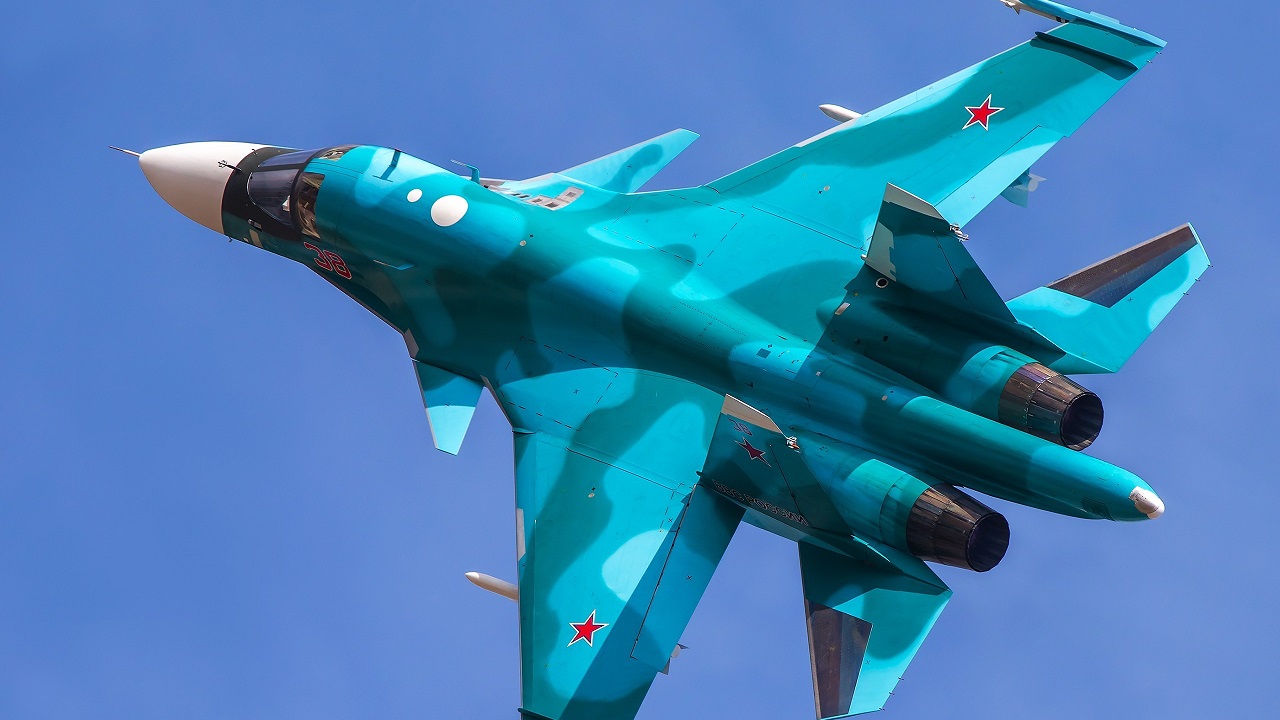
Russian Su-34 fighter-bomber. Image Credit: Creative Commons.

Su-34 fighter. Image Credit: Russian Government.

Russian Air Force Su-34 Fighter. Image Credit: Creative Commons.
-Beyond the immediate losses, the incident underscores a broader dynamic: Ukraine’s growing familiarity with Russian EW systems—helped by prior battlefield recoveries—paired against expensive, crew-intensive Russian tactical aviation under sustained attrition pressure.
-Ukrainian air defense units on January 29 were credited with shooting down two Russian Sukhoi fighter aircraft on the same day, including one that was destroyed over the Black Sea. The initial reports were made by Russian military bloggers and later confirmed by Ukrainian military officials.
Russia’s Su-34 Problem: A Costly Jet Keeps Getting Caught by Patriots
Initial reports indicated that both aircraft were Su-34 fighter-bombers. They entered service with the Russian Aerospace Forces in 2014. At least 23 of these aircraft have been lost in the Ukraine war alone, making it one of the Sukhoi variants most frequently shot down.
Official confirmation of which aircraft were intercepted and destroyed later came from Andriy Kovalenko, who is the head of Ukraine’s Center for Countering Disinformation. He announced that the two losses were actually one Su-34 and one Su-30SM multirole fighter, not two Su-34s as initially reported.
Both aircraft are normally protected by the latest electronic warfare (EW) systems produced by Russian industry.
According to a source in Moscow, they were shot out of the sky by a U.S.-made PAC-3 Patriot system.
Different Jets but Similar EW
In July 2018, the Russian defense journal New Defence Order Strategy reported that the General Staff of the Russian Aerospace Forces had decided to equip all Su-30SM fighters with the Kaluga Scientific Institute Radio-Technical Research (KNIRTI) SAP-518SM “Regata” pods of the Khibiny-U EW system.
By the time Russia invaded Ukraine, all Su-30SMs in Russian service should have been carrying the Khibiny-U system. The Su-34s are fitted with very similar versions of the Khibiny system—the L-175V Khibiny—while the Su-35S carries the L-265 Khibiny-M.

Su-30SM fighter. Image Credit: Creative Commons.

Su-30SM. Image Credit: YouTube Screenshot.

Su-30. Image Credit: Creative Commons.
The two aircraft may use very similar EW systems, but they are built on very different production lines. The Su-34 is a twin-engine, supersonic aircraft designed to deliver guided bombs, cruise missiles, and anti-ship weapons.
The Su-34 is a multi-role platform with a side-by-side cockpit that is in the same mold as the Cold War-era U.S. F-111.
In Russian service, it has replaced some of the missions of the Cold War-era Su-24, as well as some functions for both land attack and naval aviation once performed by the Tupolev Tu-22M Backfire bomber.
Russian Frustration
Ukrainian Naval Forces spokesperson Dmytro Pletenchuk said the initial reports of one of the shootdowns came not from Ukrainian military sources, but from Russian pro-war channels on Telegram.
“One of their war correspondents was the first to start whining about the loss,” Pletenchuk said on the My-Ukraine television channel, UNN reported. “Information from that source has often been confirmed later on.”
Moscow uses the Su-34 as a long-range platform to strike Ukrainian cities and frontline targets, and carry out operations over the Black Sea. The price of each aircraft is in the estimated $36 million range, but the latest variants, designated Su-34M, are fitted with new avionics that push the cost up to $85 million or more.
These aircraft are operated by highly trained crews that require extensive preparation. The platform, the pilots, and the weapon systems officers all are difficult to replace. Ukraine has been able to down so many Russian fighters by making a habit of targeting Russia’s air power—both at the front and deep in the rear.
In June 2025, the Security Service of Ukraine Alpha unit conducted Operation Spider Web, targeting multiple Russian airfields. This massive drone attack destroyed bomber aircraft, fuel facilities, and ammunition depots in operations that the security service says caused more than $1 billion in damage.
Russian air war planners are reportedly deeply frustrated by the failure of their electronic warfare (EW) systems against Western air-defense platforms such as the Patriot. “These Russian jammers were designed to defeat the Patriot above all other systems,” said a Moscow source. “Whatever algorithms were developed for these jammers are obviously not very effective anymore.”
There is a reason these EW systems are failing to perform. There were reports back in September 2022 that Ukrainian forces retrieved a near-intact RTU 518-PSM pod from a crashed Su-30SM. This pod is installed on the right wingtip of the aircraft.
This is one of several incidents during the war during which Ukrainian forces gained access to some of the most valuable Russian EW systems, increasing their knowledge about this technology by several orders of magnitude.
“Whatever Russian EW may have had that was effective against Western air defense and air-to-air missiles is greatly compromised at this point,” a retired Department of Defense analyst said of Moscow’s military hardware. “The number of these kinds of shootdowns are only going to increase from here on.”
About the Author: Reuben F. Johnson
Reuben F. Johnson has thirty-six years of experience analyzing and reporting on foreign weapons systems, defense technologies, and international arms export policy. Johnson is the Director of Research at the Casimir Pulaski Foundation. He is also a survivor of the Russian invasion of Ukraine in February 2022. He worked for years in the American defense industry as a foreign technology analyst and later as a consultant for the U.S. Department of Defense, the Departments of the Navy and Air Force, and the governments of the United Kingdom and Australia. In 2022-2023, he won two awards in a row for his defense reporting. He holds a bachelor’s degree from DePauw University and a master’s degree from Miami University in Ohio, specializing in Soviet and Russian studies. He lives in Warsaw.