Here are this week’s reading links and fiscal facts:
Medicare Advantage stocks tumble as Trump administration targets overpayments. Pia Singh and Annika Kim Constantino report in CNBC: “Shares of several big-name health-care companies plunged Tuesday after the Trump administration proposed nearly flat rates for Medicare Advantage (MA) insurers. […] The proposal entails a net average payment increase of 0.09% for Medicare Advantage plans in 2027, according to a release from the Centers for Medicare & Medicaid Services”—far below industry expectations “between 4% and 6%.” Chris Pope of the Manhattan Institute comments: “It’s astonishing what such an impact on stock prices says about: 1) the importance of MA to health insurers, 2) the importance of overpayments to MA.” Cato’s Michael Cannon has documented these pricing errors, noting that MedPAC estimates “Medicare will spend about 20 percent more for MA enrollees than it would spend if those beneficiaries were enrolled in [traditional] Medicare, a difference that translates into a projected $84 billion” in 2025 alone.
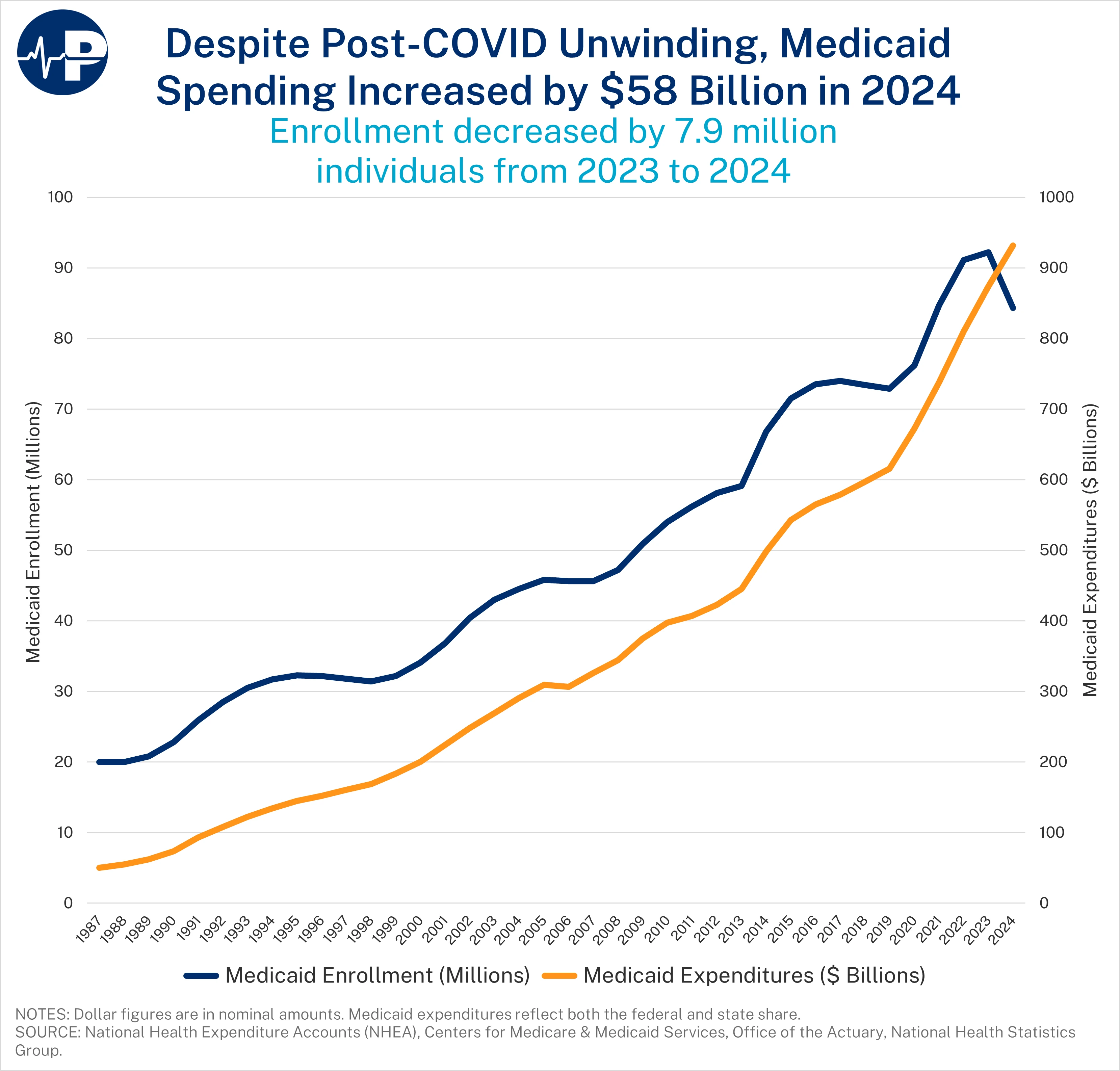
Medicaid per-enrollee spending grew at a record pace in 2024. Liam Sigaud of the Paragon Health Institute reveals: “Total Medicaid expenditures (federal and state shares combined) grew from $874 billion in 2023 to $932 billion in 2024—an increase of 6.6 percent. This surge in spending occurred despite a drop in enrollment of about 8 million people as states restarted eligibility verifications and removed ineligible individuals from the rolls. This divergence drove per-enrollee spending up by 16.6 percent in a single year—the fastest growth since at least the 1980s and more than five times the rate of overall inflation.” OBBBA made some progress in curtailing Medicaid spending growth, as Lett and Michel explain, “The OBBBA made several modest but positive Medicaid reforms, adding work requirements and curbing states’ use of ‘provider taxes’ to game its financing system.” With talk of reconciliation 2.0, Congress can go further in Medicaid reform. See here for our compiled recommendations.
Highway Trust Fund faces $410 billion shortfall as reauthorization looms. David Ditch of the Economic Policy Innovation Center writes: “The CBO estimates that the gap between the [Highway Trust Fund’s] spending and receipts will be $410 billion from FY 2026 through FY 2035, exhausting available funds in FY 2028 and requiring $329 billion in general fund transfers to maintain current spending levels over the period.” Ditch outlines three principles for the reauthorization: “Spend only what’s needed for national priorities rather than what stakeholders request,” “stop funding wasteful boondoggles,” and “give states flexibility on spending, revenue, and regulations.” Cato’s Krit Chanwong adds some specifics, as “financed mass transit grants strain the federal government’s ability to fund highway projects, widening the gap between dedicated revenues and outlays by 58 percent. Mass transit grants also distort local incentives by redistributing money from poorer states to richer ones. Eliminating mass transit grants, as such, would ensure that federal highway revenues are used only for highways.” Chanwong concludes, “Returning control of infrastructure funding to states and local governments would result in cheaper and better infrastructure.”

Farm subsidies: high-income welfare with a fraud problem. Cato’s Chris Edwards and Yasmeen Kallash-Kyler explain: “Recent scandals in Minnesota suggest the ease with which people can steal from federal grant programs for food, childcare, and health care. The epidemic of food stamp card skimming is also in the news. Low-income welfare is not the only type of federal spending hit by fraud. Farm subsidies—which are high-income welfare—also attract crime. With more than $30 billion a year in benefits, farm subsidy programs are a rich target for crooks.” Edwards and Kallash-Kyler highlight 15 cases of fraud that “were big-dollar, usually thefts of more than $1 million,” and “Many of the thefts profiled below were from the federal crop insurance program, which is the largest farm program at about $15 billion a year.” They emphasize, “farm subsidies are an inefficient, unfair, and unaffordable part of the federal budget.”
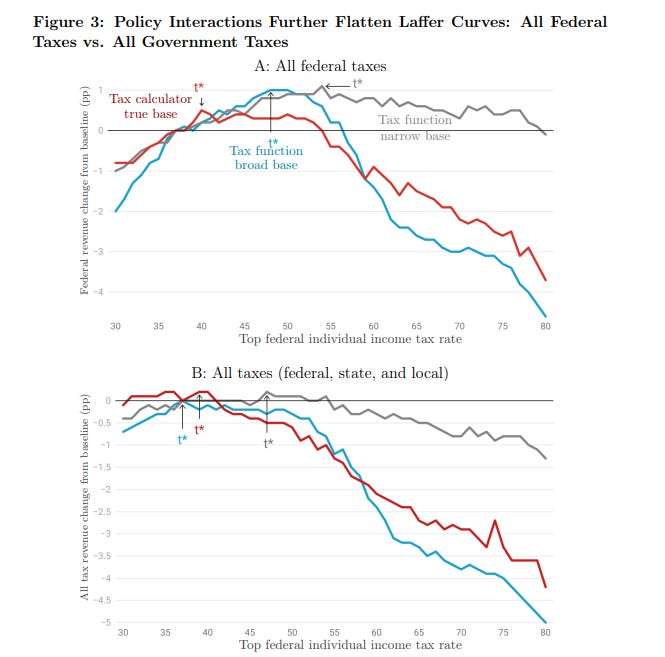
The Laffer Curve and why higher top tax rates raise less revenue than promised. In a new paper from the Joint Committee on Taxation, the authors conclude, “increasing the top tax rate two percentage points to 39% raises total taxes by only about 0.2%. Thus, when considering all levels of government, increasing the top rate to the revenue-maximizing level results in total revenue gains of less than 0.1% of GDP.” The figure below shows how the top of the Laffer curve is flatter when considering all taxes, and that the US is already near the top of the Laffer Curve. This finding reinforces the point that taxing the rich cannot close America’s fiscal gap. As Cato’s Adam Michel has explained, “If current U.S. spending growth is not slowed down, European-level taxes are inevitable. […] the current progressive tax system, where the top 10 percent of income earners pay 60 percent of all federal taxes, is unsustainable. No other large, peer welfare state supports its high spending without higher taxes on middle-class taxpayers.”