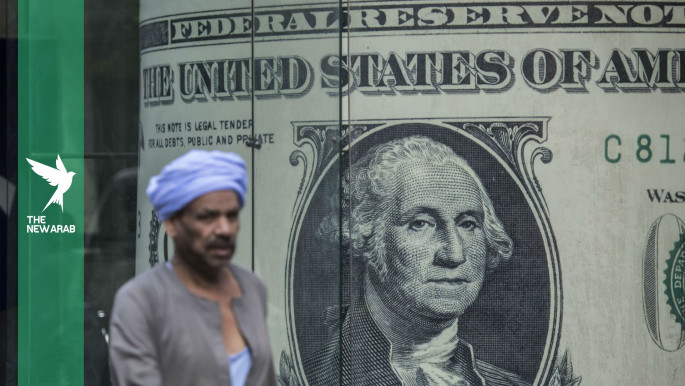
Egypt, local economists say, can be one of those winners if it attracts European and American investments. [Getty]
As trade relations between Europe and the US fray, Egypt is positioning itself as an alternative destination for European and American investors rushing to evade supply-chain disruptions and geopolitical risks.
Trade conflicts between the two sides erupted when Donald Trump returned to the White House in January last year and are intensifying amid US demands regarding Greenland.
Washington escalated by issuing pointed tariff threats, including an initial 10% levy on goods from various key European nations as of 1 February, with the possibility of raising it to 25% by June if no agreement is reached.
This prompted the EU to retaliate with measures, including the suspension of a key trade deal with the US.
International organisations, particularly the International Monetary Fund, are warning of a global economic slowdown amid this trade war.
But there appear to be some potential winners in this brewing fight: bystander nations like Egypt.
Egypt, local economists say, can be one of those winners if it attracts European and American investments and capitalises on trade-war-related investor fears on both sides, and harnesses its trade and investment advantages.
Independent economist Mohamed Abdelhamid said Egypt is proactively positioning itself to capitalise on the intensifying trade war between the US and Europe.
“It implements measures to reap the benefits of this trade conflict between the two sides,” Abdelhamid told The New Arab.
He noted that the country is actively working to attract investment to diversify and relocate supply chains away from traditional hubs, particularly as tariffs and levies continue to rise.
Drawing on his experience as a former member of the Egyptian Parliament’s Committee on Economic Affairs, Abdelhamid emphasised that the government has developed targeted contingency scenarios to navigate global trade disruptions.
These strategies, he argued, zero in on sectors where Egypt holds a distinct competitive edge, including green hydrogen, automobiles, and textiles.
The trade war between the US and Europe comes as Cairo is trying to create jobs for its ever-growing number of university graduates and attract foreign currency to repay its mounting foreign debt.
Recently, this populous country’s legislative bodies have formulated new investment laws, removed barriers to foreign investment, and introduced incentives, all aimed at attracting foreign capital.
Egyptian authorities are also working to implement an ambitious plan to increase national exports to $100 billion annually, primarily through non-oil or commodity exports, from around $40 billion at present.
Attractive destination
As US-China trade conflicts intensified a few months ago, Egypt was viewed as a possible beneficiary, with Chinese investors seeking to shield themselves from Trump’s skyrocketing tariffs on Chinese imports to the US market.
Now, Egyptian officials are openly discussing the possibility of their country benefiting from the escalating trade war between Europe and the US, especially after Trump imposed 10% tariffs on products from Egypt.
This was probably why Egyptian President Abdel Fattah al-Sisi was keen to engage with international investors, especially European ones, when he participated in the Davos Economic Forum in mid-January.
Among other activities, the Egyptian president participated in a closed-door dialogue session with around 70 international business leaders and heads of major global and regional financial institutions.
The session included discussions on investment in Egypt, with an emphasis on attracting foreign direct investment, amid reforms such as the State Ownership Policy, which is expected to help the Egyptian government exit key economic activities.
Egyptian officials accompanying the president, including Minister of Investment and Foreign Trade Hassan El-Khatib, also held separate meetings with European firms, such as Greece’s Public Power Corporation, on green energy and cross-border projects.
These engagements, economists say, are important for Egypt to showcase its investment opportunities and incentives.
“The transformative reforms enacted in recent years hold immense potential to transform Egypt into a premier destination for global investors,” Abdelhamid said.
Challenges
Egypt does not expect an easy ride in attracting European or American investment, especially at a time when tariffs are becoming political, not economic, tools.
Some observers argue that the US president could reverse his punitive tariffs on European states if negotiators on both sides reach common ground on sticky political issues, including Greenland, a flagship of the current American-European rift.
Relations between Cairo and Washington are mainly driven by Egypt’s stabilising role in the region, its efforts, together with key mediators Qatar and Turkey, to broker a ceasefire in Gaza, and its work to keep the ceasefire alive.
Nonetheless, the same relations could deteriorate in the future, especially if conflicts arise over regional arrangements, including in Gaza or elsewhere, the same observers warned.
Before reaching a common ground on Gaza, Cairo and Washington had divergent visions for the Palestinian territory, notably after Trump proposed that Egypt and Jordan take in Gaza refugees under his “Middle East Riviera” plan.
The Egyptian president, who turned down an invitation from the US president to visit Washington in February 2025, said his country would not be complicit in the displacement of the Palestinians.
Maximising own attractions
Despite these concerns, Egypt is now leveraging its strategic location, free trade agreements, and competitive sectors to position itself to benefit from current geopolitical and trade tensions between Europe and the US.
This comes as economists expect mutual tariffs between the two sides to make Egyptian goods more price-competitive in both markets by raising the cost of transatlantic trade.
The EU is Egypt’s largest trading partner, with exports to EU countries accounting for 22% of Egypt’s overall trade in 2024.
In the same year, the EU was also the main destination for Egyptian exports and the largest source of Egyptian imports.
Egyptian products, meanwhile, face relatively low or zero tariffs in the American market under arrangements such as the Qualifying Industrial Zones programme, which allows duty-free access for textiles and apparel with minimal Israeli content.
If European exports face 10-25% tariff hikes, economists say, Egypt could fill gaps in sectors like apparel, where it already benefits from trade wars by offering cheaper alternatives.
Rashad Abdo, professor of economics at Helwan University, said the escalating trade war between the US and Europe presents a golden opportunity for countries like Egypt to capture a significant market share.
“This trade conflict creates substantial gaps in each side’s market as the other withdraws or faces barriers, gaps that Egypt is well-positioned to fill profitably,” Abdo told TNA.
He emphasised that the same dynamics are enabling Egypt to emerge as a compelling alternative industrial and export hub, leveraging its low production costs to attract redirected manufacturing, supply chains, and investment flows away from tariff-affected traditional players.
Under the EU-Egypt Association Agreement, Egypt enjoys tariff-free access for most industrial and agricultural goods.
If US tariffs prompt EU retaliation, Egyptian agricultural exports, especially fruits, vegetables, and manufactured goods, could surge as EU importers avoid pricier US alternatives, some observers say.
The same observers note that companies facing higher costs in the US-EU corridor may relocate production to neutral hubs like Egypt to bypass tariffs, a phenomenon seen in past trade wars, particularly between the US and China.
Egypt’s incentives, such as the Suez Canal Economic Zone, free zones, and infrastructure upgrades, make it appealing for investors on both sides, they add.
“Exploiting the attractive incentives on offer will require serious hard work from Egyptians, who cannot simply sit back and wait for investments to arrive on their own,” Abdo stressed.
He further emphasised the critical role of government agility: “The authorities must demonstrate the necessary flexibility and swift decision-making to position Egypt as a strategic economic partner for major global blocs amid these shifting trade dynamics.”