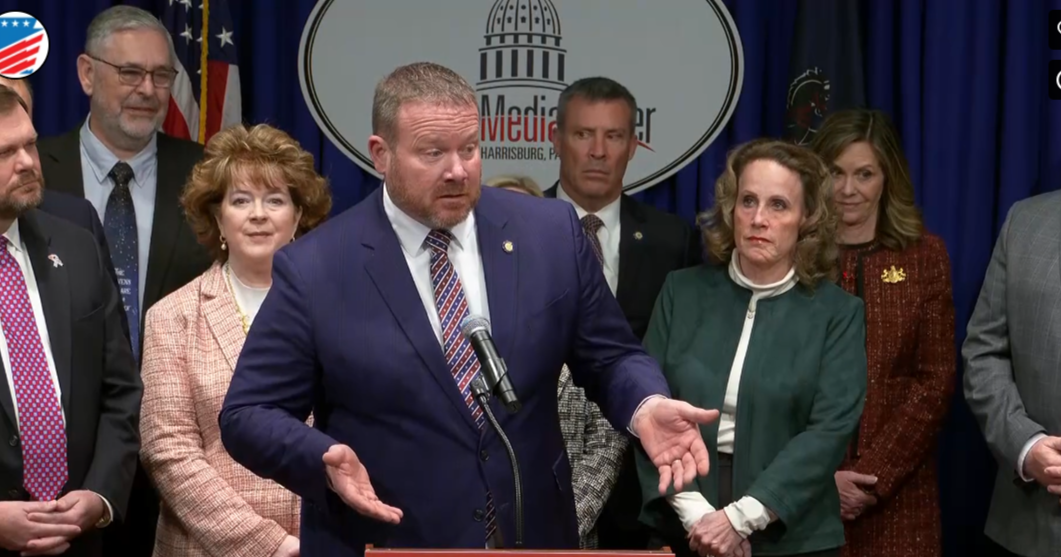
Just three months after Pennsylvania lawmakers ended a long budget impasse, state Sen. Scott Martin called Gov. Josh Shapiro’s latest budget proposal a “rinse and repeat.”
Shapiro on Tuesday put forward a $53.3 billion budget that would require using $4.6 billion of the state’s rainy day funds. This is the second year in a row Shapiro has proposed dipping into the $7.8 billion pot of reserves to close a deficit.
Martin, a Martic Township Republican who chairs the Senate Appropriations Committee, said the move is problematic for the future fiscal health of the state, echoing similar concerns he shared during last year’s budget debate.
The positive bond ratings that Shapiro touted during his Tuesday address, Martin warned, could be at risk if the state reserves are tapped again.
“On one hand, he’s sugar potting everyone over here, talking about all of the benefits of a rainy day fund, but on paper, in terms of his budget, he wants to take $4.6 billion out of that,” Martin said. “Now, if anyone’s ever done bond work, let me tell you something, the moment we start draining the fund completely is the moment we’re going to get bond downgrades.”
Martin is in a key position when it comes to state budget negotiations as the leader of the Appropriations Committee, which can amend budget-related legislation before it reaches the chamber for a floor vote.
Most Lancaster County Republican lawmakers agreed with Martin.
State Rep. Steve Mentzer of Manheim Township issued a statement calling Shapiro’s proposal “deeply concerning,” saying “reckless deficit spending” will lead to tax increases, which he predicted could come as early as next year. East Earl Republican Rep. Dave Zimmerman and Manheim Republican Rep. Mindy Fee also voiced concerns about using rainy day funds.
Rep. Keith Greiner of Upper Leacock Township called Shapiro’s pitch a “rich” budget and said he believes most line items will likely need to be shaved off the top to make the budget work.
But East Petersburg Democrat Sen. James Malone said lawmakers need to recognize when it’s appropriate to use savings to fund services across the state.
“We have an affordability issue across our commonwealth. This is the right time,” Malone said. “This is literally the time to do that investment. We need to get our revenues up.”
Shapiro is counting on new taxes on legalized marijuana and skill games to pay for his proposed spending. Republicans are quick to point out that neither sources of revenue are guaranteed and efforts to codify them into law last year were unsuccessful.
“The games of skill, it’s been an ongoing battle,” Martin said. “I know it’s been a talking point, ‘Well, the Senate Republican Caucus needs to work that out.’ I’ve never seen words on paper come from the governor.”
Martin has stood adamantly against legalizing marijuana, saying he wouldn’t let the issue pass through the Appropriations Committee, which must approve any budget-related bills before they can reach the Senate floor. Martin on Tuesday said he would be open to discussion on skill game legalization and regulation.
State Rep. Tom Jones of East Donegal also blasted Shapiro’s proposed taxes. “Yet again he is seeking to tax skill games and legalize recreational marijuana. Relying on vice taxes is not a reliable budgeting method and puts Pennsylvanians in jeopardy of addictive habits that could have far-reaching negative impacts on families,” he said.
Malone and Lancaster Democratic Rep. Izzy Smith-Wade-El said the state needs to continue pushing for those revenue sources.
READ: Lancaster city’s average monthly rent is on the move – here are the details
Affordable housing
Democrats praised Shapiro’s plan to invest $1 billion in infrastructure, part of which would fund the rehabilitation and construction of housing units.
“Housing is a serious concern,” Malone said. “Whatever we can do to be able to move that forward so that we are rebuilding and reorganizing in a way that keeps our farmland integrity, keeps our natural resources integrity, and also bring in stock that our working people can afford, I’m on board with.”
Smith-Wade-El highlighted Shapiro’s pitch to create a statewide cap on rental application fees. He said tenant rights are often overlooked during housing discussions but are just as important to pay attention to as affordable homeownership.
“What we have is a place where tenants are spending hundreds, sometimes thousands, of dollars, just to secure a single apartment,” Smith-Wade-El said. “For that money, landlords, especially large corporate landlords, are providing virtually no service.”
READ: School District of Lancaster lawsuit moves to federal court
Education boost
Lancaster County’s 17 school districts are slated to receive $248.7 million under Shapiro’s budget pitch, a slight increase from the $247.1 million included in the current year’s budget.
Smith-Wade-El said it is essential for the state to continue to meet the Commonwealth Court’s 2023 ruling that poorer school districts need more state funding. Democratic State Rep. Nikki Rivera, a former Manheim Township school board director, said savings related to cyber charter reforms are positive but wants to see more done.
Peach Bottom Republican Rep. Bryan Cutler and East Hempfield Republican Rep. Brett Miller agreed Shapiro’s proposal to add $18 million funding to career and technical schools will be a major benefit for students across the state.
“We’ve got hundreds, if not thousands, of kids waiting to get into some (career and technical) programs,” Cutler said. “While we’re increasing funding on the traditional education side, which the governor likes to tout, the truth is the demand is actually on the CTC side.”
READ: Gov. Josh Shapiro proposes $53.3B budget as Harrisburg prepares for midterm elections
Avoiding an impasse
Shapiro called on legislative leaders to meet with him to discuss the budget starting this week, and said every caucus leader has agreed to do so as they strive to hit the June 30 deadline and avoid another lengthy impasse.
Greiner said early budget negotiations should set a “positive tone” for discussions down the line.
As a former teacher and Manheim Township school board director, Rivera said a budget passed on time will be a major benefit for public school officials adopting their own budgets without knowing how much money they’d receive from the state.
“I would actually love to see April 30 be our budget deadline,” she said. “To hear that they’re starting Feb. 4 just made my day.”
