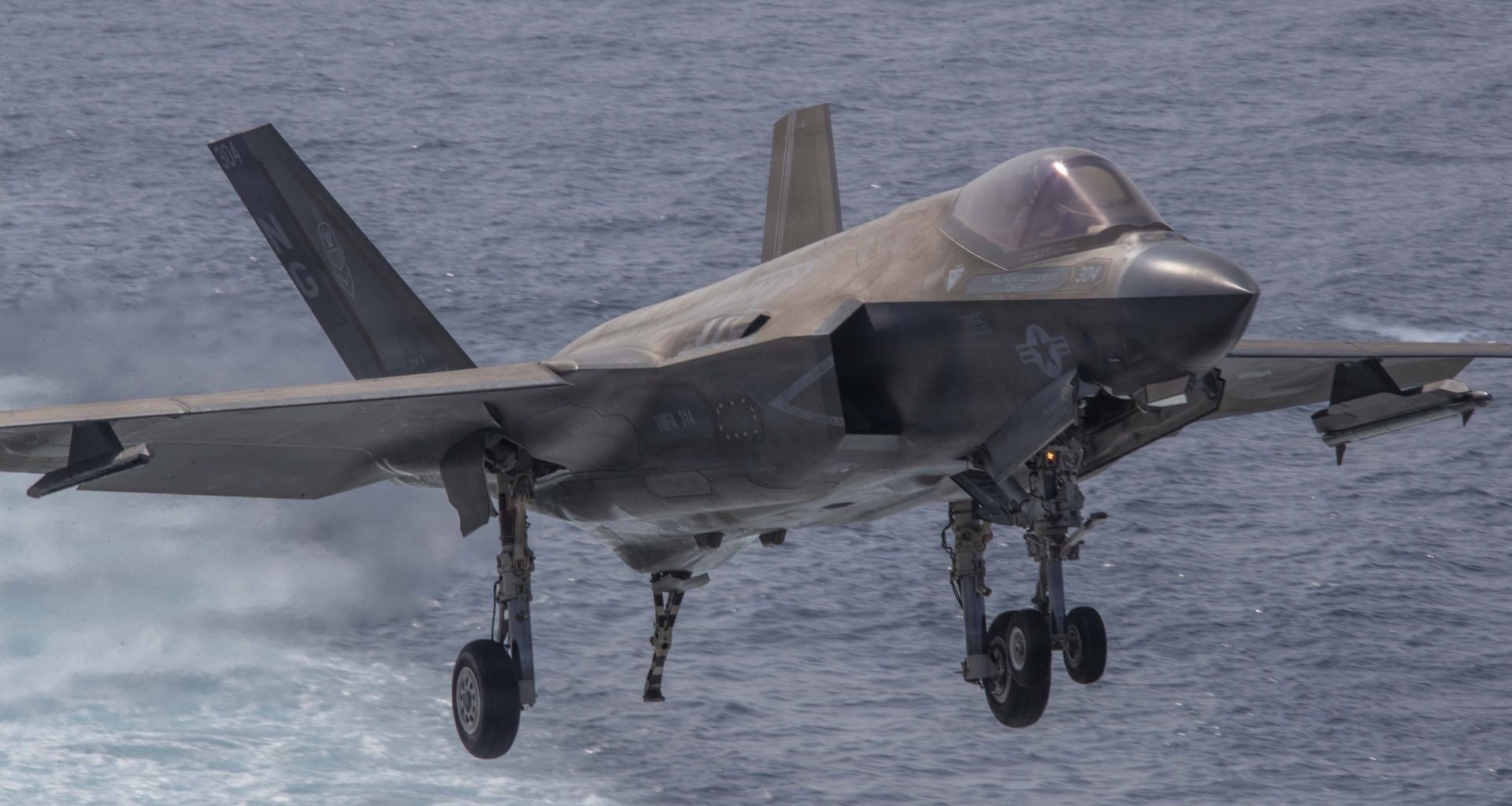
An American stealth fighter jet shot down an Iranian one-way attack drone in the Arabian Sea Tuesday after it “aggressively approached” a U.S. aircraft carrier “with unclear intent,” according to a statement from U.S. Central Command.
Just hours after the shootdown, two Iranian Islamic Revolutionary Guard Corps ships accompanied by another unmanned aerial system — this one an Iranian Mohajer drone — approached a U.S.-flagged tanker in the Strait of Hormuz, threatening to board and seize the vessel, the statement from Centcom spokesperson Capt. Tim Hawkins said.
The dual incidents could spell increased tensions between Washington and Tehran after President Donald Trump threatened military action against Iran over its deadly suppression of protests last month and amid broader nuclear negotiations that could begin this week.
The jet, an F-35C Lightning II, launched from the USS Abraham Lincoln, which was transiting the Arabian Sea roughly 500 miles from Iran’s southern coast, Centcom said. The Centcom statement did not identify the unit the jet belongs to, but Marine Fighter Attack Squadron-314, the Black Knights, were photographed by the military operating off the Lincoln several days ago.
The long-range Iranian drone — a Shahed-139 UAS known for its use in the Russia-Ukraine war and being reverse-engineered into a U.S. military one-way attack drone — “continued to fly toward the ship despite de-escalatory measures taken by U.S. forces operating in international waters,” the command said.
The F-35C shot it down “in self-defense” and to protect the Lincoln and her crew, according to the statement, which said that no service members were harmed and no American equipment was damaged.
“Many c-UAS capabilities require close proximity to engage,” Alex Plitsas, a senior fellow with the Atlantic Council focused on the Middle East, told DefenseScoop. “The U.S. likely wanted to ensure it didn’t get too close and made the call to take it out of caution. Fighter aircraft have been used to down Iranian drones over the past few years, but it does speak to the lack of an inexpensive capability to effectively deal with the situation as the missiles and [fighter aircraft] flights are expensive.”
Hours later, two IRGC boats and the Mohajer drone — which is used for surveillance, but can carry precision-guided munitions — “harrassed” the merchant vessel Stena Imperative, approaching it at “high speeds” and threatening to seize the tanker, according to the Centcom statement. The USS McFaul, a guided-missile destroyer, responded to the scene to escort the U.S.-flagged vessel with support from the U.S. Air Force, which “de-escalated” the situation.
The Trump administration began sending additional military assets to the Middle East last month after Trump told Iranians to keep protesting against their authoritarian government, adding that “help is on its way.”
But the Middle East buildup continued and last week Trump warned Iran to make a deal over its nuclear weapons and ballistic missile programs, threatening that “the next attack will be far worse” than one the U.S. carried out last year on nuclear facilities in the country during Operation Midnight Hammer.
The Lincoln and three other warships arrived in the Middle East last week, the Associated Press reported, with thousands of troops, equipment and missiles.
CNN reported this week that U.S. and Iranian officials were planning to meet in Turkey on Friday to avoid military action and reestablish nuclear negotiations, a long-time concern for Washington.
White House press secretary Karoline Leavitt told reporters Tuesday that talks between the officials are “scheduled as of right now, but of course the president has always a range of options on the table, and that includes the use of military force,” CNN reported.
“The action to shoot down the Iranians drone was for force protection given proximity to the Lincoln carrier strike group,” said Plitsas. “It was a clear message to the Iranians in addition to backing up statements from the U.S. in recent days warning Iran to act responsibly in international waters and air space.”
“The shoot down in itself is unlikely to stop talks given the repercussions for Iran if talks do not happen or fail,” he added. “If this becomes a pattern or a U.S. ship comes under fire, that could change things.”

Written by Drew F. Lawrence
Drew F. Lawrence is a Reporter at DefenseScoop, where he covers defense technology, systems, policy and personnel. A graduate of the George Washington University’s School of Media and Public Affairs, he has also been published in Military.com, CNN, The Washington Post, Task & Purpose and The War Horse. In 2022, he was named among the top ten military veteran journalists, and has earned awards in podcasting and national defense reporting. Originally from Massachusetts, he is a proud New England sports fan and an Army veteran.