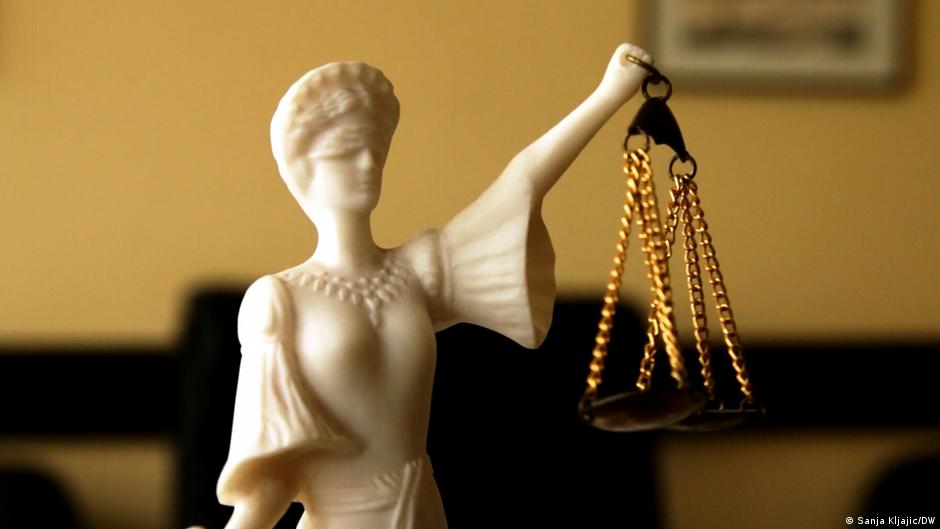
After months of mounting pressure on independent media, academic institutions and NGOs, Serbia‘s ruling majority has turned its attention to the judiciary.
In an expedited procedure, without public debate or consultations and bypassing established legislative standards, the Serbian parliament last week adopted a package of amendments to core judicial laws that critics say threatens the independence of the country’s judiciary.
The so-called “Mrdic laws” — named after ruling Serbian Progressive Party (SNS) lawmaker Ugljesa Mrdic, who formally submitted them — introduced changes to a total of five laws.
Mrdic argued that the amendments would make the justice system “more efficient.”
“This is the first step in returning the hijacked judiciary to the state and the people of Serbia, so that it is no longer governed by alienated centers of power under foreign control,” he said during the parliamentary debate.
Ugljesa Mrdic who formally submitted the amendments to parliament, said that they would make the justice system ‘more efficient’Image: Sanja Kljajic/DW
Within Serbia’s legal community, however, the amendments are widely seen as an attempt to put the prosecution under complete political control and to obstruct investigations into high-level corruption and organized crime many suspect reach right to the top of the political hierarchy.
‘Complete paralysis’
The biggest blow dealt by the amendments is to the Public Prosecutor’s Office for Organized Crime (TOK).
Under the new rules, more than half of its prosecutors are set to lose their mandates within 30 days and be reassigned to the posts they held before joining the TOK. For many, this would mean returning to jobs they left years ago.
The TOK has warned that this would lead to a “complete paralysis in handling the most complex and sensitive cases.”
“There is only one reason for this: Over the past year, the Public Prosecutor’s Office for Organized Crime has launched investigations into two former ministers and filed an indictment against a sitting government minister. This is retaliation,” Sofija Mandic of the Center for Judicial Research (CEPRIS) told DW.
Lawyer Sofija Mandic of the Center for Judicial Research (CEPRIS) told DW that these amendments are a retaliation for investigations into two former ministers and an indictment against a sitting government ministerImage: MCB
Mandic noted that prosecutors possess extensive evidence intercepted from the encrypted Sky Communications messaging platform, which, she says, explicitly mention senior state officials.
What is the TOK investigating?
The TOK is conducting investigations into several major drug cartels. It is also investigating the deadly collapse of a canopy at the entrance to Novi Sad railway station in November 2024, which claimed the lives of 16 people and triggered widespread suspicions of systemic corruption in large infrastructure projects involving Chinese contractors.
The TOK has also filed charges against Culture Minister Nikola Selakovic, accusing him of abuse of office by lifting the protected cultural heritage status of the General Staff complex in central Belgrade, thereby paving the way for a major real estate development linked to a company associated with Jared Kushner, the son-in-law of US President Donald Trump.
Kushner withdrew from the project after Selakovic was indicted.
Curbing judicial independence
DW sources note that although public trust in the prosecution has long been low in Serbia, constitutional and legal reforms adopted in 2023 gave prosecutors somewhat greater autonomy.
Serbia’s Public Prosecutor’s Office for Organized Crime (TOK) has accused the country’s Minister of Culture and Information Nikola Selakovic of abuse of office and falsifying documentsImage: Alexander Shcherbak/TASS/picture alliance
This led to the opening of a number of sensitive investigations, which were almost immediately met with political pressure and dismissals, particularly at the Belgrade Higher Prosecutor’s Office, headed by Nenad Stefanovic, a figure close to the ruling party.
Prosecutor Bojana Savovic, who two years ago publicly exposed political interference in the work of the Belgrade Higher Prosecutor’s Office, says many prosecutors needed time to fully grasp their new responsibilities.
She adds that the Novi Sad tragedy and the subsequent wave of protests pushed prosecutors toward independent action.
“I think a large part of the judiciary realized that certain red lines were being crossed — lines that were unacceptable. Statements began to be classified as criminal acts where there was not even a trace of criminal liability. People were detained and held in custody without any justification,” Savovic told DW.
The TOK itself issued a public warning about direct pressure from President Aleksandar Vucic, citing his public statements, as well as institutional obstruction of the Novi Sad investigation, including the withdrawal of the police, the Tax Administration and the Anti-Money Laundering Directorate from joint investigative work.
‘The vote by Serbia’s parliament to limit the independence of the judiciary is a serious step back on Serbia’s EU path,’ EU Commissioner Marta Kos wrote on X. Pictured here: Serbian President Aleksandar Vucic in BrusselsImage: Dursun Aydemir/Anadolu/picture alliance
Amid intense media targeting of prosecutors, news also emerged of a fire breaking out in the office of one prosecutor involved in the case, at a time when key documentation was being stored there — documents that, according to official statements, were saved at the last minute.
Robust criticism from Brussels
The legislative changes drew swift condemnation from Brussels, which announced it would conduct a “substantive assessment” and decide on further steps.
“When a country is a candidate for EU membership, as Serbia is, we expect it to behave in a European manner. This is a serious step backwards,” said EU Enlargement Commissioner Marta Kos.
Some observers expected President Vucic to refrain from signing the laws in light of the backlash. Instead, he signed them immediately, openly describing the move as an act of defiance.
“It was said that Vucic must not sign, that Brussels ordered him not to. Someone ordering me? Anyone who thinks that is possible is not normal. I will listen to everyone, but I make the decisions,” said the president.
Judicial resistance: last line of defense?
As Brussels prepares its analysis, resistance is mounting within the Serbian judiciary.
The Union of Judicial Authorities has called on judges and prosecutors to suspend work in defense of judicial independence and the rule of law — a call that many have heeded.
Prosecutors, laywers and judges protested the amendments to the laws outside the courthouse in Novi Sad on February 2Image: Sanja Kljajic/DW
In Novi Sad, groups of judges and prosecutors already left their courtrooms on Monday to join street protests, while work stoppages are spreading across the country.
“Others believe that suspending work is not enough, that different and stronger methods are needed,” says Bojana Savovic. “But whatever the method, it must be immediate. If nothing is done in the next month or two, the consequences could become irreversibly damaging.”
Sofija Mandic, however, warns that it may already be too late. “Society as a whole has reacted too slowly. The concentration of personal power has been underway for 14 years. Some only woke up at the very end,” she told DW.
Still, she sees a glimmer of hope. “Are there people resisting? I think there are — more than ever before. The pressure is so brutal that it is waking even those who slept deeply for years.”
The judiciary may still have the capacity to resist. But without sustained public support — and clear signals from the EU — that resistance may not be enough to stop Serbia’s slide toward a full autocratic system.
Edited by: Aingeal Flanagan