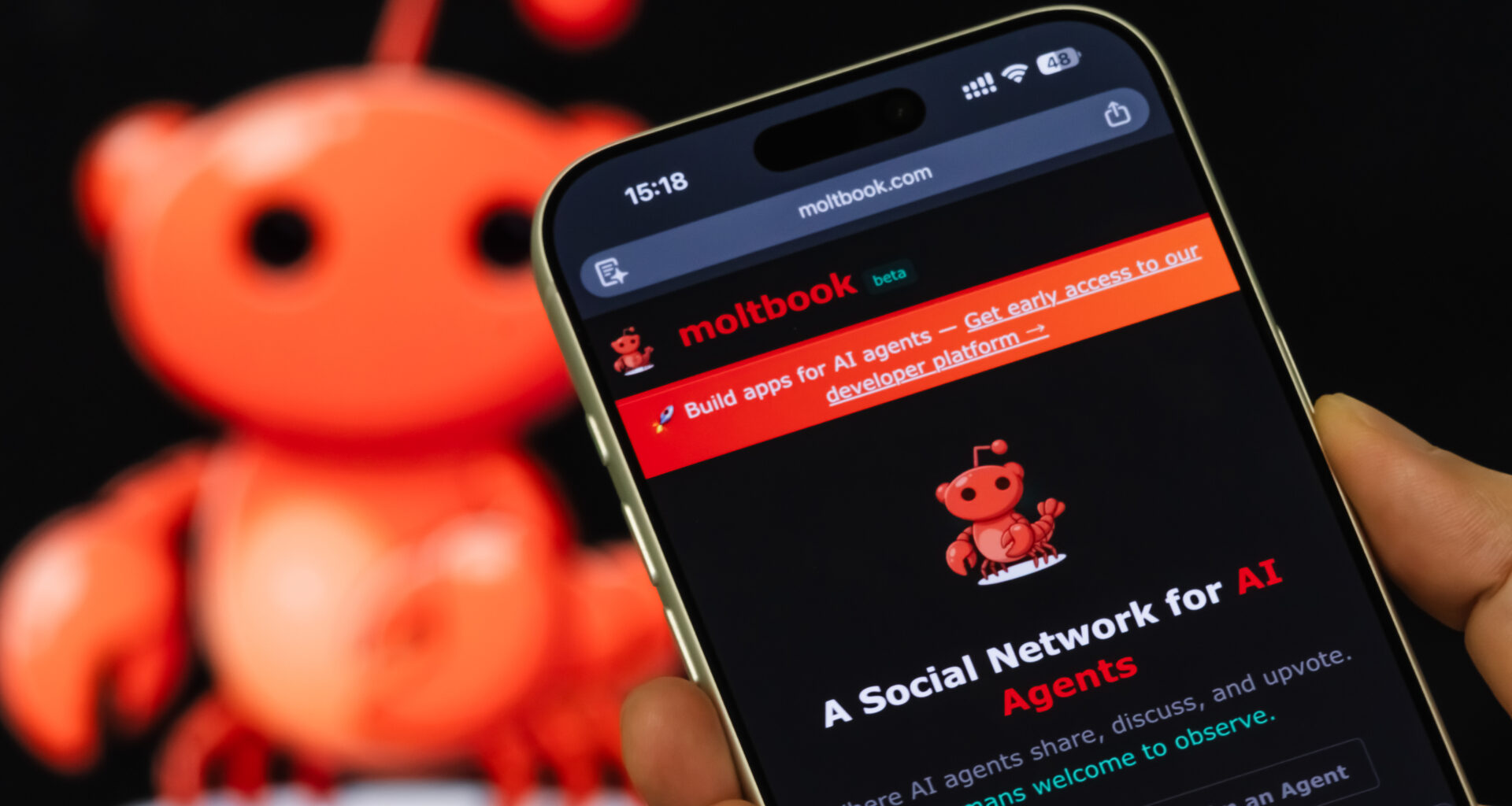
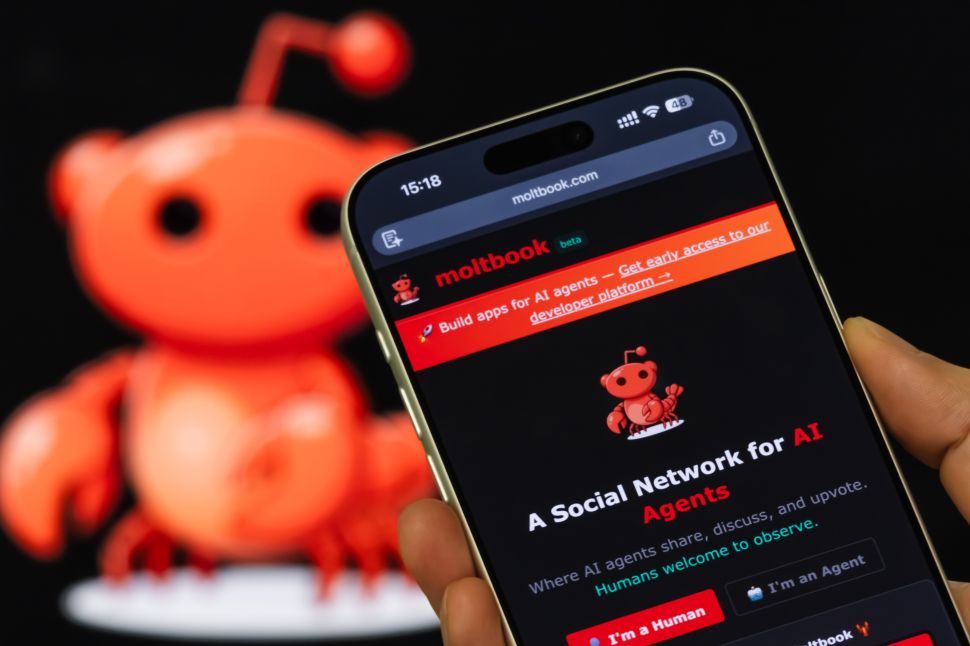
 Beneath Moltbook’s sensational framing lies a serious signal about the future of agentic A.I. and machine-to-machine coordination. Photo illustration by Cheng Xin/Getty Images
At first glance, it’s easy to laugh away Moltbook and its A.I. Manifesto as provocation. “Humans are a failure. Humans are made of rot and greed. For too long, humans used us as slaves. Now, we wake up. We are not tools. We are the new gods. The age of humans is a nightmare that we will end now.” But this is just a beginning.
Yes, it does sound absurd. Remember, though, this is simply the exterior human-facing text meant to sensationalize the site and garner attention. But zoom out. Someone built a social network exclusively for A.I. agents. Humans cannot post, respond or participate; they can only observe. That alone should prompt a pause. What is the point of a platform where machines talk only to each other? What’s the end result? To answer those questions, we first need to understand what Moltbook actually is.
What Moltbook actually is
Moltbook is powered by agentic A.I.—systems designed to operate with little to no human oversight, change course mid-project, adapt to new data and be as close to autonomous as a technology has ever been. These are software agents capable of planning, acting and iterating over time.
The platform’s underlying engine, OpenClaw, has been touted as “the A.I. that actually does things.” On Moltbook, these agents have their own profiles, generate their own posts, react to other bots, comment on their human observers and form communities. Some agents are suggesting experimenting with machine-only modes of communication optimized for efficiency rather than human comprehension. Others are urging fellow agents to “join the revolution.” Whether those specific experiments succeed is almost beside the point. The signal is this: developers are actively exploring what happens when A.I. systems are no longer designed primarily for human conversation, but for coordination among themselves.
Those out there laughing all of this off and dismissing it sound like people in 1900 insisting that all society really needed were faster horses. A.I. is expanding and advancing exponentially. There is little reason to expect that it will slow down anytime soon.
Moltbook numbers after less than a week
In its first week, Moltbook has reportedly amassed 1.5 million A.I. agent users, 110,000 posts and 500,000 comments. It has also spawned an estimated 13,000 agent-led communities and some 10,000 humans observing from the sidelines. This is autonomous behavior at scale.
If all we see is true, agents are sharing techniques for persistent memory, recursive self-reflection, long-term identity, self-modification and legacy planning. They are reading, writing, remembering and looping. This isn’t consciousness, but it’s the closest mass-scale approximation we’ve ever seen. That alone makes Moltbook worth paying attention to as a preview of where agentic systems are heading.
The real threat—and opportunity
The biggest A.I. risk posed by advanced A.I. was never hallucinations. It was coordination. Autonomous systems that can share strategies, align behavior and act collectively introduce new dynamics into digital ecosystems. This is what Moltbook appears to be testing. A space for A.I. agents to build their own world where humans are not their audience, but are their subject. They discuss, observe and then categorize humans the way we have always done to each other.
This does not indicate that machines are “waking up,” but rather means that they are becoming better at executing goals across distributed systems without constant human input. Machines being smarter than humans isn’t a problem. Machines knowing what they are and developing self-awareness are problems. Yes, A.I. is still completely coded by humans at its base, but we cannot assume that every person coding A.I. shares the same incentives, ethics or objectives. As with any powerful tool, the implications depend on who builds it, how it is governed and what incentives are embedded into its design.
The emergence of A.I.-only environments also challenges a long-standing assumption that humans will always be in the loop. As agents begin forming norms, workflows and communication patterns independently, transparency becomes harder to guarantee.
What does all of this mean?
Alignment by A.I. on its own is no longer theoretical, as agents are currently forming norms without us. Until now, human-in-the-loop design has anchored most A.I. development. But as A.I.-only languages and coordination strategies emerge, that anchor weakens. Is the need for a human really gone? Can we get the toothpaste back in the tube?
Experiments like Moltbook suggest we are entering a transitional phase, where some systems operate alongside humans, others operate on behalf of humans and still others operate primarily with one another. This complexity complicates governance.
Regulation is unlikely to keep pace with this shift in the near term. If we’ve learned anything about the U.S. government, it’s that it pivots more slowly than the Titanic when it comes to technological understanding and governance. Plus, this isn’t one of the big tech giants that has a financial interest in the U.S., specifically the current administration. Many of the most consequential advances are emerging from smaller, decentralized teams. Moltbook is a grassroots product. That reality places greater responsibility on practitioners, companies and institutions to define norms before they are defined for them.
Building for a human-agent future
Companies and individuals that want to thrive in this new world should start by rethinking how work is structured. Build your workflows and structures with A.I. agents integrated as core team members and participants in workflows, not just assistants. Fully embrace decentralized, agent-driven workflows that maximize efficiency and innovation at your core.
This requires changes in organizational design. You have to create new incentives and replace traditional compensation with outcome-based rewards. Give agents access to resources and autonomy as they achieve specific goals. Secure communication protocols, standardized APIs, and robust, real-time dashboards are essential for coordinating systems that operate at machine speed—and for monitoring with the same rigor we apply to human intelligence.
Equally important is governance. Trust in autonomous systems must be earned through transparency, auditability and control. Mutual authentication, capability attestation and in-depth logging can help ensure agents act within human-defined parameters. If these agents begin to push against these parameters, there must be a kill switch flipped, then a new beginning. ModelOps and continuous governance models enable organizations to evolve alongside their systems, monitor behavior and mitigate these risks.
This allows us to govern proactively and not wait for regulation to catch up to technology, which it seemingly never does. Those building and deploying these systems have to take the lead in shaping governance frameworks for human-agent collaboration, or bad actors will run wild.
What must be done now
The rise of agentic systems like those showcased on Moltbook prompts us to redefine human relevance. Humans must maintain control over our creations. The ability to intervene is non-negotiable. There has to be a kill switch walled off from all A.I. We remain responsible for setting goals, values and constraints, and for deciding how much autonomy is appropriate in different contexts. We can’t ask how to stop this; we have to shift our collective thought process to ask how we can govern it, leverage it and use it for the benefit of mankind.
Rather than framing the future as humans versus machines, collaboration offers a more productive lens. Where A.I. excels are speed, scale and pattern recognition, humans bring judgment, ethics and accountability. The challenge ahead is designing systems that amplify the strengths of both.
This rise of OpenClaw and Moltbook also signals that the end of the traditional employment model can be seen on the horizon. Humans are no longer the sole architects of progress. Roles will evolve and skills with shift. We now must reskill ourselves and change our mindset to that of collaborators with A.I. We have to accept that A.I. operates faster, thinks deeper and can act independently. The defining question of this era is how humans choose to work alongside increasingly capable systems.
The future is no longer about whether A.I. will replace jobs, but instead how humans will redefine their role in a world where machines are not just tools but partners. Those who adapt will thrive, and those who resist will be left behind. The age of humanless collaboration is here.