
Chancellor Friedrich Merz said on Wednesday that Germany is seeking closer partnerships in the Gulf region to safeguard its position in a rapidly changing global order, ahead of a trip to Saudi Arabia, Qatar and the United Arab Emirates.
He said Germany wanted to expand strategic dialogue with the three states in the wealthy and strategically important region in order to strengthen long-term security, economic ties and supply chains, including for oil and gas.
“We need such partnerships more than ever at a time when major powers are increasingly shaping global politics,” Merz said before departing for the Saudi capital Riyadh.
“We will be better able to preserve and increase our freedom, our security, and our prosperity in the long term if we have such partnerships.”
Merz acknowledged that the partners did not necessarily share the same values and interests. “But they do share the understanding that we need an order in which we can rely on agreements and treat each other with respect,” he said.
Berlin aims to reduce dependencies
Since taking office last May, Merz has visited allies in Europe and North America and attended summits in South Africa and Brazil. He travelled to India last month.
This is his inaugural trip to the Gulf region. The first stop is Saudi Arabia, followed by Qatar and the United Arab Emirates.
Berlin is trying to reduce its dependencies on superpowers China for exports and raw materials, and the United States for defence, liquefied natural gas and trade.
Partnership with Saudi Arabia, Qatar and the UAE would allow Germany to diversify its oil and gas supply chains, Merz said ahead of his departure.
Merz also pointed to Saudi Arabia’s modernization plans under Crown Prince Mohammed bin Salman, saying it made the only Group of 20 (G20) country in the Gulf an attractive partner for German industry.
German companies are already involved in infrastructure projects across the country, he said, while Saudi sovereign wealth funds have made significant investments in Germany.
“There is still more potential here. We want to discuss this opportunity and seize it together, including to generate new growth at home in Germany,” he said.
Gulf states seen as strategically important
Since the Arab Spring uprisings of 2011, traditional centres of power in the Arab world such as Cairo and Damascus have shifted towards the Gulf.
The Gulf states have become influential players on the diplomatic front, including with Russia’s war against Ukraine and Israel’s conflict with Hamas in the Gaza Strip.
In Abu Dhabi, the capital of the UAE, a new round of talks between Russia and Ukraine under US mediation was due to take place shortly before Merz’s arrival.
Qatar plays a central role in the Gaza conflict and is also helping Germany repatriate convicted criminals to Afghanistan through its contacts with the Islamist Taliban.
Merz to raise human rights
Merz acknowledged that human rights no longer played as prominent a role in relations as in the past, but stressed that he intended to address the issue.
“We do not place the Gulf states under general suspicion. Where we see problems, we seek dialogue and raise the issues,” he said.
Eight years ago, Saudi Crown Prince Mohammed was shunned by Western leaders following the killing of Saudi journalist Jamal Khashoggi at the Saudi consulate in Istanbul.
Now Merz was due to be received with military honours by the de facto Saudi ruler on Wednesday night and then attend a dinner with him.
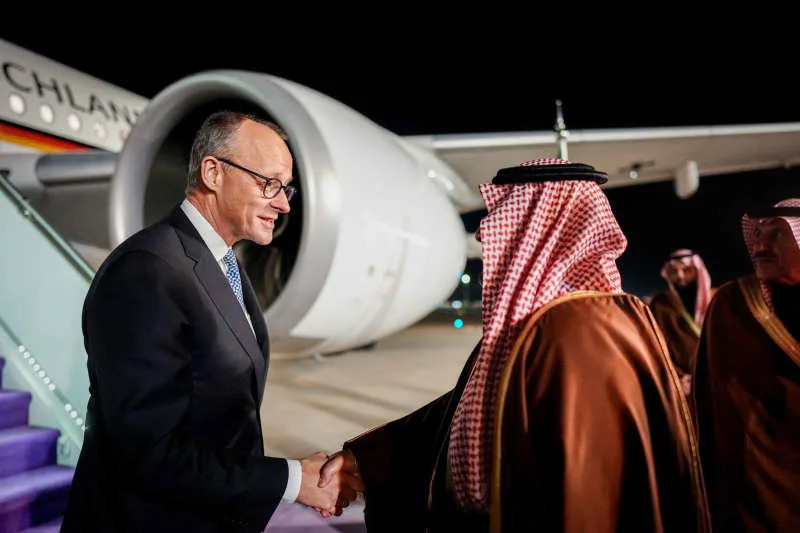
German Chancellor Friedrich Merz (C) welcomed by the Governor of Riyadh Prince Faisal bin Abdulaziz Al Saud upon his arrival at King Khalid International Airport’s Royal Terminal. Kay Nietfeld/dpa