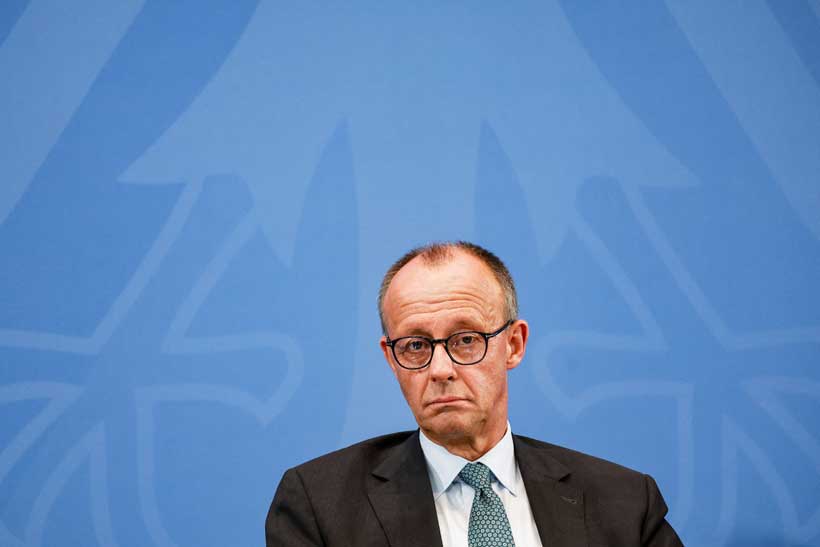
With a single sentence, Chancellor Friedrich Merz broke one of Germany’s and Western Europe’s greatest political taboos, daring to question the welfare state’s sacred status at a time when its economic costs can no longer be ignored:
“The welfare state as we know it today can no longer be financed by our economy.”
For decades, Germany was celebrated as Europe’s economic success story. Its postwar Soziale Marktwirtschaft—the social market economy—combined free-market dynamism with a limited welfare for those truly in need, powering West Germany’s rise from postwar devastation into one of the world’s most prosperous nations.
Today, that model is faltering. Germany faces stagnating growth, declining competitiveness, and the heaviest welfare burden in its history—signs that Europe’s economic engine is in trouble, suffering under the weight of its own system.
From Miracle to Quagmire
Germany’s rise from postwar ruin was built on Ludwig Erhard’s economic vision—a system that balanced free enterprise with a modest social safety net within a competitive framework. By liberalizing prices and trade, stabilizing the currency, and cutting taxes, Erhard generated competition, lower inflation, and initiated the so-called Wirtschaftswunder—the “economic miracle” of rapid growth, near full employment, and higher living standards.
Yet Erhard’s vision of a “modest safety net” burgeoned to manifest a formidable welfare state. Once governments gain legitimacy to intervene in the economy under the guise of “fairness,” intervention rarely stops; incremental creep takes hold.
Starting with the 1957 pension reform and continuing through the 1960s and 1970s, successive German governments expanded health insurance, education support, family benefits, housing subsidies, and unemployment protection—laying the foundations for one of Europe’s most generous welfare systems. Today, Germany spends 31 percent of its GDP—roughly €1.3 trillion—on social programs, one of the highest levels among OECD countries.
The pension system attests to this excess, consuming 12 percent of GDP—over twice the share spent in the UK (5.1 percent). As the population ages and the workforce shrinks, the strain on public finances has become unavoidable. In 1962, six workers supported each retiree; today, that ratio is reduced to two, and that number is expected to continue falling in the years ahead. A pyramid funding system built on such unfavorable demographics cannot last—it can survive only through higher taxes, mounting debt, and growing deficits—Germany today.
To sustain this model, German employers are paying the price. Under German law, companies must cover half of their workers’ insurance contributions, so every welfare expansion directly raises labor costs. Since the pandemic, non-wage labor costs have risen faster than total wages, eating into profits and leaving little room for pay increases. Social security contributions—long stable below 40 percent of salaries—have now climbed to 42.5 percent and are projected to reach 50 percent within a decade. The result is predictable: squeezed employers, fewer hires, smaller raises, and declining competitiveness.
Welfare Expansion Undermined German Prosperity
The economic toll of Germany’s overgrown welfare state is now unmistakable. Once Europe’s growth engine, Germany has become one of its laggards. Since 2017, GDP has grown by just 1.6 percent, compared to 9.5 percent in the rest of the eurozone. By 2023, it had ranked as the world’s worst-performing major economy, shrinking by 0.3 percent and 0.2 percent in two consecutive years—the first contraction since the early 2000s—and continued to slide under the new current government, with GDP falling by 0.3 percent in Q2 2025.
Nowhere is this decline more apparent than in the automotive sector—the backbone of Germany’s postwar prosperity. Once global pioneers, Volkswagen, Mercedes-Benz, and BMW now lag behind leaner Chinese and American rivals. Soaring labor costs (€62 per hour, compared to €29 in Spain and €20 in Portugal), combined with heavy regulation and rigid labor rules, have eroded competitiveness. A slow transition from combustion engines to EVs has enabled China’s BYD and Musk’s Tesla, with faster innovation cycles, advanced technology, and competitive pricing, to seize the lead in the industry.
The energy crisis has deepened their woes: the sudden loss of cheap Russian gas, combined with the government’s arguably short-sighted decision to phase out nuclear power, has left German industries paying up to five times more for electricity than their American or Chinese competitors. Weighed down by high costs and slow adaptation to new technologies, automakers have been forced into painful cost-cutting measures, from plant closures to mass layoffs. Since 2019, the industry has already lost 46,000 jobs, and another 186,000 could follow by 2035.
Unemployment in Germany has risen to a 12-year high, official figures released on Friday show. The labor report comes as the country’s struggling economy risks a third consecutive year without growth.
Data from the Federal Employment Agency (BA) shows that 177,000 more people were out of work in January than in December, bringing the total to over 3 million. The seasonally unadjusted unemployment rate climbed by 0.4 percentage points to 6.6 percent. (As a point of reference—the current US unemployment rate is 4.4 percent.)
Meanwhile, welfare and debt continue to grow. Germany’s famed fiscal discipline—once anchored in its constitutional “debt brake”—has all but collapsed. Repeatedly suspended since the pandemic, the rule has been bypassed through off-budget funds and “emergency” spending to finance welfare spending and energy subsidies. Now, Berlin plans to borrow €174 billion in 2026, three times the level of two years ago and the second-highest in postwar history—threatening not only its own stability but also the credibility of Europe’s fiscal rules.
At the root of Germany’s malaise lies a dangerous illusion: that a generous welfare state can coexist without sustained high productivity. When redistribution outpaces wealth creation, prosperity tends to fade. Left unchecked, welfare commitments expand faster than the economies that fund them, eroding productivity and burdening future generations. Yet reform remains untouchable—aging voters resist cuts, politicians fear backlash, and the young bear the cost of a system that may not survive. Europe is watching closely.
The Federal Republic of Germany—Europe’s anchor of fiscal discipline and industrial strength—has exposed the limitations of its burdensome welfare state. If the continent continues its current economic and political trajectory, the expansive welfare systems and the declining economies that support them could both falter. The first step against this eventuation is to end the denial; the next is to embrace the realism that once fueled the Wirtschaftswunder of the post-war era. Germany once showed the continent how to rebuild prosperity from ruins. Today, it must show Europe how to face the reality of welfare states—before they collapse under the weight of rising debt, stagnant growth and high unemployment.growth,