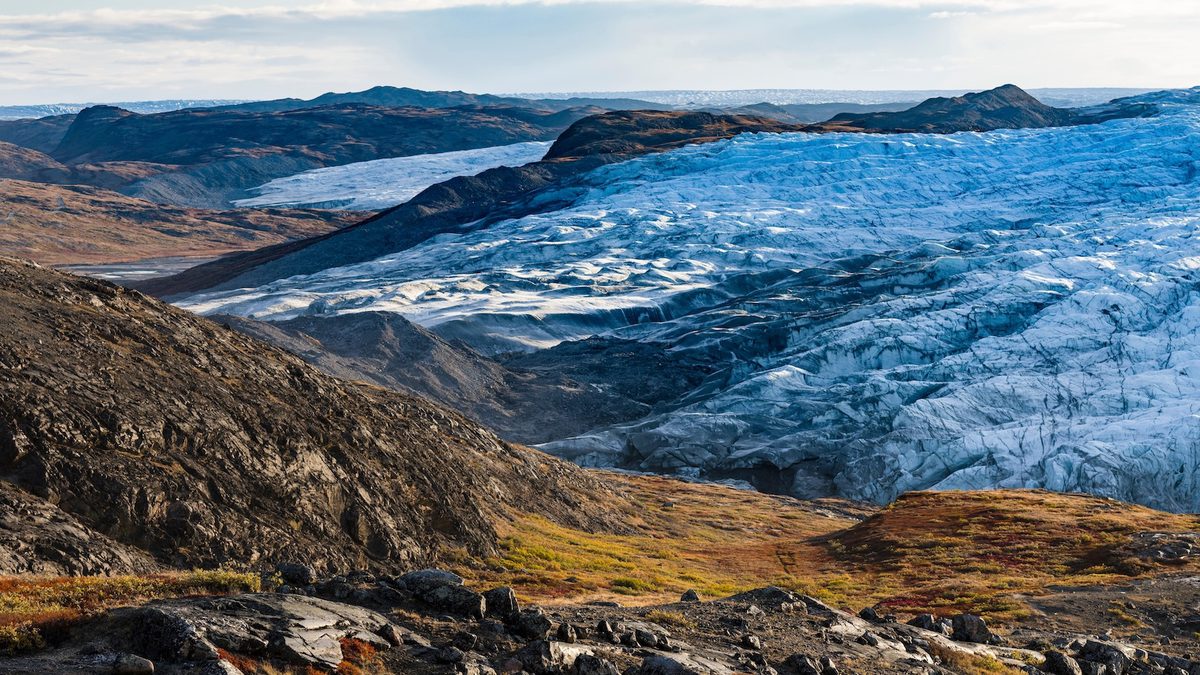
President Donald Trump has been voicing interest in exploiting Greenland’s mineral wealth since his first term in office, when he started talking about possibly seizing the autonomous territory. His threats of a hostile takeover have eased, but amid the focus on national security issues, access to critical minerals is now a key component in Trump’s “framework of a future deal.” Such a deal reportedly would open investment opportunities to U.S. mining companies — while restricting non-NATO countries from obtaining mining rights — and give the U.S. access to more valuable rare earth minerals, a global resource now nearly monopolized by China.
But experts warn that the reality of finding, extracting, and transporting precious and rare earth minerals to refineries and markets is far more complicated, and environmentally fraught, than the Trump administration may have anticipated.
“I’m skeptical, borderline cynical, that [the framework is] going to make any difference,” said Michael Jardine, managing director of Skylark Minerals. The Australia-based company recently ended a two-decade-old plan to develop a zinc mine in Greenland, a decision that Jardine attributed to high costs associated with energy, transportation, labor, and local political uncertainty. While more than 200 mining companies have exploration licenses in Greenland, only two mines are currently active.
“Greenland is a very unstable environment,” says a scientist. As ice melts, “everything close to the shoreline will be vulnerable.”
Thanks to ancient volcanic activity that transformed metamorphic rock in southern Greenland into metal ores and sedimentary rock in the north into heavy metals like lead and zinc, the island’s rare earth reserves rank eighth in the world, at 1.5 million tons. As many as 25 of the 60 critical minerals the U.S. has listed as necessary for economic prosperity and national security — materials that are crucial for developing wind and solar power, electric motors, superconducting magnets, guided missiles, and advanced radar systems — are found in Greenland. The island has two rare earth deposits — Kvanefjeld and Tanbreez — that are among the largest in the world.
Subscribe to the E360 Newsletter for weekly updates delivered to your inbox. Sign Up.
But logistical and meteorological challenges, along with Greenlanders’ environmental concerns and strict regulations, have so far prevented any rare earth mining development.
According to many scientists who have conducted research on the island, those harsh realities are becoming more intense as the Arctic warms faster than any other place on Earth.
For example, an increasing number of rain-on-snow events, combined with warmer air, is triggering so-called slush avalanches. Due to their mass, the long distances they can flow, and their difficulty to forecast, these avalanches threaten people, equipment, and roads.
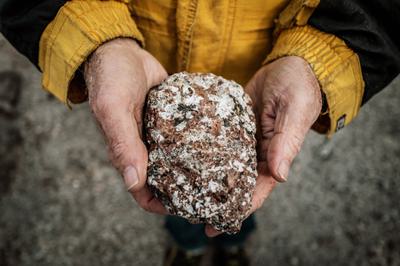
Geologist Greg Barnes holds a rock containing crystals at a rare earth mining site near Narsarsuaq, Greenland.
Carsten Snejbjerg / Bloomberg via Getty Images
Rapid thawing of permafrost is undermining the stability of hillsides, leading to rockslides. In 2017, a massive landslide in Greenland’s Karrat Fjord set off a tsunami that wiped out 45 structures in a tiny fishing village and killed four people. And at least 21 wildfires have burned Greenland’s tundra since 2008, darkening glaciers with soot and accelerating a meltdown that is being further exacerbated by algal blooms on the ice shelf, which are in turn fed by mineral dust liberated by high winds. Historically, wildfires have been rare in Greenland; scientists attribute their apparent uptick to the Arctic’s rising temperatures, drier summers, and an increase in plant life as permafrost melts.
The 60 to 70 glacial lakes that are locked below Greenland’s ice appear to be stable for now, but scientists are concerned that this may change as melting overwhelms them with runoff. In 2014, the weight of 90 million cubic meters of glacial runoff — equivalent to nine hours of water pouring over Niagara Falls — created a crater 85 meters deep over a two-square-kilometer area in a remote area of northern Greenland.
“Greenland is a very unstable environment,” said geomorphologist Paul Bierman, author of When the Ice Is Gone, a book that describes the geological and geopolitical history of the island and how climate change will shape its future. “Everything close to the shoreline will be vulnerable to permafrost thaw, rockslides, avalanches, and the tsunamis they could trigger.”
The global consultancy group Wood Mackenzie is warning investors of the formidable risks of mining in Greenland.
The situation may look relatively stable in some places, he added. But that will soon change as the atmosphere warms. Already, permafrost thaw is destabilizing runways and radar installations at the U.S.’s Pituffik Space Base in northwestern Greenland.
Greenland is roughly three times the size of Texas, but it has fewer than 100 miles of roads, only 56 of which are paved. The territory has a tiny labor force, just 16 small ports, and its electricity generation is both inconsistent and limited. In northern Greenland, the sun does not rise for 100 days during the polar night.
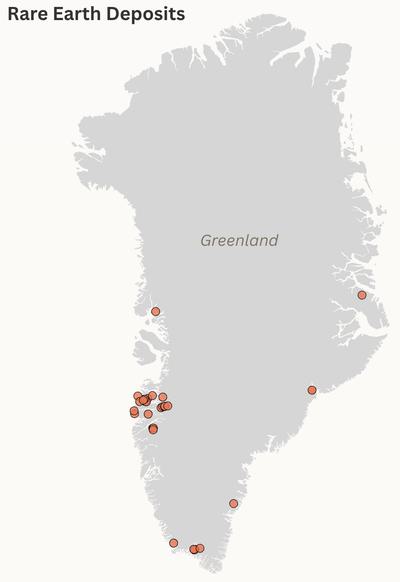
Source: Geological Survey of Denmark and Greenland.
Yale Environment 360 / Made with Flourish
Bitterly low temperatures — sometimes reaching minus 40 degrees Fahrenheit — make it difficult to operate heavy equipment as hydraulic fluid thickens. High winds ground helicopters, shut airports, and knock out communications. Pack ice hinders the movement of ships bearing fuel and equipment.
Considering all these challenges, it is perhaps not surprising that experts estimate that extracting minerals in Greenland costs five to 10 times what it would in more temperate climes. That’s why Wood Mackenzie, a global research and consultancy group, is cautioning investors about these formidable risks.
Greenlanders, who banned oil and gas drilling in 2021 because of its impact on the local environment and the climate, have been wary of mining. Past efforts have left behind long-lasting environmental liabilities. Three hard rock mines that operated in the 1970s dumped waste rock along the island’s pristine rivers, assuming their heavy metals would remain locked in that material. But they didn’t. According to a recent study, elevated levels of lead, zinc, and other heavy metals have been found in water, soil, lichens, vascular plants, and sediment in and around the mine site and in seaweed, three species of bivalves, and sculpins downstream.
It’s a similar story in Arctic Canada, where many large-scale mining companies operated in equally harsh conditions with little environmental oversight and left the Canadian government to spend several billion dollars cleaning up dozens of abandoned mines.
The island’s government says it is open to mining so long as Greenlanders benefit and mining adheres to strict environmental rules.
Some of these operations, including the Giant gold mine on the shores of Great Slave Lake in Northwest Territories, which went bankrupt in 1999, will need to be managed and monitored permanently because permafrost is thawing the underground chambers used to store 261,000 tons of arsenic trioxide dust — a byproduct of the process used to separate gold from rock — and releasing it into groundwater.
Rain comes to the Arctic, with a cascade of troubling changes. Read more.
Separating rare earth minerals from rock in Greenland may prove to be even more challenging, experts say, because Greenland’s rare earths are found inside silicates, rather than in the phosphate and carbon minerals found in most of the world’s other large reserves. Extracting them may require new technology.
“The deposits in Greenland also tend to be heavily fragmented, difficult to access, and often mixed in with unwanted minerals like uranium,” said Melissa Sanderson, a former diplomat with the U.S. Foreign Service who helped pave the way for the world’s biggest cobalt mine in the Democratic Republic of Congo. “Separating them with chemicals would be difficult and very expensive.”
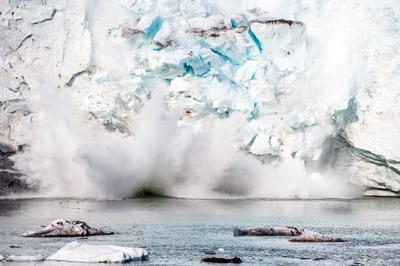
Ice breaks away from the Apusiajik Glacier, near Kulusuk.
Jonathan Nackstrand / AFP via Getty Images
Sanderson currently sits on the boards of the Critical Minerals Institute, an industry group, and American Rare Earths, an Australia-based company that is developing a 2.9-billion-ton rare earth mine in Wyoming. “If this were simply a resource play in Greenland,” she said, “the United States would be better focused on well-defined, easily accessed rare earth deposits [in the U.S.].” She suggests that the Trump administration’s focus on Greenland’s rare earths is more about keeping Russia and China out of the region. One of the proposals that Trump and NATO Secretary General Mark Rutte are discussing would reportedly restrict non-NATO countries from obtaining rights to mine Greenland’s rare earths.
In November 2023, the European Union signed a memorandum of understanding for a strategic minerals partnership with Greenland. And late last year, the British government announced fresh trade negotiations with Greenland that included talks over reducing tariffs on seafood exported to that nation; for its part, Greenland “will seek to strengthen cooperation on critical minerals” with the U.K.
The government recently made it clear at an economic development forum in Nuuk in November that it is open to mining so long as Greenlanders benefit and so long as mining companies adhere to its strict environmental regulations. But the U.S. could pressure the government to loosen those regulations to allow mining to move forward.
Mining without adequate safeguards “risks causing further harm in a territory whose ice sheet is already rapidly melting.”
Colorado School of Mines economist Ian Lange, who was part of the White House Council of Economic Advisers during Trump’s first term, said that pushing ahead with mines in Greenland, which would be very far from supply markets, doesn’t make economic sense. “Sure, there’s rocks there that have the rare minerals that the United States needs, but so do the rocks in the U.S., in Canada, in Australia, and Brazil. Why [open a new mine] when we already have many rare earth mines in play closer to home?”
The U.S. government has already signed a number of agreements with allies such as Canada, Australia, and Thailand that specifically focus on critical minerals, notes Jane Nakano, a senior fellow in the Energy Security and Climate Change Program at the Center for Strategic and International Studies. “Mineral supply disruptions remain dynamic. This reality renders it unviable for the United States to solely focus on domestic production to meet its minerals requirement.”
The U.S. has been moving quickly on this front. Last year, the Department of Defense took equity stakes in six mines in Canada, including an abandoned tungsten mine on the border of the Yukon and Northwest Territories. And this week the Trump administration announced it is spending $10 billion in financing for a nearly $12 billion critical minerals stockpile.
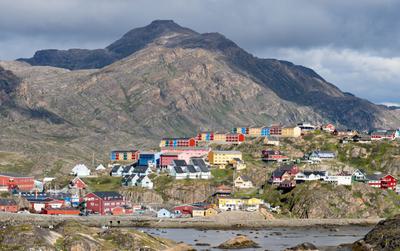
The town of Sisimiut lies in a region with rich rare earth deposits.
Marli Miller / UCG / Universal Images Group via Getty Images
Patrick Schröder, a senior fellow at the London-based Chatham House think tank, was at the economic forum in Nuuk where Greenlanders laid out their vision for the future. He said that the prospects for mining the island may not be attractive now, but that could change in several years as rapidly receding sea ice opens new shipping lanes, mining processes improve, demand grows, and the Greenland government builds new hydro dams to supply energy.
While the U.S., the U.K., and the European Union may want to secure critical minerals for long-term supply chain needs, Schröder added, they should approach any mining ventures in Greenland within the wider context of both Arctic security and the climate crisis. He cautioned that extracting critical minerals without the right environmental safeguards “risks causing further harm in a territory whose ice sheet is already rapidly melting, with disastrous results for the global climate.”
In hunt for rare earths, companies are scouring mining waste. Read more.
The dilemma for Greenlanders, he said, is that climate change is not only opening new mining opportunities but also driving valuable cold-water fish, such as halibut, mackerel, and cod, into its waters. Greenland’s stunning fjords, giant icebergs, sprawling glaciers, and stark tundra are also beginning to draw tourists from all over the world.
“Greenlanders look at how their neighbors in Iceland have benefited from climate change and they would like to replicate that success,” Schröder said. “They are well aware that pollution that may be caused by mining could undermine those opportunities.”