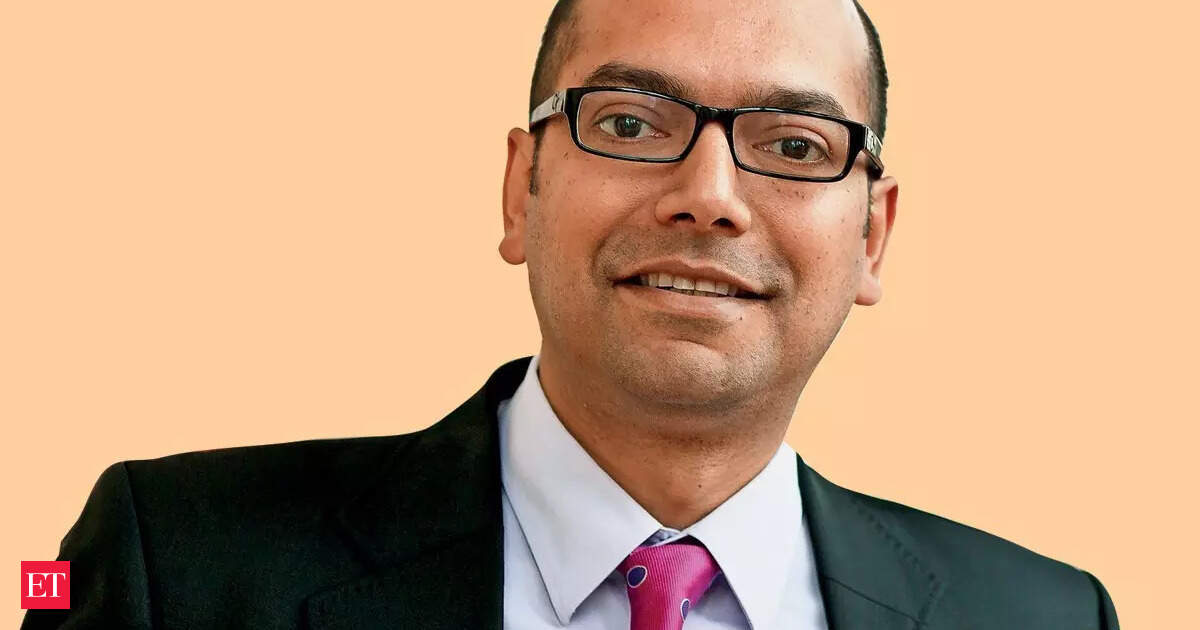
Jaideep Prabhu is Professor of Marketing at Cambridge University‘s Judge Business School. Speaking with Srijana Mitra Das in ET Evoke, he discusses ‘frugal innovation‘ in India — at a time of geoeconomics worldwide:
Q. What is your new work ‘Lean Spark’ about?
A. Co-authored with Mukesh Sud and Priyank Narayan, this discusses a phenomenon now termed ‘high-tech jugaad’, or relatively simple innovation which is reaching a new level in India — this is no longer about quick fixes or improvisation. This is very intentional and strategic — across sectors, entrepreneurs or people in large organisations are deliberately applying elements of ‘jugaad’, like its frugality, to achieve scaled solutions that are long-term and global in impact.
Consider the sphere of governance — Aadhaar shows this intentional simplicity. From its design phase itself, it was envisioned as including every Indian. It was understood that to scale, this would have to be highly affordable — that meant keeping it simple. These principles were built-in — once these were achieved with Aadhaar, they were applied to UPI and digital commerce. The same principles are now being used in AI.
Another example is the Indian Space Research Organisation (ISRO) which has been using deliberate long-term planning with focused objectives that are relatively simple. Given resource constraints, its projects must be affordable — ISRO’s budget is considerably less than what China’s space agency or NASA has. Yet, ISRO’s outcomes have been very impressive. On the back of ISRO’s accomplishments, we now see a burgeoning space sector with several ‘lean spark’ startups, agricultural efforts using satellite and drone data with AI to advise farmers, fintech ventures, etc. Importantly, so far, India didn’t have a large store of intellectual property (IP)-backed products. We see this growing now — people begin with a scienceled idea, produce and commercialise it using frugal principles and then, back it with IP.
 Live Events
Q. Frugality is the foundation of the concept of ‘jugaad’ innovation you termed thus — will that endure with a new generational mentality of spending more, saving less?
A. This is a fair concern, given the pace of change in Indian society. However, the fact is, despite its growth so far, India remains a lower-middle-income country where large numbers of people still earn quite little. Our economics thus favours frugal innovation. You make a product successful commercially by offering it at an affordable price and obtaining volume. Even if an entrepreneur is doing very well in the formal economy, this economic logic directs them to be more frugal. Some extremely affluent people were among the key minds behind UID — but they knew for this to work in India, it had to reach particularly disenfranchised groups and they put themselves in their place to understand the sensitivity and logistics involved in operations.
Q. ‘Jugaad’ is now identified with India — how does it compare with innovation in China?
A. China is somewhere between where India is today and where the United States has reached. Interestingly, another large nation with a tradition of economic frugality, Brazil, lies somewhere between India and China. China moved fast and grew rich — the Chinese state drives its innovation. China can also show frugal innovation though. DeepSeek faced hardware constraints as the US placed trade restrictions on the sale of high-end GPUs, critical for generative AI, to China — so, they focused on the software instead, developing this using human talent, open-source and other software tricks.
Q. Is geopolitics an impetus or restraint on innovation?
A. It is both and it makes the strengths and weaknesses of Indian innovation apparent. Consider how ISRO landed a spacecraft on the southern pole of the moon at a fraction of the cost involved — but with satellites, used for agriculture and development but increasingly, also for defence, despite the fact that ISRO can launch these reliably, we don’t do this fast enough. We still don’t have enough satellites in space while the Chinese and Americans have entire constellations which see every part of Earth at any time. Yet, we face a very fraught neighbourhood. Geopolitics thus introduces new threats — and opportunities. It can push us to do more with fewer resources. We are now moving towards renewables as well and supply chains must be made stronger — we need frugal innovation to replace scarce commodities with what we have. India has thorium and we could innovate around using it in nuclear power. India is also developing very interesting diplomatic partnerships —this is another reflection of innovative thinking, brought on by the pressures of both Donald Trump and China. So, a crisis can spark ingenuity.
Q. The US and China both have this — does India have a big picture for innovation?
A. The US has had decades of investment in defence, security, etc., with spillovers into the private sector. They have a very lively entrepreneurial ecosystem, which includes some of the world’s top universities. They have venture capitalists, public money and a big market. China has seen very rapid development in the last few decades and the omnipotent Chinese state has deep pockets, based on trade and manufacturing excellence. It has developed many American elements of innovation, like research excellence, bringing back leading Chinese talent from abroad, etc. China focused on getting independence from the West in science and tech — today, in many areas, it has developed an edge over the West.
India is, to a great extent, a bottom-up country unlike China, which is a top-down system. The US is mixed — and, with its current dysfunction, its innovativeness is dependent on what individual states like California do. In our book, we argue there is a pattern in India though — India’s macroeconomics, demographics, economic heritage and geopolitical experiences make us intentionally frugal and scale. We are seeing more of that across sectors — as this expands, a big picture will emerge. Currently, we are less portrait, more mosaic — we are a palimpsest or many layers of innovativeness.
Q. Much is said about science in innovation — do the humanities also have a role to play?
A. The humanities play a huge role in innovative mindsets — this will only grow with the development of AI. Generative AI has risen on the back of art, imagery, music and writing — it is deeply informed by the humanities and creativity. The humanities’ teaching of judgement, critical thinking, logic and aesthetics are inextricably implicated in AI. Humans themselves, using their own rationale and emotions, ask AI questions and evaluate its answers — increasingly, the humanities, and the understanding and empathy these inspire, will come to the fore in AI and its enormous field of innovation.
Views expressed are personal