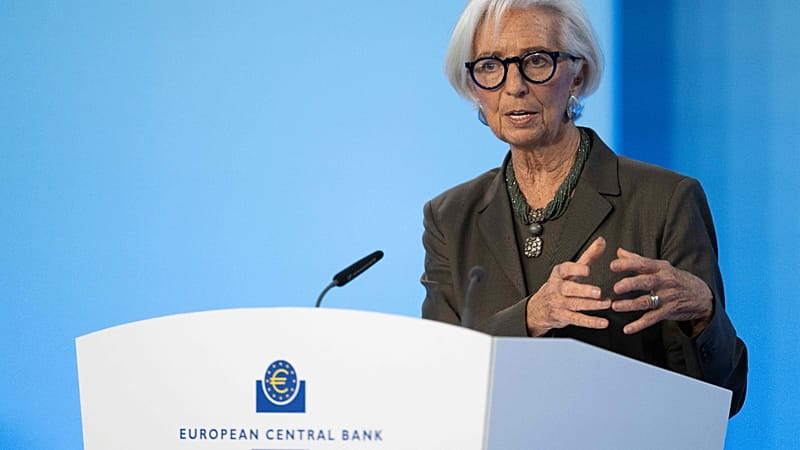
The European Central Bank left interest rates unchanged on Thursday, with President Christine Lagarde saying policymakers are “in a good place” despite inflation falling below target, stressing that the ECB “cannot be hostage to one data point” as it sticks to a data-dependent, meeting-by-meeting approach.
The meeting opened with a symbolic gesture as the ECB welcomed Bulgaria to the euro area, effective 1 January 2026. Dimitar Radev, Governor of the Bulgarian National Bank, joined the ECB’s Governing Council with voting rights, marking the culmination of Bulgaria’s long path toward monetary union.
Lagarde praised the accession as further evidence of “the attractiveness of the single currency and the enduring benefits of European integration.”
Since 1999, euro area membership has nearly doubled, now encompassing 21 countries.
Eurostat’s flash estimate showed eurozone inflation fell to 1.7% in January, from 2.0% in December and 2.1% in November. This drop was largely driven by a sharp fall in energy prices, which declined by 4.1% year-on-year.
Core inflation (excluding food and energy) eased to 2.2% — its lowest since October 2021 — while services inflation decelerated to 3.2%.
However, food inflation ticked up slightly to 2.7%. Lagarde downplayed fears of excessive disinflation, attributing much of the drop to base effects and emphasising that the headline figure does not alter the ECB’s medium-term inflation trajectory.
“We cannot be hostage to one data point,” she remarked.
Several questions probed whether the ECB’s language had turned more hawkish.
Lagarde refused the label, insisting that policy is “agile” rather than directional.
Eurozone GDP rose by 0.3% in the fourth quarter of 2025, driven mainly by services — particularly in information and communication technologies (ICT) and AI-related sectors.
In response to questions on artificial intelligence, Lagarde pushed back against the idea that Europe is falling decisively behind, pointing instead to rising private investment in AI-related activity.
She described ICT investment as “the big story” behind the resilience of domestic demand, stressing that it goes well beyond software alone and includes data centres, hardware and supporting infrastructure.
Crucially, Lagarde framed AI as a potential productivity dividend, not an inflation risk — at least for now.
Construction activity also gained momentum, bolstered by public investment in defence and infrastructure.