
Homegrown wines have experienced “explosive growth” in the wake of the trade war with the United States. As alcohol sales slump worldwide, all four of Canada’s key wine-producing provinces have seen increased interest in local products, according to liquor board data.
In Ontario, VQA wine sales have increased by more than 56 per cent since American products were stripped from Liquor Control Board of Ontario (LCBO) shelves last March in response to U.S. tariffs on Canadian goods. “We’ve always supported local, and that’s been a growing category for us, but I think with customers now really wanting to support local, this is definitely that moment for our local industry to shine,” says Marie Cundari, senior buyer of Ontario wines at the LCBO.
A Société des alcools du Québec (SAQ) representative says that Quebec wines experienced a similar boost since the removal of American products, at 54.5 per cent. Nova Scotia wine sales increased by 19.5 per cent to $6 million in 2025’s second quarter (June 30-Sept. 28), according to the Nova Scotia Liquor Corporation (NSLC). Net sales for B.C. wines were $159,735,364, compared to $133,622,958 during the same time frame last year, which represents a 19.5 per cent increase, according to the third-quarter Liquor Market Review released by the BC Liquor Distribution Branch in December 2025.
Winemakers in Ontario, British Columbia, Quebec and Nova Scotia are embracing the opportunity to win over Canadians with the unique flavours that come from grapes grown at the northern edge of what’s possible. At the same time, they’re concerned about what’s to come when American wines return to store shelves. (At the time of writing, there were no plans to lift the U.S. booze bans, though Nova Scotia is liquidating its inventory, with proceeds going to charity.)

The LCBO has seen “a large boost in demand” for local products in the past year, with Ontario and Canadian wines fuelling the growth.
The situation is “absolutely” unprecedented, says Aaron Dobbin, president and chief executive of Wine Growers Ontario. Especially given the state of the global alcohol industry, which lost US$830 billion over the past four years as a result of shifting drinking habits. Dobbin says that Ontario winegrowers laid out their plan for the future a couple of years ago, based on taking market share from other countries selling in the province, including the United States, Italy and France. Unexpectedly, a singular opportunity to introduce — or reintroduce — local wines presented itself.
“Thankfully, Ontarians have been supporting Ontario wines as they’re supporting all kinds of Ontario products,” says Dobbin. “Our goal is that once the U.S. wines are back, we will have proven to Ontarians the value and the quality of Ontario wines, and they will stay with purchasing our wines.”
Alcohol was left out of the Canadian Mutual Recognition Agreement on the Sale of Goods, which came into effect in November 2025. Selling direct to consumers across the country “could really be a game-changer,” especially for smaller wineries, says Dobbin. “Breaking down those interprovincial trade barriers represents some real opportunities.”
The LCBO has seen “a large boost in demand” for local products in the past year, with Ontario and Canadian wines fuelling the growth, says Cundari.
Since the LCBO stopped selling U.S. products, sales of Canadian wines have increased by 19 per cent across the board. Ontario wines “have benefitted greatly,” adds Cundari. The growth of VQA wine sales is driven by red, which has increased over 60 per cent, followed by white at 54 per cent. VQA rosé (+30 per cent), icewine (+16 per cent) and sparkling wine (+15.5 per cent) have also seen double-digit increases.
There’s been growing interest in other provinces as well, with sales of British Columbia and Nova Scotia wines up more than 100 per cent.
The “Buy Local” sentiment is strong, but customers are also gravitating to other regions offering a similar style of wine to that of the United States. Sales of red wines from Australia (+36 per cent), Chile (+25.8 per cent) and Argentina (+22.4 per cent) are up, with Cabernet Sauvignon — a popular varietal in the American wine portfolio — leading the growth. Sales of Italian and French reds are up as well.
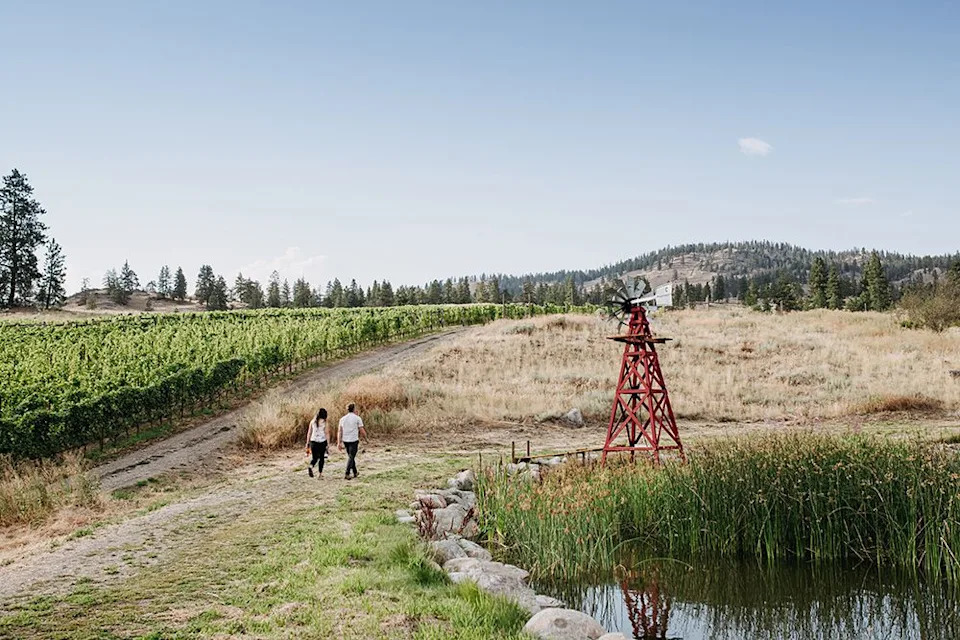
Garnet Valley Ranch is one of Okanagan Crush Pad’s two properties in Summerland, B.C.
BCLIQUOR stores also removed all U.S.-made products from the shelves in March 2025, adding more B.C. and Canadian-made items in their place, including BC VQA and Crafted in B.C. wines. Jeff Guignard, president and chief executive of Wine Growers British Columbia, sees the chance to capture shelf space as “once in a lifetime.”
Guignard says that B.C. winemakers have seen a clear “Buy Local” movement among consumers, which has led to some increased tourism visits and sales, but notes that growth hasn’t been widely or evenly distributed.
“The opportunity is what excites everybody,” says Guignard. “When you suddenly have all these SKUs (stock keeping units) that are no longer available for purchase, we know that customers are going to be looking somewhere else. Our job is to get our products in front of them, to tell our story. And what we’ve found is that once customers try B.C. wines, a lot of times, they’re very impressed with the quality and the varieties that we have here.”
Opening up interprovincial markets is a priority for some B.C. winemakers as well, adds Guignard. “How can we get access to customers in Toronto and Alberta?”
Christine Coletta, owner of Okanagan Crush Pad with two properties in Summerland, B.C., Haywire Winery and Garnet Valley Ranch, echoes the importance of communicating the unique qualities of local wine to consumers. “When people get into retail stores, although there’s perhaps no American wines, they’re certainly presented with an unbelievable collection from around the globe. So, we’re still competing, and we’re still going to be compared to what else is available on the shelf.”
Coletta began her wine career in 1990 as the executive director of what’s now known as Wine Growers British Columbia and has been recognized as a “trailblazer” for her work in the industry. She has seen a renewed focus and passion for buying local, “but there is that big but.” Makers need to ensure that they’re relevant, relatively affordable and imparting the differences between what they do and wines from other regions, says Coletta.
“All of our grapes are grown in the Okanagan, so we’re very committed to the terroir of this region, and I do believe that the industry as a whole has gotten over that need to compare ourselves to Napa Valley or Bordeaux. I think we now know that we’ve come into our own, and we can proudly stand up as being makers of Okanagan wine and be inspired by our territory.”
The last five years have been challenging for B.C. winemakers, from deep-freezes, floods and wildfires to the pandemic and economic downturns. “We seem to be under an evil spell of some sort,” says Coletta. “But we see a lot of that in the rearview mirror. Collectively, what I’m seeing is a lot of energy around people really feeling like it’s their opportunity to reinvent what they’re doing, take a look at how they’re operating. There’s a lot of renewed excitement in the industry right now.”
Coletta credits this excitement, in part, to the recent wave of Canadian pride and desire to support local. Whether it’s wine made in Nova Scotia, Quebec, Ontario or British Columbia, she highlights the flavour complexity and purity that makes Canadian wines special.
“I’ve had an opportunity over the years to go to all those regions and taste the products and the wines and meet the people. And it’s really remarkable what we’re doing here. So go out, no matter where you are, go out, get in a car, drive, hop on a plane and go and visit and learn the story and taste the products. I think you’re going to be very, very, very surprised and also very proud.”

“With no American wines, it’s going to help us, but they’re going to come back,” says Charles-Henri de Coussergues, winemaker at Vignoble de l’Orpailleur in Quebec’s Eastern Townships.
As Canadian wineries make inroads, capturing the shelf space vacated by American products, they’re also concerned about what might happen when U.S.-made wines return.
Quebec makes three million bottles of wine per year, says Charles-Henri de Coussergues, winemaker at Vignoble de l’Orpailleur in Quebec’s Eastern Townships. By 2030, the goal is five million. “Right now, with no American wines, it’s going to help us, but they’re going to come back,” he adds through interpreter and son-in-law Alain Bazinet, head of vineyard operations. The SAQ has an excellent selection of wines from around the world, which is beneficial for consumers. But as a producer, it can make it difficult to compete. “The main concern right now is, when the American products come back, what are they going to do with all those extra (local) products they put in? So, people are happy on one side, but very nervous on the other.”
A founding member of the Association des Vignerons du Québec and a pioneer of viticulture in the province, de Coussergues began making wine at Vignoble de l’Orpailleur in 1982 and selling it at the SAQ in 1996. Since the trade war started last spring, they’ve had five per cent more visitors to their farm than the average year, and on-site sales have increased by eight per cent. Well-established at the SAQ, they were already leading the Quebec red, white and icewine categories. While they saw about a five per cent sales increase in-store, de Coussergues notes that some of the new, smaller vineyards saw increases of up to 50 per cent.
De Coussergues highlights that he and other Quebec winemakers cultivate grapes in a cool climate and challenging conditions. Over the last decade, growing knowledge and improved practices have vastly improved the quality. Climate change has also played a role, with milder winters and hotter summers. Thanks to the “Buy Canadian” and “Buy Local” movements, many people who hadn’t previously bought Quebec wines have now. “And we do believe that there’s going to be a bit of a momentum that’s going to happen after this.”

Nova Scotia’s wineries are part of the tourism landscape year-round, and Grand Pré Wines was built for that purpose, says chief executive Beatrice Stutz.
Beatrice Stutz, chief executive of the family-owned Grand Pré Wines in Nova Scotia’s Annapolis Valley, says that though there’s “been a noticeable shift in consumer behaviour” since the start of the trade war, with an increase in sales and visitors, she considers it a result of the industry’s ongoing effort to build awareness rather than the flip of a switch.
“There is a bit of a combination of both, where, when this all happened with the U.S. alcohol, I think it was just amplified. And people were even more so open to looking at alternatives,” says Beatrice. “It’s almost like when the pandemic happened, and people were forced to travel within. They discovered that there’s all this beauty to have, and they never even realized.”
Overall wine consumption may be down, but wine tourism is expanding, which puts Nova Scotia “in a wonderful position,” says Beatrice. Local wineries are a year-round tourist attraction, and Grand Pré Wines, which her father, Hanspeter Stutz, founded in 1994, is intended for that purpose. “We have our doors wide open, and we want people to come. We want them to experience. We want them to walk the site. We want them to eat here. We even have an inn. We want them to stay. We want them to experience the farm as a whole, and other wineries are doing the same.”
The Stutzes moved to Nova Scotia from Switzerland to start the winery, which surprised the rest of their family because the concept of Canadian wine was so unknown. As a niche, still-emerging region, Beatrice feels that Nova Scotian winemakers are writing their own story about resilience and how to develop an industry in a place that wasn’t always favourable to growing grapes. While many other countries are saturated, Nova Scotia has room to grow.
Just as the surge of homegrown interest in Canadian wines didn’t happen overnight, Beatrice underscores that the conversation around lifting interprovincial trade restrictions is timely but nothing new. “We’ve been pushing for this for years and years and years. Canada doesn’t have a wine industry that’s evenly spread throughout the entire country. So, there are these pockets. And we, as a country, need to celebrate what we produce right here way more — with more pride and confidence. And I think this is a step in that direction.”
Our website is the place for the latest breaking news, exclusive scoops, longreads and provocative commentary. Please bookmark nationalpost.com and sign up for our cookbook and recipe newsletter, Cook This, here.