
Just south of the River Campus, the University of Rochester’s Laboratory for Laser Energetics (LLE) is home to the largest, and some of the most powerful, lasers in academia. Here, scientists, engineers, and students use light and matter to model the interiors of distant planets, keep our nation secure, and work toward fusion energy for the future.
Here are a few takeaways about the preeminent facility we at URochester informally—and fondly—call the Laser Lab.
1. Federal and state investments power cutting-edge science and national security.
LLE operates at the intersection of basic science, national and energy security, and workforce development. Much of that work is made possible by federal and state funding. That means public investments in LLE and URochester directly support the scientific underpinnings of the US nuclear stockpile while also fueling new discoveries in physics, fusion energy, and materials science, while training up the next generation of America’s scientists and engineers. These scientists and engineers are needed by the national laboratories, academia, and industry, especially the fast-growing domestic fusion industrial base.
 GRATE SCOTT! Laboratory engineer Jeremy Czirr of the OMEGA EP Laser System’s Grating Compressing Chamber. (University of Rochester photo / J. Adam Fenster)
2. Lasers the size of football fields push matter to star-like extremes.
LLE is home to the world’s largest university-based laser facilities. At the heart of the lab is the Omega Laser Facility. Here, two football-field-sized laser systems drive targets smaller than a millimeter to pressures like those found in the center of planets and to temperatures hotter than the core of a star. These large lasers accomplish these phenomenal conditions in about a billionth of a second.
To make those experiments work, LLE crafts and measures targets with astonishing precision, using tools such as two-photon polymerization 3D printing, coherent anti-Stokes Raman spectroscopy, and 3D x-ray tomography.
Even the tiniest imperfection can derail a high-energy-density physics experiment, so this micron-scale precision is essential for generating reliable data about plasmas, materials, and fusion processes.
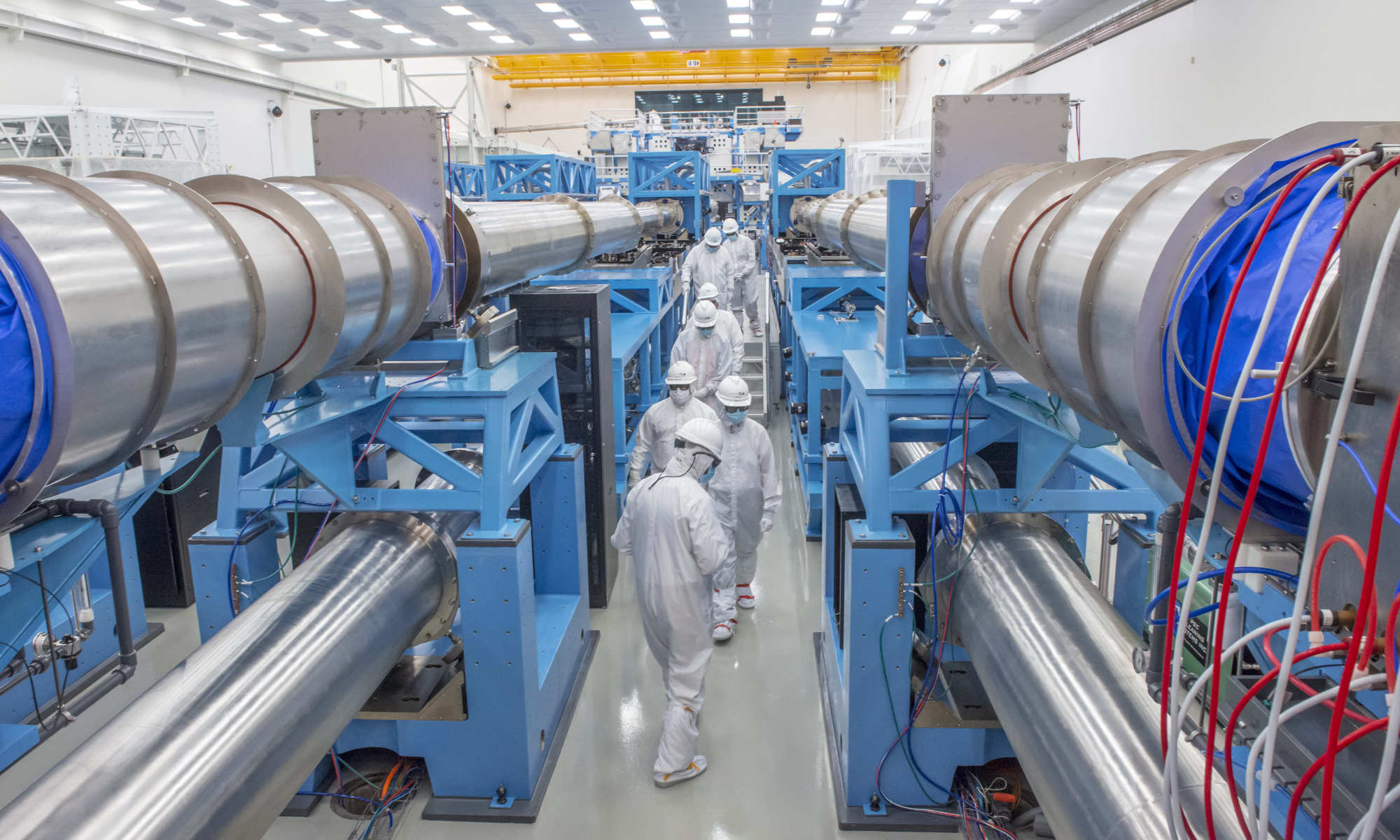 BETTER TOGETHER: The newest cooperative agreement with the National Nuclear Security Administration allows the Laboratory for Laser Energetics to operate the Omega Laser Facility, which houses two of the largest laser systems in academia. (University of Rochester Laboratory for Laser Energetics photo / Eugene Kowaluk)
3. URochester leads the nation in laser-direct-drive fusion research.
LLE is the #1 US lab in academia for the laser–driven approach to inertial confinement fusion (ICF), where carefully arranged laser beams symmetrically compress a fuel capsule.
Each year, more than 800 users from 70-plus institutions—including universities, national labs, and industry—conduct research at LLE, making URochester a global hub for fusion, high-energy-density science, and technology.
While it may sound like science fiction, LLE is helping bring fusion-based energy closer to reality. In 2022, ignition was achieved by LLNL, with LLE playing a significant role in the journey to this long-awaited achievement. The Laser Lab now leads a national research hub dedicated to advancing inertial fusion energy (IFE) science and technology.
Today, the lab’s scientists are turning to artificial intelligence and similar advanced computing technologies to accelerate research.
 DIRECT-DRIVE TIME: View from inside the OMEGA target chamber during a direct-drive inertial fusion experiment at the Laboratory for Laser Energetics. (University of Rochester Laboratory for Laser Energetics GIF / Rebecca Sabowski)
4. LLE has rare, end-to-end capabilities for tritium and cryogenic fuel.
Fusion experiments don’t just require powerful lasers—they also depend on safely handling tritium, a rare and radioactive form of hydrogen. LLE’s Cryogenic and Tritium Facility is unique in the nation for bringing every step of tritium-based fuel preparation under one roof.
These capabilities minimize waste, maximize control over a scarce resource, and support world-class fusion science for researchers across the country.
 SAFETY FIRST: Working with tritium requires rigorous safety, precision, and expertise. With facilities designed to meet strict regulatory standards, LLE is one of the few institutions capable of conducting this highly specialized work. (University of Rochester Laboratory for Laser Energetics photo / Jake Deats)
5. A next-generation, 25-petawatt laser facility is in design.
As if having the largest university-based laser systems wasn’t enough, LLE is now designing what could become one of the most powerful lasers in the world.
The NSF OPAL facility—funded by the National Science Foundation—will consist of two 25-petawatt lasers located at LLE. (For reference, one petawatt equal to one quadrillion watts of power). The system will harness another URochester innovation, optical parametric chirped-pulse amplification, to push beyond current peak-power limits.
NSF OPAL will enable scientists to study ultra-high electromagnetic fields, explore unprecedented and extreme temperatures and pressures, and probe matter under conditions similar to the most energetic events in the universe. Omega Laser Facility fusion experiments take mass and convert it to energy through fusion, consistent with Albert Einstein’s famous equation, 𝐸=𝑚𝑐 2. NSF OPAL experiments may someday demonstrate the opposite process of converting laser energy to mass.
Designed to serve the global research communities for decades to come, NSF OPAL will keep URochester—and the United States—at the very frontier of ultrahigh-peak power, ultrafast laser science.
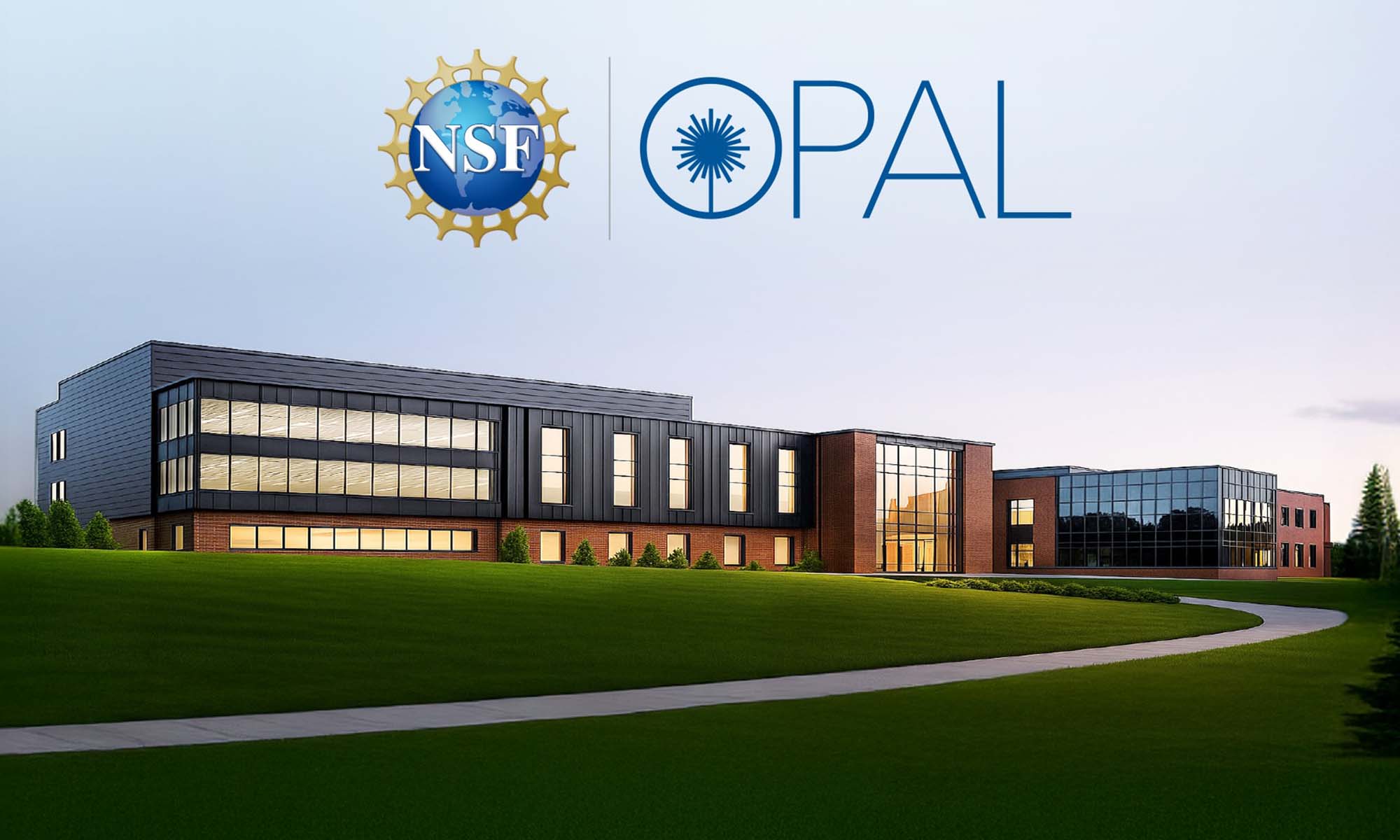 Three-dimensional architectural rendering of the proposed NSF OPAL Facility (courtesy of SWBR).
6. It’s one of the only laser facilities that trains high school, undergraduate, and graduate students in laser-based science and engineering.
LLE isn’t just a lab—it’s a training ground for tomorrow’s workforce.
Through close collaboration with University of Rochester faculty, LLE builds the world’s largest university-based community in laser science and technology, preparing students to lead in industry, academia, and national laboratories.
And we believe in giving capable and ambitious young researchers a head start. In addition to regularly hosting undergraduates on site, each year the Laser Lab welcomes high schoolers to spend two months conducting hands-on research in a world-class facility. And did we mention they get paid? Not a bad way for area juniors to answer the question, “What did you do on your summer vacation?”
 PATHWAY PROGRAMS: Undergraduate students Ruth Reynolds and Daniel Menis work in the Microfabrication Lab. (University of Rochester Laboratory for Laser Energetics photo / Jake Deats)
7. Nobel Prize–winning laser technology was invented here—and it touches everyday life.
In 1985, at LLE, then-graduate student Donna Strickland ’89 (PhD) and senior scientist Gérard Mourou invented chirped-pulse amplification (CPA), a technique that revolutionized laser science.
CPA works by stretching a laser pulse in time to lower its peak power, amplifying the stretched pulse, and then compressing it back into an ultrashort, extremely intense pulse. The breakthrough earned Strickland and Mourou the 2018 Nobel Prize in Physics—and it underpins many technologies we now take for granted:
Medicine: laser-based cancer treatments and precision procedures such as bladeless Lasik to reshape the cornea.
Manufacturing: micromachining and the precise cutting of smartphone cover glass and other materials.
Research: taking ultrafast images of split-second molecular processes, modeling extreme conditions in space, and developing new materials and fusion concepts.
CPA is also foundational for OMEGA EP and the next generation of ultrahigh-intensity lasers around the world.
In the hands of URochester’s scientists and students, light itself becomes a tool for understanding the universe—and for imagining what comes next.
 NOBEL PURSUITS: LLE scientists continue to use chirped-pulse amplification to develop new laser technologies and better understand the fundamentals of high-energy-density physics. (University of Rochester photo / J. Adam Fenster)