
 Evanston resident Ben Schapiro gestures to the outdoor PurpleAir sensor in his backyard.
Credit: Jeff Balch
Breathe in, breathe out. Repeat.
In recent years, multiple Evanstonians using different technologies have been responding to airborne threats to our lungs.
The Air Quality Index, reported occasionally in the media, is monitored steadily by about a dozen local citizen scientists who share data via websites sponsored by organizations like PurpleAir.
Public service
“I do it for two main reasons,” said Ben Schapiro, a librarian who lives in Evanston’s west end.
“There is the citizen science piece. My [PurpleAir] sensor feeds data to the internet —you can see readings from all over the country. You see red clusters [denoting high particulate levels] around cities, and anyone can get an idea of what is upwind,” he said. “I also monitor [AQI] because of my own sensitivity.”
He has a PurpleAir monitor in his kitchen, as well as the standard unit in his yard. Globally, more than 25,000 such outdoor monitors have been deployed, most of them in the United States.
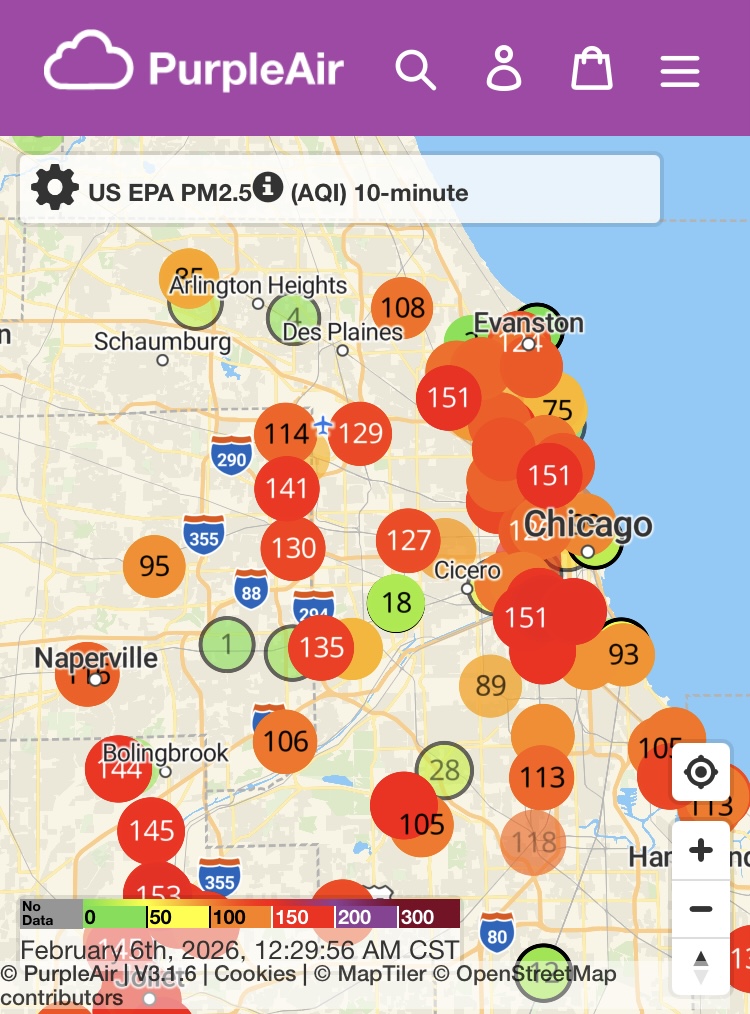 Feb. 6 was a day of poor air quality in the Chicago area (a circled green dot indicates an indoor sensor). Credit: Screenshot via PurpleAir
A pro-science approach
Growing up on Long Island with parents who were “big environmentalists,” Schapiro often took trains into New York City, and he recalls the air quality changing during the ride as he approached “burning diesel and other city smells.”
“Here, last summer, I could smell air blowing in from [wildfires in] Canada and the Pacific Northwest,” Schapiro said. “It hurts. We had a whole week when the AQI was in the 100s,” a level posing risks regardless of one’s sensitivity.
“But you can see online info in advance. The monitors are a pro-science approach to making my health better. I have a tight house and air purifiers inside — I change filters every month or two. When I come in from a bad AQ day, my lungs feel better in 10 minutes,” he added.
“I have water filters too, for the kitchen sink. That’s for if we have a water main break. But I trust Evanston water. The air is another story — there’s no control over that.”
Micro forecasting
Like Schapiro, new Evanstonians Jodie Eason and Jordan McClure pay close attention to air quality. They moved to a house near Evanston Township High School in 2023.
“We got the sensor within a year after we bought the house. We often see a difference between general AQI and [the AQI in] our neighborhood,” Eason said. “I think it’s the waste transfer station, or once in a while maybe somebody’s fire pit. The differential is usually 15 to 20 points.”
Eason and McClure have a PurpleAir monitor only in their yard. An indoor monitor manufactured by Aranet tracks carbon dioxide buildup inside.
“Setting up the [outdoor] monitor was straightforward,” said McClure. “It took maybe an hour, no troubles.” The unit cost about $300.
 New Evanstonians Jodie Eason and Jordan McClure’s air quality sensor is perched roughly 15 feet from their house.
Credit: Jeff Balch
Monitor and respond
On high-particulate days, McClure and Eason operate multiple indoor filters to improve their air quality.
“We have Coway filters in various rooms,” Eason said. “When they shade toward purple [from the healthier blue LED], we try to respond.
“We also have a Corsi-Rosenthal box,” she added, which is a simple air purifier that many homeowners construct as a do-it-yourself project: four rectangular air filters connected by their edges, with a box fan on top, so that when the fan blows upward, away from the makeshift cube, it draws household air through the filters.
“We might run everything if the [PurpleAir] website is showing red,” Eason said. “Once in a while, cleaner air blows from the east, off the lake, and our readings are lower.”
National picture
“The PurpleAir data is important for context,” Schapiro said. “It gives local info, which is important. But you can also expand [the online view] and see what’s likely to come tomorrow, usually from the northwest.
“And you can see trends,” he added. “Over time, [the monitors] refute the argument that climate change isn’t real.”
 This pair of screenshots highlights a pocket of relatively poor air quality in central Evanston. The left image indicates mediocre quality, whereas the right shows a larger area at the same moment, clarifying that regional air quality remained good. The orange dot, an outlier, indicates a sensor rendered inaccurate by local smoke or malfunction. Credit: PurpleAir
Related Stories